

Despite some key milestones since 2000, Australia still has a long way to go on gender equality
- Written by: Janeen Baxter, Director, ARC Life Course Centre and ARC Kathleen Fitzpatrick Laureate Fellow, The University of Queensland
Australia has a gender problem. Despite social, economic and political reform aimed at improving opportunities for women, gender gaps are increasing and Australia is falling behind other countries.
The World Economic Forum currently places Australia 24th among 146 countries, down from 15th in 2006. At the current rate of change, the forum suggests it will take more than 130 years to achieve gender equality globally.
Australia has taken important steps forward in some areas, while progress in other areas remains painfully slow. So how far have we come since 2000, and how much further do we have to go?
The good stuff
There are now more women in the labour market, in parliament, and leading large companies than at any other time.
Over the past 25 years, there have been major social and political milestones that indicate progress.
These include the appointment of Australia’s first female governor-general in 2008 and prime minister in 2010, the introduction of universal paid parental leave in 2011, a high-profile inquiry into workplace sexual harassment in 2020, and new legislation requiring the public reporting of gender pay gaps in 2023.
Timeline of equality milestones
-
2000
Child Care Benefit introduced, subsidising cost of children for eligible families
-
2008
First female Governor-General (Dame Quentin Bryce)
-
2010
First female Prime Minister elected (Julia Gillard)
First Aboriginal woman from Australia elected to UN Permanent Forum on Indigenous Issues (Megan Davis)
Australia’s first national paid parental leave scheme
-
2012
Julia Gillard misogyny speech
Workplace Gender Equality Act becomes law, Workplace Gender Equality Agency established
-
2013
Dad or Partner Pay Leave commenced
-
2016
First Indigenous woman elected to House of Representatives (Linda Burney)
-
2017
Launch of Women’s Australian Football League
#metoo movement spreads globally to draw attention to sexual harassment and assault
-
2020
Respect@Work National Inquiry into sexual harassment in the Australian workplace chaired by Kate Jenkins released.
-
2021
Grace Tame named Australian of the Year for her advocacy in sexual violence/harassment campaigns
Independent review into Commonwealth parliamentary workplaces launched
-
2022
National plan to end violence against women is finalised
-
2023
Closing the Gender Pay Gap Bill passes parliament
-
2024
Superannuation on government-funded paid parental leave from July 1, 2025
Parental leave to be increased to 26 weeks from July 2026.
There are, however, other areas where progress is agonisingly slow.
Violence and financial insecurity
Women are more likely to be in casual and part-time employment than men. This is part of the reason women retire with about half the superannuation savings of men.
This is also linked to financial insecurity later in life. Older women are among the fastest-growing groups of people experiencing homelessness.
The situation for First Nations women is even more severe. The most recent Closing the Gap report indicates First Nations women and children are 33 times more likely to be hospitalised due to violence compared with non-Indigenous women.
They are also seven times more likely to die from family violence.

Improving outcomes for Indigenous women and children requires tackling the long-term effects of colonisation, removal from Country, the Stolen Generations, incarceration and intergenerational trauma. This means challenging not only gender inequality but also racism, discrimination and violence.
At work, the latest data from the Workplace Gender Equality Agency suggests the gender pay gap is narrowing, with 56% of organisations reporting improvements.
On average, though, the pay gap is still substantial at 21.8% with women earning only 78 cents for every $1 earned by men. This totals an average yearly shortfall of $28,425.
There are also some notable organisations where the gender pay gap has widened.
The burden of unpaid work
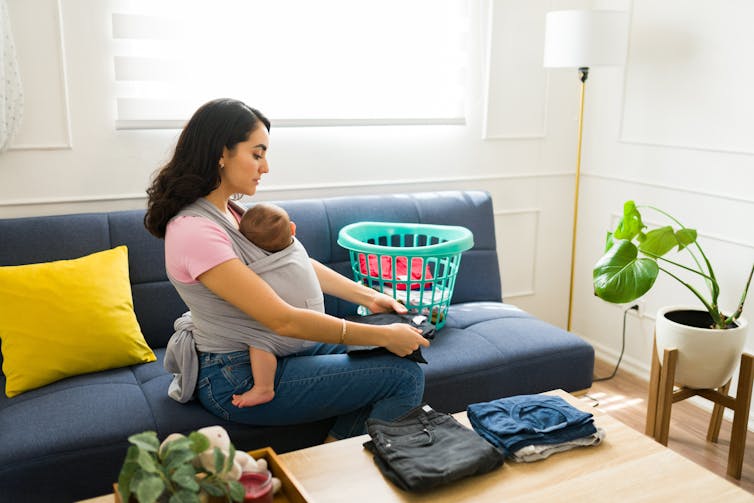
Another measure of inequality that has proved stubbornly slow to change is women’s unequal responsibilities for unpaid domestic and care work.
Without real change in gender divisions of time spent on unpaid housework and care, our capacity to move towards equality in pay gaps and employment is very limited.

Australian women undertake almost 70% of unpaid household labour. The latest Australian Bureau of Statistics time use data show that of those who participate in domestic labour, women spend an average of 4.13 hours per day on unpaid domestic and care work, compared with men’s 2.14 hours.
This gap equates to more than a third of a full-time job. If we add up all work (domestic, care and paid), mothers have the longest working week by about 10 hours. This has changed very little over time.
These charts, based on analyses of data from the Households, Income and Labour Dynamics in Australia (HILDA) study, show what drives this gap.
Women respond to increased demand for care and domestic work by doing more, while men do not. Parenthood significantly increases the time women spend on unpaid care and housework, while also reducing their time in employment.
Men increase their time in unpaid care after a birth, but the jump is minor compared with women, and there is no change to men’s employment hours.
Not surprisingly given these patterns, parenthood is associated with substantial declines in women’s employment hours, earnings, career progression, and mental health and wellbeing.
The way forward
Current policy priorities primarily incentivise women to remain in employment, while continuing to undertake a disproportionate share of unpaid family work, through moving to part-time employment or making use of other forms of workplace flexibility. This approach focuses on “fixing” women rather than on the structural roots of the problem.
There is limited financial or cultural encouragement for men to step out of employment for care work, or reduce their hours, despite the introduction of a two-week Dad and Partner Pay scheme in 2013 and more recent changes to expand support and access.
Fathers who wish to be more actively involved in care and family life face significant financial barriers, with current schemes only covering a basic wage. If one member of the family has to take time out or reduce their hours, it usually makes financial sense for this to be a woman, given the gender earning gap.
The benefits of enabling men to share care work will not only be improvements for women, but will also improve family relationships and outcomes for children.
Research shows relationship conflict declines when men do more at home. Time spent with fathers has been found to be especially beneficial for children’s cognitive development.
Fixing the gender problem is not just about helping women. It’s good for everyone.
Gender inequality costs the Australian economy $225 billion annually, or 12% of gross domestic product.
Globally, the World Bank estimates gender inequality costs US$160.2 trillion. We can’t afford to slip further behind or to take more than a century to fix the problem.
This piece is part of a series on how Australia has changed since the year 2000. You can read other pieces in the series here.
Authors: Janeen Baxter, Director, ARC Life Course Centre and ARC Kathleen Fitzpatrick Laureate Fellow, The University of Queensland


















