

Silicosis is ruining the lungs of construction workers. An AI-powered breath test can detect it in minutes
- Written by: William Alexander Donald, Professor of Chemistry, UNSW Sydney
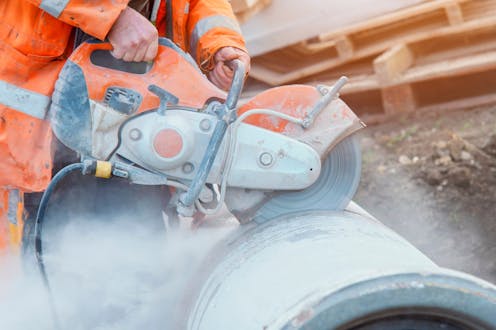
Silicosis is an incurable but entirely preventable lung disease. It has only one cause: breathing in too much silica dust. This is a risk in several industries, including tunnelling, stone masonry and construction.
Just last week, ABC reported that 13 workers from tunnelling projects in Sydney have been diagnosed with silicosis. It’s yet another reminder that current diagnostic methods are limited. They often detect the disease only after the lungs already have significant damage.
Our new study, published in the Journal of Breath Research, provides the latest results on a breath test for detecting silicosis powered by artificial intelligence (AI). It’s non-invasive and measures dozens of molecules to identify silicosis in just minutes.
The test we’ve developed achieved over 90% accuracy in differentiating silicosis patients from healthy individuals. This is better than traditional lung function tests.
While our test is yet to be trialled in real-world clinics, our results so far suggest breath testing could become a crucial tool in workplace health screening. Early detection would prevent suffering and disease progression, and reduce healthcare costs.
Silicosis is a growing problem – but hard to detect
Currently, more workers in New South Wales, elsewhere in Australia and internationally are being diagnosed with silicosis at younger ages. The Australian government has responded by banning engineered stone, but that doesn’t address ongoing risks in other industries.
Patients with silicosis often describe a feeling like they are slowly being strangled, with every breath becoming more difficult over time. In advanced stages, silicosis can be fatal unless patients can access a lung transplant.
The only way to stop the progression of silicosis is removing affected workers from further silica exposure. This is why diagnosing patients in the early stages – before irreversible lung damage occurs – is critical.
However, this isn’t easy to achieve. Lung function testing and chest X-rays only identify the problem once irreversible lung damage has occurred. In some cases, patients also need CT scans and invasive biopsy to confirm diagnosis. But CT scans, although much higher resolution, also rely on visible signs of silicosis.
And these methods are costly and take time, making it harder to easily screen the thousands of workers who could be at risk.
This is where breath testing comes in.

How breath tests can detect disease
Human breath contains hundreds of volatile organic compounds – small gas molecules that come from metabolic processes in the body, as well as the environment.
The composition of these molecules changes in response to physiological conditions like disease. However, volatile organic compounds are often present in extremely low concentrations – we need highly sensitive technology to detect them reliably.
Our team has developed tools that can detect volatile organic compounds at concentrations as low as parts per trillion. This is equivalent to detecting a single drop of liquid diluted in multiple Olympic-sized swimming pools.
This level of sensitivity allows us to identify very small biochemical changes in breath. AI is key to this approach. Our machine learning model analyses breath samples to tell apart healthy individuals and those with silicosis.
This builds on our previous work using AI to analyse blood plasma for early Parkinson’s disease detection with high accuracy and interpretability, which allows us to determine the chemical features that contribute the most to model accuracy. Interpretability refers to the ability to understand and explain how the AI model arrives at its predictions, providing insights into which data inputs are most important.
Now, we have applied similar methods to breath analysis. Thanks to the sensitivity of our test, we could potentially detect silicosis at very early stages.

How well does it work?
In our new study, the breath test was trialled on 31 silicosis patients and 60 healthy controls. The AI-powered model successfully distinguished silicosis cases with over 90% accuracy.
The test takes less than five minutes per sample, making it feasible for large-scale health screening. Additionally, the test doesn’t require subjects to fast or undergo any special preparation beforehand.
An important question in breath analysis is whether external factors, such as diet or smoking, influence test results. Our study included smokers and non-smokers in both silicosis and healthy control groups, and the test maintained high accuracy.
Our results show great promise, but there are challenges to overcome. The test relies on highly sensitive instrumentation that, while compact (less than a cubic metre), still requires technical expertise to operate.
 The AI-powered breath test involves specialised tools to perform the analysis.
Richard Freeman/UNSW
The AI-powered breath test involves specialised tools to perform the analysis.
Richard Freeman/UNSW
Currently, breath samples are collected in clinics and transported to a lab for analysis. We hope future iterations could allow for testing in workplace settings, creating routine screening programs. Further validation in larger, diverse worker populations is also necessary before full implementation.
The next phase of research will involve refining the AI model and expanding real-world testing to thousands of silica-exposed workers who might be at risk.
While routine medical evaluations will still be necessary for at-risk workers, the addition of breath analysis could enable more continuous monitoring than what is currently practical. It could help detect silicosis earlier, before the symptoms become irreversible, reducing long-term health risks.
Acknowledgements: Aruvi Thiruvarudchelvan and Jeff Gordon also contributed to this research.
Authors: William Alexander Donald, Professor of Chemistry, UNSW Sydney


















