

What is Australian bat lyssavirus? Can I catch it from bat poo? What if bats roost near me?
- Written by: Hamish McCallum, Emeritus Professor, infectious disease ecology, Griffith University
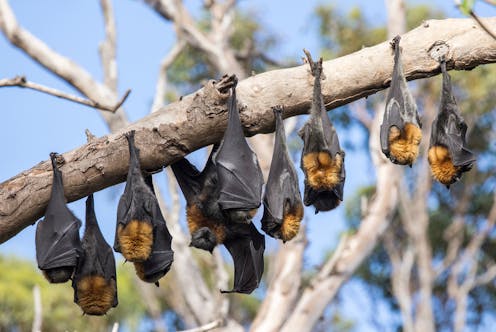
Last week, Queensland Health alerted the public about the risk of Australian bat lyssavirus, after a bat found near a school just north of Brisbane was given to a wildlife carer group.
The bat later died, but it was not confirmed whether it carried the virus.
This is not unusual. Volunteer wildlife carers respond to thousands of calls from the public every year after encountering sick, injured and orphaned bats. And testing them all routinely for the virus is not warranted or feasible.
Here’s what you need to know about the risk of catching Australian bat lyssavirus and how it can be treated.
What is bat lyssavirus?
Australian bat lyssavirus belongs to the same group of viruses that includes rabies – one of the most notorious diseases humans can catch from animals. Rabies causes about 59,000 deaths worldwide a year, mainly after dog bites. It is almost always fatal once symptoms appear.
Australian bat lyssavirus was discovered in 1996. There have been only three confirmed cases of the virus in humans in Australia, the most recent in 2013. All three were fatal.
Fortunately, because Australian bat lyssavirus and rabies are so closely related, the preventative measures that have been developed internationally against rabies can also protect humans from the effects of Australian bat lyssavirus.
Australian bat lyssavirus and rabies have a long incubation period (the period between exposure to infection and appearance of symptoms). If preventative treatments are given during the incubation period, they are highly effective in preventing disease and saving lives.
Such treatment reduces what is already a very low risk of illness and death to effectively zero.

How could I be exposed to the virus?
The virus is present in the saliva of some Australian bats, including the large flying foxes (fruit-eating bats) and some smaller bats that eat insects. But the proportion of bats infected by the virus is normally very low – less than 0.5%.
Infected bats may become sick and die, but some may appear unaffected. In other words, you can’t always tell just by looking at a bat whether it’s infected or not. However, there is evidence the virus is present at a higher level in sick bats than in healthy ones.
You cannot be exposed to the virus by being under a flying fox roost, even if the bats poo on you. You cannot be exposed by having bats in your roof or in a shed.

But the virus can be transferred to a human via either a scratch or bite. That’s if an infected bat scratches or bites you, or if their saliva is transmitted to an existing wound.
So you do need to be careful if you come across a sick or injured bat, or you find a child playing with a bat.
There is no evidence the virus regularly infects dogs and cats, although rabies does.
Nevertheless, given that Australian bat lyssavirus is a close relative of rabies and that rabies will infect most mammals, the possibility that it may sometimes spill over to mammals other than humans cannot be eliminated.
For example, in 2013 two horses in the same paddock became infected and had to be euthanised. The source of infection was not identified.
So you should also seek advice if you see an animal such as a dog or cat play with a dead or injured bat. Contact a wildlife care group for advice about the bat and a vet to discuss post-exposure treatment for your pet.
 If your dog plays with a dead or injured bat, seek advice from your veterinarian to be on the safe side.
Lazy_Bear/Shutterstock
If your dog plays with a dead or injured bat, seek advice from your veterinarian to be on the safe side.
Lazy_Bear/Shutterstock
How great is the risk?
It is important to put the risk posed by Australian bat lyssavirus into perspective.
Although each of the three deaths known to have been caused by the virus since 1996 is tragic, in 2017-2018 alone, 12 people in Australia died from bee or wasp stings.
Bats play an important role in our ecosystems. Without the pollination and pest control services bats provide, our increasingly fragmented native forests would struggle to recover after fires, and we’d need to use more pesticides on our crops. There is also no evidence bat lyssaviruses are increasing in Australian bat populations.
Is the risk to humans changing?
However, as we encroach upon natural habitats via land clearing we are likely to have increased contact with wildlife, including bats.
Mass mortality events in bats in Australia – such as those in recent years caused by extreme heat or bat paralysis syndrome (thought to be caused by bats ingesting an environmental toxin) – are likely to lead to increased contact between people, their pets and vulnerable bats.
The risk to human health is therefore likely increasing, albeit from a very low level.
What should I do?
First, don’t panic. Infection is extraordinarily rare and will continue to be so.
Second, don’t interfere with bat populations. Do not pick up sick or injured bats and do not allow your children or pets to play with them. Keep your pets inside at night to minimise potential contact with bats.
Third, if you or a member of your family is bitten or scratched by a bat, or suspect you have been, seek medical attention, including post-exposure treatment. People who regularly handle bats, such as wildlife carers or researchers, should be vaccinated in advance. They are also trained to handle bats safely and use appropriate personal protection equipment.
If you find a sick or injured bat, contact your local wildlife rehabilitation group or veterinarian.
Authors: Hamish McCallum, Emeritus Professor, infectious disease ecology, Griffith University


















