

In Ancient Greece and Rome, who were the harpies, and why did they stink so much?
- Written by: Kitty Smith, PhD Candidate in Classical Greek and Roman History, University of Sydney
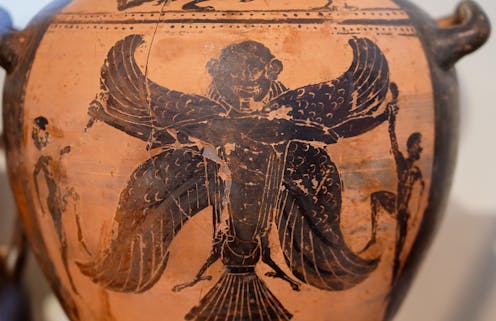
Once yelled at women seen to be pestering or annoying – or at feminists questioning and threatening the status quo – “harpy” has long been used as a derogatory term targeting women.
But have you ever wondered what a harpy was in the first place?
Much like similar derogatory titles “siren” and “fury”, the term “harpy” is derived from a group of monstrous female figures from ancient Greek and Roman mythology.

Who were the harpies?
In Greek and Roman myth, the harpies were a group of animal-human hybrid monsters on par with other such mythological creatures like the sirens, the sphinx, and the centaurs.
Harpies were commonly imagined as an amalgam of a bird’s body, such as wings and claws, with a woman’s head.
The ancient story of the Aeneid, by Latin poet Virgil, describes the story’s hero Aeneas encountering harpies on his quest to found Rome, saying:
Maiden faces have these birds, foulest filth they drop, clawed hands are theirs, and faces ever gaunt with hunger.
This description matches a common design from Greek and Roman art of birds with women’s heads.
In Greco-Roman myth, the harpies were typically tasked with meting out justice on behalf of Zeus and other gods by using their great speed from their wings and sharp talons.
The importance of their claws was likely a result of their name, which was derived from the Ancient Greek word for “snatching” (ἁρπάζω or harpazdo).
As was common of many mythological figures with hybrid features, the way their animal features were portrayed tended to vary across different media (art or literature), different narrative purposes, and over time.
Sometimes the claws were emphasised; other times it was their supernaturally swift wings and voracious hunger.

Enforcers of swift justice
The harpies were not nice people. They existed in myth to dish out punishments from the gods.
Their primary target? Phineus, a seer and king of Salmydessus in Thrace, a city believed to have been located on the Western coast of the Black Sea near the modern day Turkish town of Kıyıköy.
His story is told in the Argonautica by ancient Greek author Apollonius of Rhodes. This tale centres on the journey of Jason and the Argonauts in search of the golden fleece.
In the story, Phineus is said to have abused his powers as a seer by sharing too many of the gods’ secrets with mortals.
This was among the most egregious of crimes in the eyes of the gods, so an especially awful punishment was decided upon.
Phineus was blinded and given the dubious gift of immortality while still allowed to age endlessly. And worst of all, he was set upon by the harpies.
Every time Phineus picked up and tried to eat food, the harpies would burst out from the clouds, moving as fast as lightning, and
with their crooked beaks incessantly snatched the food away from his mouth and hands.
The harpies brought a further gift for Phineus: their smell. This supernaturally “intolerable stench” could putrefy food, so any scraps the harpies didn’t grab were left rotting on the table. You couldn’t even stand near it, “so foully reeked the remnants of the meal”.
And while the harpies swooped in and out in seconds, their smell stuck to the rotting food (and probably poor Phineus).
Some ancient poets add a little extra zest and disgust by also suggesting the harpies may have been defecating on the food, and presumably Phineus.
Most notable is Virgil in his text the Aeneid who wrote about “foedissima ventris proluvies”, meaning:
the foulest discharges from their bellies.
This was likely an exaggeration of their bird-like qualities, used to emphasise how disgusting and monstrous they were.
Phineus was eventually given a reprieve from the harpies, by order of Zeus, so he could help the hero Jason on his quest for the golden fleece.
Having completed their job, the harpies then flew to Crete to live in a cave far away from annoying mortals – only being disturbed once by Aeneas on his meandering path to Rome.
The story of Phineus helped harpies become a metaphor for greed.
Those compared to harpies could include greedy house-guests overstaying their welcome, people living extravagantly or frivolously, or even family members taking advantage of wealthy relatives.
Although the harpies were female monsters, the term was not exclusively applied to women, but used to describe groups of greedy people.
 Harpies were often associated with greed. In this Renaissance painting, part of a series depicting the Seven Deadly Sins, a harpy-drawn chariot is being used by Gluttony (who has wings, carries a jug and and wears wine leaves in her hair).
The Metropolitan Museum of Art, Gift of Mrs. Frederic R. Coudert Jr., in memory of Mr. and Mrs. Hugh A. Murray, 1957.
Harpies were often associated with greed. In this Renaissance painting, part of a series depicting the Seven Deadly Sins, a harpy-drawn chariot is being used by Gluttony (who has wings, carries a jug and and wears wine leaves in her hair).
The Metropolitan Museum of Art, Gift of Mrs. Frederic R. Coudert Jr., in memory of Mr. and Mrs. Hugh A. Murray, 1957.
Harpies today
Happily, today the title of “harpy” is falling out of favour as a derogatory term. But the hordes of monstrous, snatching, winged women live on in modern books, games, comics, movies and TV shows.
From video games with swathes of harpy-like creatures snatching and clawing at the protagonist, like the 2020 video game Hades, to characters in stories inspired by Greek and Roman myth, the harpies are sticking around – like a bad smell.
Authors: Kitty Smith, PhD Candidate in Classical Greek and Roman History, University of Sydney


















