

Using tranquillisers on racehorses is ethically questionable and puts horses and riders at risk
- Written by: Paul McGreevy, Professor, School of Veterinary Science, University of Sydney
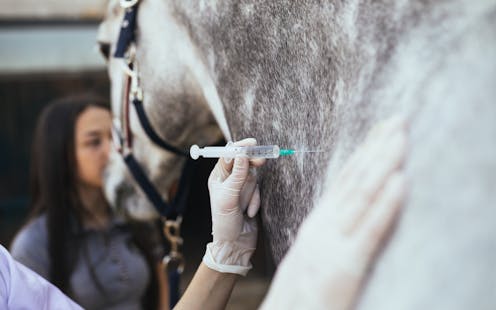
Australia’s horse racing industry is in the spotlight after recent allegations of tranquilliser use on horses so they can be “worked” (exercised) between race days.
A recent ABC report stated workers in the Australian racing industry allege horses are being routinely medicated for track work at the peril of rider and horse safety.
Using tranquillisers on horses during training and management may not be illegal but this could breach nationwide racing rules.
The prevalence of the practice is not clear but many industry insiders report it as common.
Racing Australia had “recently become aware” of the use of acepromazine for track work and had begun collecting data about the practice, but had not been made aware of any complaints or concerns.
What medications are horses given?
Horses may be given a low dose of a tranquilliser, most commonly acepromazine. This makes their behaviour easier to control in certain situations, such as when they’re being examined by a veterinarian.
This drug must be prescribed by an attending veterinarian, and it can calm unfriendly and apprehensive animals. This could assist with making excited, hyperactive horses easier to control and less likely to buck, rear or put people at risk of injury from uncontrolled flight responses.
But proprioception – the way horses feel the world around them, notably the ground beneath them – is likely to be compromised. So, from a work health and safety perspective, the risk of tripping and falling is front of mind.
Other risks to horses from acepromazine can include impaired blood clotting, lower blood pressure, respiratory depression and, in rare cases, permanent paralysis of the penis in male horses.
A dangerous combination
In the racing industry, tranquillisers are given to reduce the difficulties that come from riding and handling very fit, young horses that have been bred, fed and managed to be highly reactive and move at very high speeds.
This combination of selective breeding and only basic training can make them very difficult to control both during trackwork, when speeds of over 60 kilometres per hour can be reached, as well as during routine management.
Thoroughbreds’ diets, intensive management and relative lack of behavioural conditioning can be a dangerous combination.
The diets and confinement make them excitable and likely to take off; if they do, the lack of appropriate training makes them difficult to stop.
What makes race thoroughbreds hard to handle?
All horses have three fundamental needs – friends, forage and freedom, known as the “three F’s”.
Friends: horses have evolved to spend time with large mixed groups. They feel safer in these groups and this safety is highly valued: mutual grooming with preferred conspecifics (other equids) can calm them. In contrast, most stabled horses have no choice about who their neighbours are and can usually only have minimal physical interactions. Once out on the track, horses are highly motivated to stay with other horses and are more likely to be distracted rather than to attend to the rider.
Freedom: horses evolved to move for up to 70% of their day, which is essential for their welfare. In contrast, most racehorses, and indeed many other performance horses, often spend up to 23 hours a day confined in stables. Unfortunately, stabled horses are harder to train and more likely to buck. Prolonged confinement leads to many horses becoming more reactive, a state that increases the likelihood of injuries to riders.
Forage: horses are trickle feeders that graze on high-fibre, low-nutrient forages for up to 16 hours a day. In contrast, racehorses are fed high-energy diets that can be quickly consumed, leading to risk of digestive disturbances, such as gastric ulcers and long periods during which, confined to their stables, they have nothing to do.
Modern racehorse management and training often denies them access to these “three F’s”, which leads to behavioural problems that are then sometimes managed by tranquillising the horse.

Lastly, there’s the kind of work racehorses do.
High-intensity work increases the concentrations of adrenaline and cortisol to support the energy demands of the work. However, this increases the horse’s arousal and reduces their ability to attend to rider cues.
This can make them hard to control.
Collectively, these factors create horses that are not having their fundamental needs met. It’s no wonder that, once free of the confinement of their stables, they can become excited and hard to control, putting their riders and even themselves at risk of injury.
A band-aid solution
There is no textbook that advises vets on how to diagnose or treat horses that are hyperactive, nor are there any data on how horses can be safely tranquillised before being ridden.
However, a UK government data sheet for the most common equine tranquilliser globally, acepromazine maleate, states: “do not, in any circumstances, ride horses within the 36 hours following administration of the product”.
In Australia, racing trainers must keep records of all medications given to horses. Unfortunately, the veterinarians who supply this medication to trainers for use on racehorses are usually doing so without a specific diagnosis or treatment plan.
Routine use of tranquillisers is a band-aid solution to an industry-wide practice of confining, over-feeding and under-training fit, young horses that have been bred to run.
If this practice is ever policed, there will likely be enormous repercussions for the sustainability of racing.
As a first step to addressing this issue, the industry could commit to monitoring and publishing annual data on the routine use of tranquillisers.
Authors: Paul McGreevy, Professor, School of Veterinary Science, University of Sydney


















