

Scientists worked with Warlpiri to track down bilby poo – and uncover clues to help conserve these iconic animals
- Written by: Hayley Geyle, Ecologist, Charles Darwin University
The greater bilby (Macrotis lagotis) is one of Australia’s most iconic yet at-risk animals — and the last surviving bilby species. Once found across 70% of Australia, its range has contracted by more than 80% since European colonisation.
Today, these nocturnal marsupials, still culturally significant to many Indigenous peoples, are restricted to remote deserts. They face an ongoing threat of extinction.
Local elders, Indigenous rangers and scientists hold valuable knowledge about bilby populations, the threats they face, and strategies needed to sustain them into the future.
Our new study, published today in Conservation Science and Practice, reveals how collaboration between scientists and Indigenous land managers can help yield new and vital information.
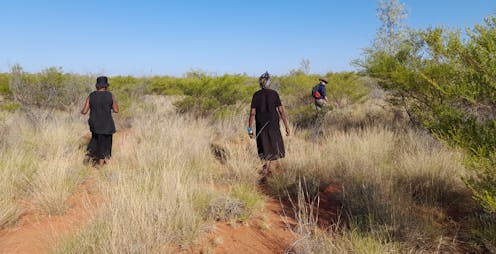
In the field, we used two methods – one based on Warlpiri knowledge and one based on standard scientific protocols – to locate bilbies and collect scat (poo) samples in the North Tanami Indigenous Protected Area in the Northern Territory.
By drawing on Warlpiri tracking expertise and Western scientific methods, we uncovered crucial information on bilby populations that could help conserve these rare creatures.

Understanding bilby numbers is important – but hard
Bilbies turn over tonnes of soil each year, helping to improve soil health, help seeds germinate and enhance water infiltration. Their deep, complex burrows also provide shelter for other species.
They’re crucial to the health of desert ecosystems; protecting bilbies means protecting the web of life they support.
To do this, we need to know more about:
- how many bilbies there are
- how they respond to land management techniques such as planned burning
- how they respond to threats such as feral predators.
Yet, bilbies are notoriously difficult to monitor directly via live capture. They’re nocturnal, shy and solitary. And they inhabit vast landscapes, making it very hard to estimate population numbers.

Luckily, the tracks, diggings and scats bilbies leave behind provide ample clues. DNA from scat (if it can be found) can be used to estimate how many bilbies are present in a particular area.
Systematic ecological surveys, often used to monitor wildlife, can be rigid and expensive, especially in remote regions.
We need flexible methods that align with local knowledge and the practical realities of monitoring bilbies on Country.
A new approach to monitor and manage bilbies
We tested two methods of locating bilby scat for DNA analysis.
The first was systematic sampling. This is a standard scientific approach where fixed lengths of land were walked multiple times to collect scat.
This ensures sampling effort is even over the search area and comparable across sites. However, like most species, bilby distribution is patchy, and this approach can lead to researchers missing important signs.
The second method was targeted sampling, guided by Warlpiri knowledge, to search in areas most likely to yield results.
This allowed the search team to focus on areas where bilbies were active or predicted to be active based on knowledge of their habits and food sources.
Altogether, we collected more than 1,000 scat samples. In the lab, we extracted DNA from these samples to identify individual bilbies. These data, combined with the location of samples, allowed us to estimate the size of the bilby population.
We then compared estimates that would have been derived if we had only done systematic or targeted sampling, or both, to assess their strengths and limitations for monitoring bilby populations.
 The deep, complex burrows of bilbies also provide shelter for other species.
Kelly Dixon/Author provided
The deep, complex burrows of bilbies also provide shelter for other species.
Kelly Dixon/Author provided
What we found
We identified 20 bilbies from the scats collected during systematic surveys and 26 – six more – from targeted surveys. At least 16 individual bilbies were detected by both methods. In total, we confirmed 32 unique bilbies in the study area.
When it came to population estimates – which consider how many repeat captures occur and where – combining data from both types of surveys produced the most accurate estimates with the least effort.
Targeted sampling tended to overestimate population size because it focused on areas of high activity. Systematic sampling was more precise but required greater effort.
Combining both approaches provided the most reliable estimates while saving time.
 In the lab, we extracted DNA from bilby scat samples to identify individual bilbies.
Hayley Geyle/Author provided
In the lab, we extracted DNA from bilby scat samples to identify individual bilbies.
Hayley Geyle/Author provided
What this means for conservation
Our research highlights how collaboration that includes different ways of knowing can improve conservation.
By adapting standard on-ground survey techniques to include Warlpiri methods for tracking bilbies, we produced better data and supported local capacity for bilby monitoring.
Elders also had opportunities to share tracking skills with younger people, helping keep cultural knowledge alive.
Conservation programs often rely on standardised ecological monitoring protocols – in other words, doing things much the same way no matter where you’re working.
While these protocols provide consistency, they are rigid and don’t always yield the best results. They also fail to incorporate local knowledge crucial for managing species like the bilby.
Our approach shows how integrating diverse ways of working can deliver more inclusive and effective outcomes, without compromising data reliability.
A path forward
Bilbies face ongoing threats including:
- introduced predators (particularly foxes)
- habitat degradation and
- inappropriate fire regimes.
Their future depends on collaborative efforts that draw on scientific and Indigenous and local knowledges.
This study provides an example of how such partnerships can work – not just for bilbies, but for other species and ecosystems.
As Australia confronts biodiversity loss, this research underscores the importance of listening to those who know Country best.
By valuing and respecting local expertise, we can build a stronger future for bilbies and the landscapes that are their home.
Authors: Hayley Geyle, Ecologist, Charles Darwin University


















