

Batteries for all, not just the rich? Labor’s home battery plan must be properly targeted to be fair
- Written by: Rohan Best, Senior Lecturer, Department of Economics, Macquarie University
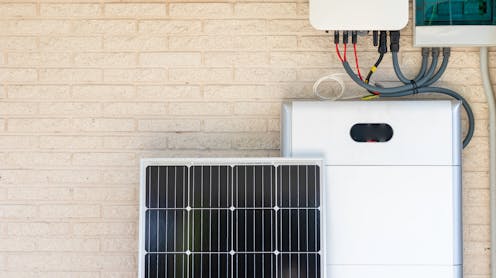
Over the weekend, Labor promised to subsidise home batteries by 30%. This would save about A$4,000 per household up front for an average battery. The scheme has a goal of one million batteries by 2030, costing an estimated $2.3 billion.
The promise was received broadly favourably as a measure to help with cost of living pressures and encourage the broader shift to clean energy. Labor’s policy has some similarity to an earlier Greens pledge. Last month, the Coalition hinted it was working on its own home battery plan. Opposition leader Peter Dutton has attacked Labor’s plan, claiming the subsidies would benefit the rich.
Dutton makes a good point. Upfront subsidies have to be well targeted. If they’re not, they could easily go to wealthier households and leave poorer ones behind.
To fix it, Labor should start with lower subsidies – and means test them.

What’s the fuss about home batteries?
Homes with batteries can use stored solar energy instead of grid energy, or charge from the grid when power is cheap and use it when grid power is expensive. They can reduce power bills by around $1,000 a year.
Over 300,000 Australian households already have a home battery. Uptake was already accelerating in Australia and overseas, as battery prices fall and power prices climb.
If this policy leads to 1 million batteries by 2030 as Labor hopes, they would boost grid stability, reduce demand for expensive peak power from gas generators and even avoid the need to build some new transmission lines. These would be positive – if the benefits can be spread fairly.
Subsidies must be properly targeted
Caution is necessary, because we have seen very similar issues with previous schemes.
When solar panels were expensive in the 2000s, many state governments offered subsidies to encourage more households to put them on their roofs. On one level, this worked well – one third of all Australian households now have solar. But on another, it failed – richer households took up solar subsidies much more than poorer, as my research has shown. As solar prices have fallen, this imbalance has partly been corrected.
Home batteries are now in a similar situation. Installing an average sized home battery of between 5 and 10 kilowatt hours can cost less than $10,000, without the proposed federal subsidy. But this upfront cost means it’s currently largely wealthy households doing it, as I have shown in other research.
If Labor’s policy isn’t properly targeted, wealthier households are more likely to take it up. This is because they can more easily afford to spend the remaining cost. Studies on electric and other vehicle subsidies in the United States show at least half of the subsidies went to people who would have bought the vehicle regardless. That’s good for wealthy households, but unfair to others.
Targeting has advantages for governments, too. Proper targeting would reduce the cost to the public purse.

So who should be eligible?
Wealthier households are likely to be able to afford home batteries without the subsidy – especially as costs fall.
The cost of living crisis has hit less wealthy households hardest. A home battery policy should focus heavily on giving these households a way to reduce their power bills.
How can governments do this? Largely by means-testing. To qualify for the subsidy, households should have to detail their financial assets.
To begin with, a policy like this should only be eligible for households outside the top 25% for wealth.
What about the 31% of Australians who rent their homes? This diverse group requires careful thought.
Governments may have to offer extra incentives to encourage landlords to install home batteries. The solar roll-out shows landlords do benefit, as they can charge slightly higher rent for properties with solar.
How much should subsidies be?
Labor’s election offering of a 30% subsidy is too generous.
While home batteries can cost more than $10,000, cheaper battery options are now available and state incentive schemes are also emerging. Western Australia, for instance, will have its own generous battery subsidy scheme running before July 1.
Some households might be able to get subsidies at both state and national levels, which would cover most of the cost of a smaller battery.
When governments offer high subsidies at the start of a new scheme, there’s a real risk of a cost blowout.
To avoid this, governments should begin with the lowest subsidy which still encourages household investment. If low subsidies lead to low uptake, the government could then raise subsidies after an annual review.
Another option is to vary how much the subsidy is based on household wealth. Lower wealth households get higher subsidies (say $2,500) while higher wealth households get a much lower subsidy (say $500).
Governments could even consider equitable reverse auctions, where households with similar wealth compete for subsidies. Governments can then choose lower bids in the interest of cost-effectiveness.
At present, Labor’s policy would give higher subsidies for larger batteries. This isn’t ideal. On solar, there’s a lack of evidence higher subsidies lead to larger solar systems, while households with more wealth tend to get larger solar systems.
Good start, improvement needed
Labor’s home battery policy has been welcomed by many in the energy sector. But as it stands, we cannot be sure it will fairly share the benefits of home batteries.
If Labor or the Coalition does offer a well-targeted home battery policy, it would be world leading. Over time, it would directly help with the rising cost of living and ensure less wealthy households benefit.
Authors: Rohan Best, Senior Lecturer, Department of Economics, Macquarie University


















