

how Australia overcame housing shortages in the past
- Written by: Rachel Stevens, Lecturer, Institute for Humanities and Social Sciences, Australian Catholic University
As part of their federal election campaign, the Coalition announced plans to limit the number of international students able to commence study each year to 240,000, “focused on driving […] housing availability and affordability”.
This announcement was criticised as a “fact free zone” by the Property Council.
The Coalition proposal falsely equates high immigration with housing shortages. Studies indicate limiting international students will have minimal impact on housing supply. Most international students stay in student housing or share house accommodation, not suitable or desirable for many Australians to live in.
History shows us Australia has previously gone through periods of high migration and economic uncertainty. But history also shows us, if we are willing to adapt and innovate, high immigration and housing affordability can co-exist.
Lessons from Australia’s gold rush
The discovery of gold in Victoria caused Melbourne’s population to explode.
In 1851, Melbourne’s population was 77,000. Within a decade, that figure had more than quadrupled to 540,000.
As a young colony, the Victorian government actively recruited British and Irish migrants, subsidising fully or partially the cost of the sea voyage to Australia.
It wasn’t all smooth sailing: competition across migrant groups developed, and new Chinese immigrants in particular were singled out. Europeans staged violent anti-Chinese riots, which included the murder of three Chinese migrants.
To accommodate new migrants, the Victorian colonial government expanded housing supply in two ways.

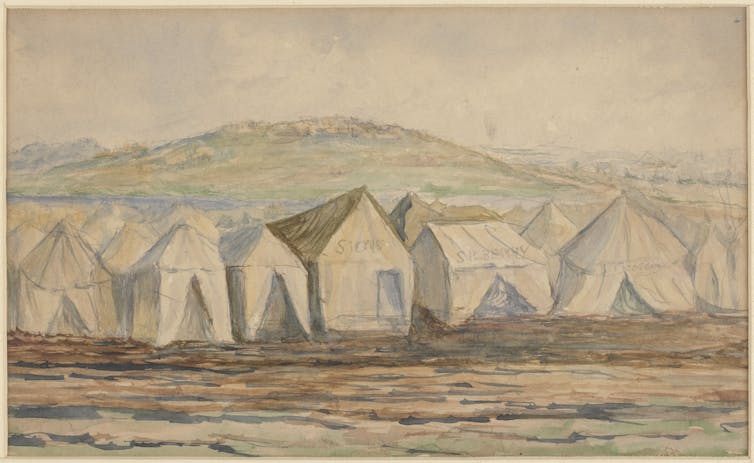
First, in 1852 Lieutenant-Governor Charles La Trobe permitted the establishment of Canvas Town, essentially a tent city on the southern bank of the Yarra River.
There were problems in Canvas Town: disease was common, sanitation nonexistent, and crime rife. But Canvas Town provided newcomers protection from the elements. Canvas Town was officially disbanded in 1854, although people continued to live in tents across Melbourne as they awaited the construction of more permanent housing.
Second, prefabricated iron houses were imported to Melbourne from Britain to overcome supply shortages. These British-built “kit homes” were dismantled, every component labelled and then shipped to Australia for assembly.
Rapidly-built homes appeared in Port Melbourne, North Melbourne, Fitzroy, Collingwood and Richmond. Three such examples still exist today in South Melbourne.

Gold Rush Victoria reminds us of the importance of nimble government intervention in the housing market to offset housing pressures and mitigate anti-foreigner sentiments.
Responding to migrants after World War II
One hundred years later, Australia was again facing an immigration and population boom. Australia faced housing shortages in the post-World War II years, as the population grew from 7.6 million to 10.5 million people between 1947 and 1961.
In the era of post-war shortages and rationing, Australians worried about the impacts of the new arrivals on employment and social issues such as crime.
The arrival of displaced persons and assisted migrants from Europe strained existing housing stock. Some new and existing Australians resorted to squatting and other forms of temporary housing.
Commonwealth and state governments took leading roles in housing construction.
 Houses were pre-fabricated in the United Kingdom, like in this photograph from 1947, before being shipped to Australia.
State Library Victoria
Houses were pre-fabricated in the United Kingdom, like in this photograph from 1947, before being shipped to Australia.
State Library Victoria
Between 1947 and 1961, Australia’s housing stock increased by 50% compared with a 41% increase in population. Australian governments directly contributed to 24% of this increase in stock, or 221,700 homes.
As the minister for immigration, Harold Holt said in 1950, “migrant labour was helping to solve Australia’s housing problems, not aggravating it” by working in essential industries that produce housing materials.
Once again, prefabricated homes were part of the solution.
 British migrant bricklayers work on building new State Housing Trust houses in Elizabeth, South Australia, in 1958.
National Archives of Australia
British migrant bricklayers work on building new State Housing Trust houses in Elizabeth, South Australia, in 1958.
National Archives of Australia
But on-site construction also had a role to play and could capitalise on the skills of new migrants, particularly in the new migrant town of Elizabeth, South Australia.
Migrants also pooled their resources and constructed homes for their community.
In Wexcombe, Western Australia, 12 British families formed a building group. Within three years, they had built new homes for each family.
Eras of innovation
In the 1850s and 1950s, increased immigration triggered bigotry and xenophobia. However, governments at this time were focused on nation building.
 Bill Wilson from Belfast making a footpath around his new home in Wexcombe, Western Australia, in 1960.
National Archives of Australia
Bill Wilson from Belfast making a footpath around his new home in Wexcombe, Western Australia, in 1960.
National Archives of Australia
Even if this was largely focused on supporting new white migrants, many politicians resisted the temptation to fan social divisions for political gain.
Instead, during the Gold Rush and post-World War II eras, Australian governments assisted individuals to adapt and innovate to new circumstances and create novel forms of housing.
Australian history gives us episodes where we see our society under strain and yet capable of addressing social issues with innovation and adaptability, while welcoming migrants.
Authors: Rachel Stevens, Lecturer, Institute for Humanities and Social Sciences, Australian Catholic University


















