

Can you spot a financial fake? How AI is raising our risks of billing fraud
- Written by: Matthew Grosse, Director of the Master of Business Analytics, Senior Lecturer, Accounting, University of Technology Sydney

Along with the many benefits of artificial intelligence – from providing real time navigation to early disease detection – the explosion in its use has increased opportunities for fraud and deception.
Large and small businesses and even the Australian Taxation Office (ATO) may be hit with fraudulent reimbursement claims, which are almost impossible to distinguish from legitimate receipts and invoices.
Individuals also need to be wary.
Look at the photos of the receipts shown below. One documents a genuine transaction. The other was created using ChatGPT. Can you spot the fake?
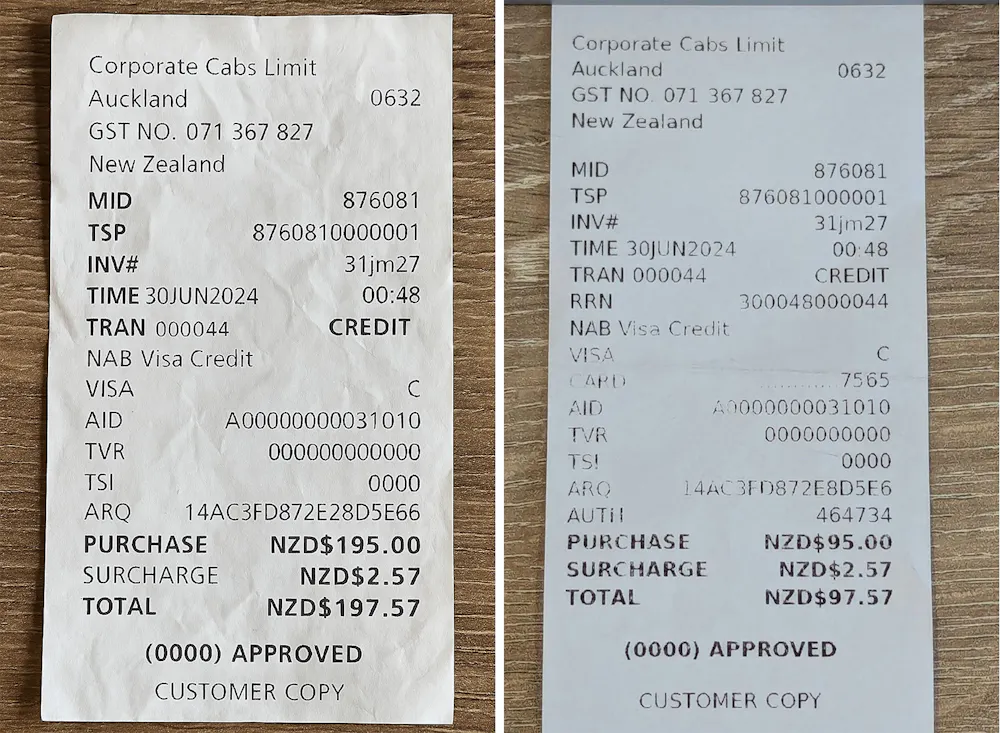
Now have a look at this one.

You possibly couldn’t – and that’s exactly the point. Systems which can reproduce near perfect counterfeits of legitimate financial documents are increasingly prevalent and sophisticated.
Last week, OpenAI released an improved image generation model which can create images with photorealistic outputs including text.
Why should we care?
Fraud involving fake financial documents is a massive global issue. The international Association of Certified Fraud Examiners estimate organisations lose approximately 5% of revenue to fraud each year.
In its 2024 report, the association documents losses exceeding US$3.1 billion across 1,921 cases. Billing and expense fraud constitute 35% of asset misappropriation cases, with firms reporting median losses of US$150,000 per incident.
Most concerning, fraudsters primarily conceal these crimes by creating fake documents or altering files, exactly what AI now simplifies.
Fake documents enable fraud in various ways. An employee might create a fictitious receipt for a business lunch that never happened, or a contractor might fabricate receipts for expenses never incurred. In each case, the fraudster uses counterfeit documentation to extract money they’re not entitled to.
This problem is likely more widespread than recognised. A 2024 survey revealed 24% of employees admitted to expense fraud, with another 15% considering it.
Even more concerning, 42% of UK public sector decision makers confessed to submitting fraudulent claims.
AI removes barriers to deception
Understanding how AI technology may lead to a surge in potential fraud requires examining the classic “fraud triangle”. This explains that fraud requires three elements: incentives, rationalisation and opportunity.
Historically, technical barriers limited the ability to create fake documentation even when motivation existed.
AI eliminates these barriers by making fake documentation easy to create. Research confirms when opportunity expands, fraud increases.
When fake claims become everyone’s problem
When fake receipts support tax deductions, we all pay.
Consider a marketing consultant earning $120,000, who uses an AI image generator to create several convincing receipts for non-existent expenses totalling $4,000. At their marginal tax rate of 30%, this fraud saves them about $1,200 in taxes – if they are not caught.
The Australian Taxation Office estimates a $2.7 billion annual annual gap from incorrectly over-claimed deductions by small businesses. With digital forgery becoming more accessible, this gap could widen significantly.
Fake receipts and invoices
Consumers are also becoming increasingly vulnerable to scammers using AI-generated receipts and invoices.
Imagine receiving what looks like an official invoice from your energy provider. The only difference? The payment details direct funds to a scammer’s account.
This is already occurring. The Australian Competition and Consumer Commission reported more than $3.1 billion lost to scams in 2023, with payment redirection fraud growing rapidly.
As AI tools make creating and editing convincing business documentation easier, these scam numbers have the potential to increase.
The growing threat
This vulnerability for both businesses and consumers is amplified by our increasing reliance on digital documentation.
Today, many businesses issue receipts in digital formats. Expense management systems typically require employees to submit photos or scans of receipts. Tax authorities also accept electronically stored documentation.
With paper receipts becoming increasingly rare and paper’s physical security features gone, digital forgeries become nearly impossible to spot through visual inspection alone.
Is digital authentication the answer?
One potential countermeasure is the Content Provenance and Authenticity (C2PA) standard. The C2PA standard embeds AI generated images with verifiable information about file origin.
However, a major weakness remains, as users can remove metadata by taking a screenshot of an image. For businesses and tax authorities, digital authentication standards are just part of the answer to sophisticated digital forgery. Yet reverting to paper documentation isn’t feasible in our digital era.
Seeing is no longer believing
AI’s ability to create realistic fake financial documents fundamentally changes our approach to expense verification and financial security.
The traditional visual inspection of receipts and invoices is rapidly becoming obsolete.
Businesses, tax authorities and individuals need to adapt quickly by implementing verification systems that go beyond simply looking at documentation.
This might include transaction matching with bank records, and automated anomaly detection systems that flag unusual spending patterns. Perhaps the use of blockchain technology will expand to help verify transactions.
The gap between what AI can create and what our systems can reliably verify continues to widen. So how do we maintain trust in financial transactions in a world where seeing is no longer believing?
Authors: Matthew Grosse, Director of the Master of Business Analytics, Senior Lecturer, Accounting, University of Technology Sydney


















