

The Coalition’s domestic gas plan would lower prices – just not very much
- Written by Samantha Hepburn, Professor, Deakin Law School, Deakin University
It surprised many Australians when the Coalition announced a plan straight from the progressive side of politics: force large gas companies to reserve gas for domestic use – at a lower cost than they could sell it for overseas.
As a populist move during a cost-of-living election, it’s a good one. Australia’s gas producers sell 70% of gas extracted on the east coast overseas under long-term contracts, even as southeastern states such as Victoria face possible gas shortages. Western Australia has long had an effective policy requiring up to 15% of offshore gas to be reserved for domestic use.
After a fortnight’s delay, the Coalition has now publicly released the modelling behind its policy. Undertaken by Frontier Economics, the modelling indicates that reserving 50 to 100 petajoules of gas in the first year would cut wholesale prices by 23%. This would mean a 15% drop in prices for large-scale users – but only a 7% fall for household gas bills and a 3% fall in electricity bills.
This doesn’t sound like much, because it isn’t. Gas prices soared during the Ukraine war and haven’t yet returned to their pre-war levels. Labor has dubbed the plan “gaslighting”, and will rely instead on a gas policy released last year to open up more gasfields and build import terminals. Gas producers don’t like the Coalition’s plan, and neither does billionaire Liberal benefactor Gina Rinehart. Dutton’s plan isn’t crazy – it’s just not likely to make a big difference.

How would this gas reservation policy work?
The Coalition has proposed what it calls an East Coast Reservation Scheme, with the goal of progressively decoupling Australia’s east coast gas market from the volatile international market.
It has two parts. First, it would require new exporters, in the first year of operation, to reserve an additional 50–100 petajoules for the domestic market. Second, it would create a gas security charge, to be imposed on gas producers seeking to export “additional” (non-contracted) gas on the international market.
This would give gas producers an incentive to sell non-contracted gas to the domestic market, because they would get greater profits selling in Australia, even at a lower base price.
Further, the policy would prevent gas producers from charging domestic buyers international prices, setting a competitive price.
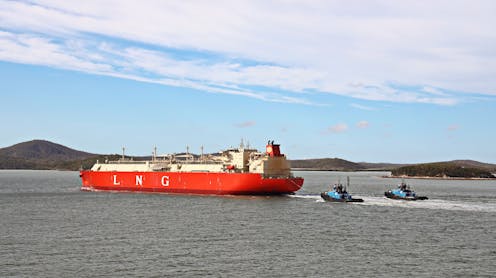
In effect, the gas security charge is akin to a levy or a reverse tariff. The levy can be avoided if producers supply up to 100 petajoules to domestic markets. That’s about as much gas as New South Wales’ gas pipelines deliver each year – 101 petajoules (PJ) as of 2022–23, or the equivalent of 26 full liquefied natural gas (LNG) carriers, which hold about 3.8 PJ on average.
What are the issues with this plan?
There are legitimate concerns. First, the policy does not directly address domestic gas pricing and won’t help with the cost of living crisis. Over time, it could create a more competitive domestic market, but the fact producers could make marginally more money selling gas on the domestic market doesn’t guarantee change.
Second, the policy does not directly address the looming gas supply crisis. That’s because existing gas producers would not be legally obliged to commit to more gas domestically – they could still export it. The obligation to commit an additional 50-100 petajoules to the domestic market only applies to gas exporters in their first year of operation.
If policymakers want to solve the supply crisis, they would be better served by imposing direct export controls in the form of a clear gas reservation mandate. This works, as Western Australia’s long experience shows.
How did we get here?
When Russia invaded Ukraine in 2022, it led to huge spikes in global gas prices and shortages in Europe as the world moved away from Russian gas.
In the 2010s, Australia had already been ramping up gas production. But in the wake of the Ukraine war, Australia became a major gas exporter. Producers traded as much gas as possible on the international market, selling it for over A$40/GJ. Meanwhile, Australia’s coal production was falling.
Domestic gas demand shot up, and prices went from $8 to $30 a gigajoule. In response, the Albanese government introduced an emergency price cap for the wholesale gas market, prohibiting producers from entering into supply contracts with domestic purchasers for prices above a cap, currently set at $12/GJ. While the cap did partly insulate domestic consumers, it was always intended as a temporary measure.
The Australian Competition and Consumer Commission recently predicted a gas supply shortfall of up to 40 petajoules in the southern states as early as September due to declining production in Victoria and South Australia as well as higher demand. Without access to uncontracted Queensland gas, supply will run very low. This is a significant energy security risk, and one the Coalition’s gas policy doesn’t directly address.

What’s next?
Australia is one of the world’s top three LNG exporters. The fact a gas giant could be facing domestic shortages is both unnecessary and embarrassing. Reaching this point represents decades of policy failure.
Reserving gas for domestic use works for the west coast, and it would work for the east. But the Coalition’s plan is not quite a gas reservation scheme. It doesn’t create a comprehensive reservation mandate and questions remain about its capacity to address domestic pricing and supply.
At present, it seems like a lot of effort without great benefit. Will households really notice their gas bill is 7% cheaper?
Authors: Samantha Hepburn, Professor, Deakin Law School, Deakin University

















