

We study ‘planktivores’ – and found an amazing diversity of shapes among plankton-feeding fishes
- Written by: Isabelle Ng, PhD candidate, College of Science and Engineering, James Cook University
Swim along the edge of a coral reef and you’ll often see schools of sleek, torpedo-shaped fishes gliding through the currents, feeding on tiny plankton from the water column.
For decades, scientists assumed these plankton-feeding fishes – or planktivores – shared specialised traits: forked tails and streamlined body forms for speed, large eyes for spotting small prey, and small extendable jaws for suction-feeding.
But our new study, published in Reviews in Fish Biology and Fisheries, shows there is more nuance to this story. We found plankton-feeding fishes don’t follow a single uniform design. To our surprise, they display the widest range of body forms of any feeding group among reef fishes.
Evolving similar traits
A core idea in evolutionary theory since Charles Darwin is that species facing the same problem often evolve similar traits. This is a process known as convergent evolution. It explains the pattern we see among dolphins, sharks, and tunas – distantly related lineages unified in their streamlined body shape used for fast swimming.
We set out to test whether the same phenomenon was true for plankton-feeding reef fishes. Planktivores are an ideal group to study in this case.
For one, plankton-feeding is the most common feeding group among reef fishes – giving us many distantly related species to compare. For another, they all share the same challenge of having to spot and suck out small prey from the water column.

So we asked: do plankton-feeding fishes have a distinct body shape? And do patterns of convergence hold true across a diversity of plankton-feeding reef fishes?
The broadest range of body shapes
To answer these questions, we collected shape data from nearly 300 species of reef fishes from 12 globally distributed families – including surgeonfishes, wrasses, snappers, and damselfishes. We measured 15 feeding, swimming, and vision-related traits such as jaw length, tail shape, and pupil size.
By combining these measurements with evolutionary trees, we tested whether plankton-feeding fishes were distinct in shape to their counterparts.
But what we found surprised us. Plankton-feeding fishes aren’t converging on a specific body shape. It is quite the opposite – they display the broadest range of body shapes among reef fishes. Some species – such as the schooling fusiliers – truly fit the typical “plankton-feeding” model. They exhibit traits such as a forked tail, torpedo-shaped body, large eyes, and small, extendable jaws.
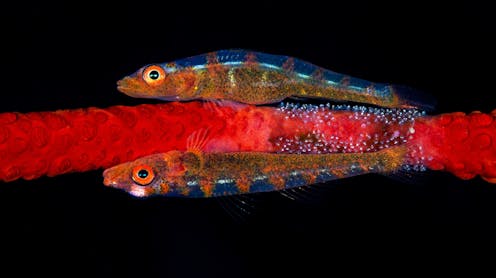
But most others break the mould entirely. For example, tiny gobies – just three centimetres long – cling onto whip corals and adopt a sit-and-wait approach for plankton to pass by.
Other deep-bodied damselfishes depart a small distance from their coral hosts to feed on plankton. But how can we explain this diversity of planktivore body shapes?

An innate ability
The answer lies in the vast diversity of their behaviours and environments.
Their body shape isn’t dictated by plankton-feeding alone – it’s shaped by where, when and how they feed. Some planktivores feed during the day, others at night. Some inhabit deep reefs, others are mere metres below the surface of the water. Some are restricted to rubble slopes while others prefer the reef edge. Some even target specific sizes and types of the plankton itself.
This diversity in activity patterns, habitat use, and prey preferences places different demands on their body forms – explaining why we see such a range of shapes and sizes among plankton-feeding fishes.
Even species we don’t typically think of as planktivores will feed on plankton when the chance arises. Just last year, while on Lizard Island, we watched yellowmask surgeonfishes – normally feeding on algae and detritus – swimming high above the reef, targeting plankton.
Perhaps this flexibility shouldn’t surprise us. After all, all reef fishes begin their lives as plankton feeders, floating in the open ocean before settling on the reef. The ability for fishes to feed on plankton is likely innate.
 Yellowmask surgeonfish (Acanthurus xanthopterus)
COULANGES/Shutterstock
Yellowmask surgeonfish (Acanthurus xanthopterus)
COULANGES/Shutterstock
Challenging a longstanding assumption
Our findings challenge the longstanding assumption that planktivorous reef fishes are distinct in form and are converging towards an optimum body type.
Instead, plankton-feeding is a highly accessible and flexible feeding strategy on coral reefs – available to fishes of many shapes, sizes, evolutionary histories, and even different feeding groups.
This has important implications for how we think about reef fish ecology and evolution. It shows that broad feeding categories like “planktivore” can mask the diversity of other behavioural and ecological traits.
Rather than converging on a single solution, reef fishes highlight something different: that there is more than one way to be a planktivore.
Authors: Isabelle Ng, PhD candidate, College of Science and Engineering, James Cook University


















