

Australian honeybees are under attack by mites and beetles. Here’s how to keep your backyard hive safe
- Written by: Cornelia Sattler, Research Fellow in Ecology & Videographer, Macquarie University
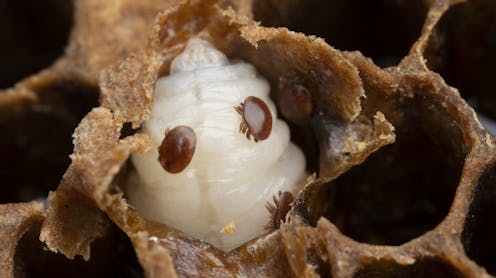
Australia’s honeybees are facing an exceptional crisis. The tiny but devastating foreign pest Varroa destructor is steadily spreading across the country.
The mite feeds on baby bees (larvae), weakening them. It can also spread viruses that eventually destroy entire bee colonies.
Efforts to contain its spread have failed, so it looks like Australia must learn to live with this parasite.
What’s worse, Varroa destructor isn’t acting alone. In many parts of New South Wales, the mite’s arrival appears to have triggered a surge in another destructive pest: the small hive beetle (Aethina tumida).
A wet summer in the east has created ideal conditions for beetle outbreaks. This combination is putting enormous pressure on bees and beekeepers alike. Here’s how to help support the bee industry and, if you’re a backyard beekeeper, defend your hives against attack.

Know your enemy
Varroa was first detected in Australia at the NSW Port of Newcastle in June 2022.
The mite is now widely established in NSW and in Queensland between Toowoomba and Brisbane.
It was detected in Victoria, North-West of Melbourne in February and the ACT earlier this month.
In September 2023, Australian authorities acknowledged eradication was no longer possible. The focus shifted to long-term management.
A slimy accomplice
The varroa invasion appears to be making hives more susceptible to the small hive beetle (Aethina tumida). This species arrived in 2002.
The beetle thrives in warm, humid conditions and lays its eggs inside hives. The larvae feed on honey and wax, turning once-thriving hives into a foul, fermented mess. Beekeepers call this a “slime-out” — and it’s just as bad as it sounds.
The deadly one-two punch
A healthy bee colony can usually defend itself against beetles. But when bees are weakened by varroa mites, they’re far less capable of resisting a beetle invasion.
This deadly one-two punch has already devastated many beekeepers in NSW. One commercial beekeeper reported:
I had large infestations of mites. And then following the mite, I got the boom of the hive beetles. I probably lost 30 hives to beetles.

What to do if you suspect an infestation?
The number of registered recreational beekeepers in Australia is growing. In 2019, there were around 27,800 registered hobbyists. By 2023, that number had jumped to over 47,000. Backyard beekeepers also contribute A$260 million to the economy.
Varroa represents a major threat to every Australian honey producer, so here’s a few tips.
Inspect your hives at least once a month. If larvae appear to be tunnelling through honeycomb, or the honey appears fermented, these are signs beetles may be present.
It’s difficult to detect mites visually, especially when there are few mites present. That’s where monitoring techniques come in. Typically, 300 bees are placed in ethanol or icing sugar and shaken until mites fall off. This allows beekeepers to not only detect the mites but also to count them.
Report mites to the relevant state authorities. Failure to do so can result in fines.
Immediately treat the infested hive and move it at least ten metres away from any others.
Chemicals called miticides can kill varroa mites and knock the population down. But some beekeepers report side effects, including queen loss, so be prepared to replace queens.
Mites may develop resistance to these treatments over time, as one commercial beekeeper from NSW said:
We’ve experienced a lot of queenless hives. I don’t know whether that’s from treatments […] it might be just coincidence, but I’m hearing a lot of other beekeepers having the same problem.
Varroa mites feed on bee larvae, so caging the queen and taking a short break from brood production can reduce the mite population. Mites prefer male bee larvae, so removing these can help.
These control methods are effective, though labour-intensive, and potentially suitable for backyard beekeepers. They can lessen the need for chemical treatments — slowing the evolution of resistance to miticides.
Protection against mites and beetles
To prevent your backyard hives being infested by mites or beetles:
keep colonies well fed, so they don’t rob other colonies and catch their parasites
help bees recognise hives, so they don’t enter the wrong colony with varroa mites on their back (paint hives, space them apart by a few meters, ideally 10m)
reduce the size of hive entrances to help bees block access to intruders
regularly check that your beetle traps are still working, as bees often block the holes that let the beetles into the traps with tree resin
fill the cracks where beetles hide.
How consumers can help
Australians can support the nation’s beekeepers in a few simple ways. Buy 100% Australian honey and hive products from trusted, local sources.
Sugar can easily be swapped for honey in most recipes and honey is a great way to sweeten tea.
When substituting sugar for honey, it’s worth noting honey tastes sweeter so you might want to use less. Honey also contains 18% water, so you may need to reduce the amounts of other liquids in cake recipes accordingly.
Avoid imported honey and bee products to reduce the chance of bringing bee viruses into the country. Not all imported bee products are treated to kill bee viruses.
Finally, planting pollinator-friendly gardens helps to feed local bees.
Safeguarding an industry and a popular hobby
As well as backyard hobbyists, Australia’s beekeeping community includes 1,872 large-scale commercial beekeepers.
Many fear mites will push beekeepers out of business. Protecting the industry requires a shift in mindset, from emergency response to long-term pest management.
With good science, community support and adaptive management, beekeepers — both commercial and backyard — can weather the storm.
Authors: Cornelia Sattler, Research Fellow in Ecology & Videographer, Macquarie University


















