

Why does Putin insist Ukranians and Russians are ‘one people’? The answer spans centuries of colonisation and resistance
- Written by: Darius von Guttner Sporzynski, Historian, Australian Catholic University
Russian president Vladimir Putin does not seem interested in peace: Sunday’s missile strike on Sumy, the worst civilian attack this year, proves he is determined to expand into Ukraine at any cost.
This is a war of ideas, narratives and myths – one that can be traced to the mid-1500s, when Ivan the Terrible, Grand Duke of Muscovy declared himself the first “tsar” of all Russia.
As part of his quest for power, Ivan the Terrible challenged King Sigismund I of Poland, who as Duke of Rus, ruled over territories that now comprise parts of modern-day Ukraine.
Russian rulers have often repurposed history to build their power, according to historian Orlando Figes. Putin wrote a well known essay in 2021 that called Russians and Ukrainians “one people”. He was relying on old beliefs that Russia has the right to “restore” or reunite lands it once ruled.
Ukraine has survived bans on its language, forced assimilation policies, and famines like the Holodomor, orchestrated by Stalin in the 1930s. The country declared independence from Russia in 1991. Now, teachers, artists and local leaders have joined soldiers in resisting Russia.

Empire and a holy mission
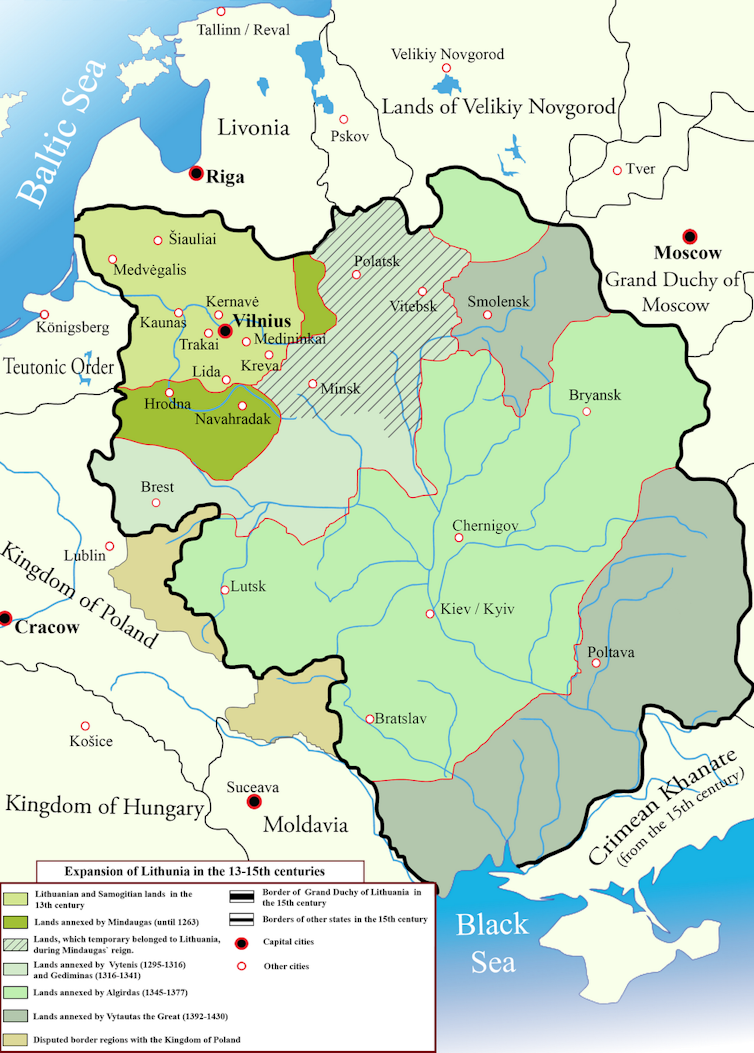
A broad expanse of the former medieval kingdom of Kyivan Rus incorporated territories in present-day Ukraine, Belarus and Russia, including Ukraine’s capital, Kyiv. From 1386 until 1772, the majority of these lands came under the rule of Poland-Lithuania, governed by the Lithuanian Jagiellon dynasty, and their successors.
Today, Russia often points to Kyivan Rus (which lasted from the 9th to the 13th century), claiming it is reuniting these ancient lands, as Ivan the Terrible claimed in the mid-1500s.

In 1547, Ivan declared Muscovy a tsardom and Moscow to be the “Third Rome” – in other words, the latest centre of true Christianity, after Rome and Constantinople. This idea made conquest seem like a holy mission. By the late 1700s, the Russian Empire had destroyed Poland-Lithuania in a series of territorial annexations and wars. It had spread far to the south and east, and now bordered with Prussia and Austria.
Ukraine, with its rich farmland and cultural connection to Kyivan Rus, was a top prize. Russian leaders called Ukraine “Malorossiya”, or “Little Russia”, to claim it was just a small part of a larger, Russian whole. They banned Ukrainian-language publications, forced the Orthodox Church of Ukraine to answer to Moscow, and tried to stamp out any sense of a separate Ukrainian identity.
However, Ukraine developed its own cultural identity, shaped by its Cossack traditions, its history under Polish–Lithuanian rule, and its separate experiences. Many Ukrainians argue their culture existed long before Muscovy evolved into an empire.
 Winter Scene in Little Russia.
Ivan Constantinovich Aivazovsky/Wikimedia Commons
Winter Scene in Little Russia.
Ivan Constantinovich Aivazovsky/Wikimedia Commons
Meanwhile, Russia had expanded into its next-door neighbours, then pretended these lands had always been part of Russia. Historian Alexander Etkind calls this process “internal colonisation”. This strategy helped Russia become a vast empire. But it also built lasting resentment, particularly in Ukraine.
Famine and ‘fascists’
The Soviet Union (USSR), established in 1922 in the wake of the successful Bolshevik Coup in 1917, claimed to be a union of equal republics. But in practice, Moscow stayed firmly in control.
Ukraine had the label of “Soviet Republic”, but had little genuine independence. Soviet leaders demanded enormous amounts of grain, coal, and labour from Ukraine to support the rest of the USSR.
 A postcard printed in Germany by Ukrainian Youth Association for the 15th anniversary of Holodomor, 1933.
Wikimedia Commons, CC BY
A postcard printed in Germany by Ukrainian Youth Association for the 15th anniversary of Holodomor, 1933.
Wikimedia Commons, CC BY
One of the darkest periods in Ukrainian history was the Holodomor, an orchestrated famine that spanned 1932–33, in which millions of Ukrainians died of hunger, after Stalin’s government seized huge amounts of grain from farmers. These policies aimed to break Ukrainian resistance and nationalist feelings.
The Holodomor was an act of genocide against Ukrainians, though Russia disputes this interpretation.
After World War II, the Soviet Union took over the Baltic states and parts of Poland, including regions now in western Ukraine. Although Ukraine became one of the more industrialised parts of the USSR, genuine displays of Ukrainian culture or independent thought were often met with harsh punishment. People who spoke out were labelled “fascists”, a term still used in Russia’s modern propaganda.
 Starved peasants on a street in Kharkiv during the famine.
Widener Library, Harvard University
Starved peasants on a street in Kharkiv during the famine.
Widener Library, Harvard University
Reclaiming Ukraine
The USSR fell apart in 1991. Ukraine, along with other former Soviet republics, became independent nations. This was a major blow to Russia’s idea of itself as a world empire. For centuries, Moscow had seen Ukraine as central to its identity.
The 1990s brought tough economic reforms and political changes in Russia. Then Vladimir Putin rose to power in the early 2000s, promising to restore Russia’s influence. He described the former Soviet states as the “near abroad”, suggesting Moscow still had special rights over these regions.
In 2008, Russia went to war with Georgia. After winning, it recognised two breakaway provinces in Georgia, effectively keeping troops there.
In 2014, Russia annexed Crimea from Ukraine, claiming it was protecting Russian speakers. It also backed separatists in eastern Ukraine’s Donbas region. The United Nations General Assembly passed Resolution 68/262 in March 2014, declaring Russia’s annexation of Crimea illegal. The Kremlin continued its policies regardless.
 A Putin supporter celebrates the 2014 annexation of Crimea in Sevastopol, Republic of Crimea.
Sergei Chirkov/AAP
A Putin supporter celebrates the 2014 annexation of Crimea in Sevastopol, Republic of Crimea.
Sergei Chirkov/AAP
‘Denazifying’ Ukraine?
In February 2022, Russia expanded the conflict by launching an invasion of Ukraine. It described its actions as a mission to “denazify” the country, accusing Ukraine’s government of being controlled by Nazis – although president Zelenskyy has Jewish heritage.
There was no evidence to support these claims. Still, Russian leaders used these slogans to justify their aggressive push. They also spoke of “traditional values” and “Orthodox unity”, painting themselves as defenders of a shared Slavic culture.
The military objective was to capture the Donbas completely, create a land bridge to Crimea, and maybe advance further to Transnistria in Moldova, a pro-Russian separatist region.
What Russia hoped would be a quick victory has become a long, brutal conflict. For many Ukrainians, independence is more than just avoiding control by Moscow. It is about creating a society built on democracy, human rights and ties to Europe.
These values inspired the Euromaidan protests in Kyiv in 2013–14, where demonstrators demanded less corruption and closer links to the European Union. Russia used these protests to justify seizing Crimea in 2014.
 Ukrainians mark the first anniversary (in November 2014) of the Euromaidan Revolution.
Sergey Dolzhenko/AAP
Ukrainians mark the first anniversary (in November 2014) of the Euromaidan Revolution.
Sergey Dolzhenko/AAP
A message of self-determination
The Kremlin’s insistence that Ukrainians and Russians are the same mirrors the older imperial model: expand, absorb and claim these territories were always part of Russia. Breaking free from this “mental empire” demands a deep shift in how Russians, Ukrainians, and the world view Eastern Europe’s past and present.
When the Soviet Union collapsed, many hoped for a new era of cooperation in Eastern Europe. Instead, authoritarian politics and old beliefs about empire have led to a devastating conflict.
By refusing to be pulled back into Russia’s orbit, Ukrainians send a message about self-determination. They reject the claim bigger nations can absorb smaller ones simply by invoking a shared past.
Authors: Darius von Guttner Sporzynski, Historian, Australian Catholic University





















