

Dutton directive gives journalists more breathing space, but not whistleblowers
- Written by: Denis Muller, Senior Research Fellow in the Centre for Advancing Journalism, University of Melbourne
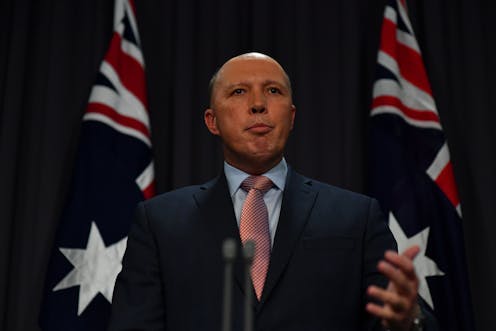
In light of the ministerial direction issued to the Australian Federal Police by the Home Affairs Minister Peter Dutton on August 9, it would be a spectacular contradiction in policy if the Australian Federal Police’s current pursuit of journalists were to end in prosecutions.
Read more: Explainer: what are the media companies' challenges to the AFP raids about?
The direction stated in part:
I expect the AFP to take into account the importance of a free and open press in Australia’s democratic society and to consider broader public interest implications before undertaking investigative action involving a professional journalist or news media organisation in relation to unauthorised disclosure of material made or obtained by a current or former Commonwealth officer.
So much for the uncompromising stance of Dutton and the then acting commissioner of the AFP, Neil Gaughan, that the law was the law, and if journalists broke it they could expect to be prosecuted like anyone else.
The political sensitivity of this climb-down may be gauged from the fact the direction was issued at 4pm on a Friday.
A combination of early deadlines for the Saturday papers, the incapacity of television to pull together a comprehensive story in time for the evening bulletins, and the dead air of the weekend make late Friday the preferred time of the week to drop bad or embarrassing news.
Dutton’s announcement was bereft of explanation. However, events since the AFP raids on the home of a News Corp journalist, Annika Smethurst, and on the ABC headquarters on June 5 and 6 respectively give a hint of the likely reason.
First, there was the international condemnation across the Western world of the repressive nature of the police raids, expressed in a tone of disbelief that this could be happening in a mature democracy.
Then there was the unified response from the heads of Australia’s three main news organisations, the ABC, News Corporation and Nine. Their message, delivered in a nationally televised broadcast from the National Press Club on June 26, was that a government obsessed with secrecy had now gone so far as to criminalise journalism.
There was also the statement by the Federal Attorney-General, Christian Porter, that he was “seriously disinclined” to prosecute journalists for doing journalism. His consent is needed for any such prosecution.
Faced with international condemnation, pressure from the media and the potential for a major row in Cabinet between Dutton and Porter, the government then tried to take the sting out of the situation by setting up an inquiry into press freedom.
Bizarrely, this is being conducted by the Parliamentary Joint Committee on Intelligence and Security (PJCIS), the very body that has waved through most of these repressive laws in the first place.
The inquiry has generated a body of strongly worded submissions arguing for the balance between press freedom and government secrecy to be struck in a way that is more consistent with democratic principles.
It begins its public hearings this week.
So Dutton’s ministerial direction may be seen as having two objectives: heading off a potentially damaging split in cabinet, and accomplishing a preemptive buckle before the parliamentary inquiry calls him and outgoing AFP Commissioner Andrew Colvin, to give an account of themselves.
Of course, as far as anyone knows, the AFP investigations are still on foot. Already officers have removed thousands of records from the ABC, accumulated travel data concerning two ABC journalists and requested their fingerprints, as well as turning Annika Smethurst’s home upside-down.
So the government’s intimidatory tactics have had a good run already, even if prosecutions do not follow.
There is nothing to stop the police from completing these investigations and providing a brief of evidence for Porter. However, given his stated position, allied with the new political dynamics created by the reaction to the raids and Dutton’s directive, it seems unlikely prosecutions will follow.
While the ministerial direction represents a genuflection in the direction of press freedom, it provides nothing by way of protection for whistleblowers.
The direction says it
does not constrain investigation by the AFP of unauthorised disclosure of material made or obtained by a current or former Commonwealth officer.
So it seems the pursuit of whistleblowers – the people who provide journalists with leaked information – can continue unabated. They still have only a demonstrably useless law – the Public Interest Disclosure Act 2013 – offering a fig leaf of protection.
The present prosecutions of Richard Boyle (Tax Office) and David McBride (Defence) attest to this.
The last paragraph of Dutton’s directive deals with the process by which government departments or agencies refer leaks to the AFP, and the AFP then assesses for investigative possibilities.
Read more: Media raids raise questions about AFP's power and weak protection for journalists and whistleblowers
This entire reference and assessment process has been shot through with politics, either at the departmental end or the police end, or both.
That is why the ABC and Smethurst leaks – neither of which had much to do with national security but were acutely embarrassing to the government – were subject to police action.
By contrast, a leak to The Australian about the alleged security effects of the medevac legislation, which the head of ASIO Duncan Lewis publicly complained was a real threat to national security, was not subject to police action because it played into the hands of the government’s scare campaign about people-smuggling.
Dutton’s direction says:
I expect the AFP to strengthen its guidance and processes about the types and level of information required from a Government department or agency when they are referring to an unauthorised disclosure. Referring departments or agencies will need to provide a harm statement indicating the extent to which the disclosure is expected to significantly compromise Australia’s national security.
If the direction is to be taken as meaning only leaks significantly compromising national security are to be referred to the police, then there may be a larger safe space within which journalists can operate.
But the hunt for whistleblowers will go on.
Authors: Denis Muller, Senior Research Fellow in the Centre for Advancing Journalism, University of Melbourne


















