

how emissions trading schemes work and they can help us shift to a zero carbon future
- Written by: Catherine Leining, Policy Fellow, Climate Change, Motu Economic and Public Policy Research
 CC BY-ND
Climate Explained is a collaboration between The Conversation, Stuff and the New Zealand Science Media Centre to answer your questions about climate change.
If you have a question you’d like an expert to answer, please send it to climate.change@stuff.co.nz
Would you please explain how the New Zealand Emissions Trading Scheme (ETS) works in simple terms? Who pays and where does the money go?
Every tonne of emissions causes damages and a cost to society. In traditional market transactions, these costs are ignored. Putting a price on emissions forces us to face at least some of the cost of the emissions associated with what we produce and consume, and it influences us to choose lower-emission options.
An emissions trading scheme (ETS) is a tool that puts a quantity limit and a price on emissions. Its “currency” is emission units issued by the government. Each unit is like a voucher that allows the holder to emit one tonne of greenhouse gases.
The New Zealand Emissions Trading Scheme (NZ ETS) is the government’s main tool to meet our target under the Paris Agreement. In a typical ETS, the government caps the number of units in line with its emissions target and the trading market sets the corresponding emission price.
In New Zealand, the price for a tonne of greenhouse gases is currently slightly below NZ$25, which is not in line with our target. We are still waiting for the government to set a cap on the NZ ETS, which is (hopefully) coming.
Read more:
Why NZ's emissions trading scheme should have an auction reserve price
In the past, we had no limit on the number of emission units in the system, which is why emission prices stayed low, our domestic emissions continued to rise, and the system accumulated a substantial number of banked units.
How an ETS works and who pays
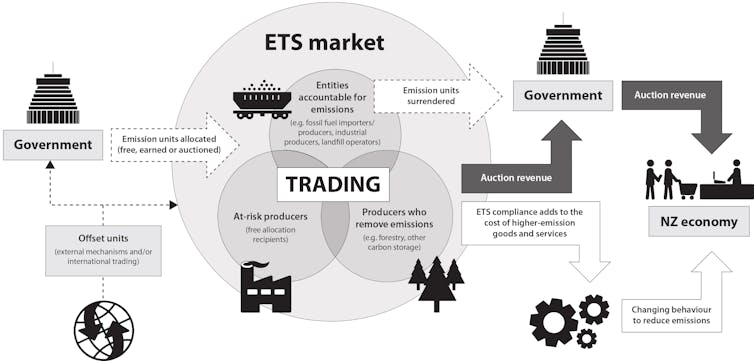
The government decides which entities (typically companies) in each sector (e.g. fossil fuel producers and importers, industrial producers, foresters, and landfill operators) will be liable for their emissions. In some cases (e.g. fossil fuel producers and importers), liable entities are not the actual emitters but they are responsible for the emissions generated when others use their products.
There is a trading market where entities can buy units to cover their emissions liability and sell units they don’t need. The trading price depends on market expectations for supply versus demand. Steeper targets mean lower supply and higher emissions mean higher demand; both mean higher emission prices and more behaviour change.
Each liable entity is required to report emissions and surrender to the government enough units to cover the amount of greenhouse gases they release. The companies that have to surrender units pass on the associated cost to their customers, like any other production cost. In this way, the emission price signal flows across the economy embedded in the cost of goods and services, influencing everyone to make more climate-friendly choices.
CC BY-ND
Climate Explained is a collaboration between The Conversation, Stuff and the New Zealand Science Media Centre to answer your questions about climate change.
If you have a question you’d like an expert to answer, please send it to climate.change@stuff.co.nz
Would you please explain how the New Zealand Emissions Trading Scheme (ETS) works in simple terms? Who pays and where does the money go?
Every tonne of emissions causes damages and a cost to society. In traditional market transactions, these costs are ignored. Putting a price on emissions forces us to face at least some of the cost of the emissions associated with what we produce and consume, and it influences us to choose lower-emission options.
An emissions trading scheme (ETS) is a tool that puts a quantity limit and a price on emissions. Its “currency” is emission units issued by the government. Each unit is like a voucher that allows the holder to emit one tonne of greenhouse gases.
The New Zealand Emissions Trading Scheme (NZ ETS) is the government’s main tool to meet our target under the Paris Agreement. In a typical ETS, the government caps the number of units in line with its emissions target and the trading market sets the corresponding emission price.
In New Zealand, the price for a tonne of greenhouse gases is currently slightly below NZ$25, which is not in line with our target. We are still waiting for the government to set a cap on the NZ ETS, which is (hopefully) coming.
Read more:
Why NZ's emissions trading scheme should have an auction reserve price
In the past, we had no limit on the number of emission units in the system, which is why emission prices stayed low, our domestic emissions continued to rise, and the system accumulated a substantial number of banked units.
How an ETS works and who pays
The government decides which entities (typically companies) in each sector (e.g. fossil fuel producers and importers, industrial producers, foresters, and landfill operators) will be liable for their emissions. In some cases (e.g. fossil fuel producers and importers), liable entities are not the actual emitters but they are responsible for the emissions generated when others use their products.
There is a trading market where entities can buy units to cover their emissions liability and sell units they don’t need. The trading price depends on market expectations for supply versus demand. Steeper targets mean lower supply and higher emissions mean higher demand; both mean higher emission prices and more behaviour change.
Each liable entity is required to report emissions and surrender to the government enough units to cover the amount of greenhouse gases they release. The companies that have to surrender units pass on the associated cost to their customers, like any other production cost. In this way, the emission price signal flows across the economy embedded in the cost of goods and services, influencing everyone to make more climate-friendly choices.
 Supplied by author, CC BY-ND
There are several ways for entities to get units.
First, some get free allocation from the government. Currently, these free allocations are granted to trade-exposed industrial producers (for products such as steel, aluminium, methanol, cement and fertiliser) as a way of preventing the production and associated emissions from shifting to other countries without reducing global emissions. Producers who emit beyond their free allocation need to buy more units, whereas those who improve their processes and emit less can sell or bank their excess units.
Second, entities can earn units by establishing new forests or through industrial activities that remove emissions. By stripping emissions from the atmosphere, such removal activities make it possible to add units to the cap without increasing net emissions. The government publishes information on ETS emissions and removals every year.
Third, entities can buy units from the government through auctioning. In this case, market demand still sets the price. The NZ ETS does not yet have auctioning, but again this is (hopefully) coming. The government currently does allow emitters to buy uncapped fixed-price units at NZ$25.
In the past, entities had a fourth option – buying offshore units – but this stopped in mid-2015. This option is not currently available under the Paris Agreement. If that changes in the future, quantity and quality limits will be needed on offshore units.
Read more:
New Zealand poised to introduce clean car standards and incentives to cut emissions
Where the money goes
The entities that surrender units to the government directly face the price of emissions – either because they had to buy units from other entities or the government, or because they lost the opportunity to sell freely allocated units.
When the government sells units – through auctioning or the fixed-price mechanism – it earns revenue. In 2018, the New Zealand government sold 16.82 million fixed-price units and received NZ$420 million in revenue. When selling fixed-price units that allow the market to emit more, the government has to compensate through more action to reduce domestic emissions (like reducing fossil fuel use or planting more trees) or purchasing emission reductions from other countries - and these actions have a cost.
When ETS auctioning is introduced (potentially in late 2020), the government will receive more significant revenue. It has signalled that any revenue from pricing agricultural emissions (methane and nitrous oxide) will be returned to the sector to help with a transition to lower emissions.
What will happen with NZ ETS auction revenue from other sectors is an open policy question. So are the questions of how large the NZ ETS cap, and how high the emission price, should be. This will be determined under the Zero Carbon Bill and future amendments and regulations to the ETS.
This article was prepared in collaboration with Bronwyn Bruce-Brand and Ceridwyn Roberts at Motu Economic and Public Policy Research.
Supplied by author, CC BY-ND
There are several ways for entities to get units.
First, some get free allocation from the government. Currently, these free allocations are granted to trade-exposed industrial producers (for products such as steel, aluminium, methanol, cement and fertiliser) as a way of preventing the production and associated emissions from shifting to other countries without reducing global emissions. Producers who emit beyond their free allocation need to buy more units, whereas those who improve their processes and emit less can sell or bank their excess units.
Second, entities can earn units by establishing new forests or through industrial activities that remove emissions. By stripping emissions from the atmosphere, such removal activities make it possible to add units to the cap without increasing net emissions. The government publishes information on ETS emissions and removals every year.
Third, entities can buy units from the government through auctioning. In this case, market demand still sets the price. The NZ ETS does not yet have auctioning, but again this is (hopefully) coming. The government currently does allow emitters to buy uncapped fixed-price units at NZ$25.
In the past, entities had a fourth option – buying offshore units – but this stopped in mid-2015. This option is not currently available under the Paris Agreement. If that changes in the future, quantity and quality limits will be needed on offshore units.
Read more:
New Zealand poised to introduce clean car standards and incentives to cut emissions
Where the money goes
The entities that surrender units to the government directly face the price of emissions – either because they had to buy units from other entities or the government, or because they lost the opportunity to sell freely allocated units.
When the government sells units – through auctioning or the fixed-price mechanism – it earns revenue. In 2018, the New Zealand government sold 16.82 million fixed-price units and received NZ$420 million in revenue. When selling fixed-price units that allow the market to emit more, the government has to compensate through more action to reduce domestic emissions (like reducing fossil fuel use or planting more trees) or purchasing emission reductions from other countries - and these actions have a cost.
When ETS auctioning is introduced (potentially in late 2020), the government will receive more significant revenue. It has signalled that any revenue from pricing agricultural emissions (methane and nitrous oxide) will be returned to the sector to help with a transition to lower emissions.
What will happen with NZ ETS auction revenue from other sectors is an open policy question. So are the questions of how large the NZ ETS cap, and how high the emission price, should be. This will be determined under the Zero Carbon Bill and future amendments and regulations to the ETS.
This article was prepared in collaboration with Bronwyn Bruce-Brand and Ceridwyn Roberts at Motu Economic and Public Policy Research.
Authors: Catherine Leining, Policy Fellow, Climate Change, Motu Economic and Public Policy Research


















