

We have the blueprint for liveable, low-carbon cities. We just need to use it
- Written by: Deo Prasad, Scientia Professor and CEO, Co-operative Research Centre for Low Carbon Living, UNSW
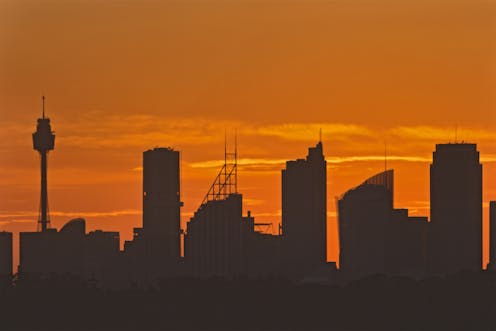
Over the past seven years more than 100 research projects at the Co-operative Research Centre for Low Carbon Living, in collaboration with industry across Australia, have pondered a very big question: How do we build future cities that are sustainable, liveable and affordable?
This is exactly what Australians want, as the recent Greater Sydney Commission report, The Pulse of Greater Sydney, revealed. People want cities in which they live close to jobs and have reasonable commuting times. They want access to parks and green space, and relief from ever-increasing urban heat.
Read more: If we want liveable cities in 2060 we'll have to work together to transform urban systems
The good news is we already know what it will take to deliver on much of this wish list. Since 2012, I have headed the A$100 million Low Carbon Living CRC, which has brought together Australian businesses, industries, communities and many of our brightest researchers to work out how to steer change.
Our Cooling Sydney Strategy, for instance, is the result of years of research into how to combat urban heatwaves. The burden of this heat is unevenly spread across our cities.
For example, residents of Sydney’s western suburbs are exposed to many more days hotter than 35 degrees than Sydneysiders living in the CBD and the city’s north. Last summer that meant over a month’s worth of intense heat in the suburb of Penrith, including nine days in a row above 35°C.
Read more: Building cool cities for a hot future
While the recent winter sun might feel welcome, the negative impacts of increasingly hot cities on our health, lifestyle and energy use greatly outweigh any winter comfort.
So what are the solutions?
Our researchers have already found how we can offset increasing heat. The strategies includes cool and permeable pavements, water features and evaporative cooling, shade structures, vertical gardens, street trees and other plants – even special heat refuge stations.
Keeping cool inside, without huge power bills, is possible too. During last summer’s heatwave, our pilot 10-star energy-efficient house in Perth remained a comfortable 24°C inside, without air conditioning, when it was over 40°C outside. The exceptional thermal performance of the house was down to its evidence-based design.
Josh Byrne explains how his house keeps temperatures comfortable year-round with low energy use and no net emissions.Read more: When the heat is on, we need city-wide plans to keep cool
This work is just one part of our wider remit. Our UNSW-based centre is on track to deliver independently verified cuts of 10 megatonnes of carbon emissions generated by Australia’s built environment by 2020. By integrating renewable energy systems, smart technologies, low-carbon materials and people-centred design into buildings and urban precincts, we have developed a sustainable, liveable and affordable urban blueprint for Australia. A PwC study (yet to be released) estimated cumulative economic benefits totalling A$684 million by 2027.
To put this another way, we have identified and verified evidence-based pathways to cut emissions equivalent to taking some 2.1 million cars off the road.
Read more: Cutting cities' emissions does have economic benefits – and these ultimately outweigh the costs
Some of the progress to date is not immediately obvious to the casual observer. Take an otherwise unremarkable stretch of road along the back way to Sydney Airport. Recently, a 30-metre section of concrete was installed, which looks more like an ad hoc road repair than an important scientific pilot study.
Bu 15 metres is paved with a new geopolymer concrete that slashes greenhouse gas emissions by 50%. The other 15 metres is conventional concrete, the most widely used man-made material on the planet. Concrete production, using cement as its binder, accounts for about 8% of all global emissions.
The geopolymer concrete developed through our research centre is a similarly high-performance product but its binder safely incorporates otherwise noxious industrial waste streams, such as fly ash from coal-fired power stations and slag from blast furnaces. Australia has stockpiled about 400 million cubic tonnes of waste from coal-fired power generation and steelmaking.
In Alexandria, in collaboration with the City of Sydney, we are testing this low-carbon concrete as a road surface that could help clean up industrial waste while slashing emissions. Working with NSW Ports, we’ve also shaped it into low-carbon bollards to form a breakwater to protect the coastline at Port Kembla from extreme weather.
Waste from coal-fired power stations has been used to make low-carbon bollards to protect the coastline at Port Kembla.We now have the know-how to do better
There are many such success stories, but with 105 CRC Low Carbon Living projects the list is too long to detail. What’s more important, as our funding period comes to an end and Australia loses its only innovation hub committed to lowering carbon in the built environment, is to note how we got to where we are today.
The federal government’s Co-operative Research Centre program fosters co-operation and collaboration on a grand scale. Industries, businesses, government organisations and communities with a stake in solving big, complex challenges partner with researchers from a wide range of academic fields. This structure brings together sectors and people whose paths might otherwise rarely cross.
The cross-fertilisation of ideas, expertise and skills delivers innovative solutions. Research worldwide has consistently shown that collaboration drives innovation, and that innovation drives economic growth. Our experience confirms that as we partnered with organisations such as Multiplex, AECOM, BlueScope Steel, Sydney Water, ISCA, CSIRO and the United Nations Environment Program.
Cities are complex, exciting beasts, but we have the knowledge and expertise to live better, more comfortable urban lives in Australia while reducing demand for energy, water and materials. That is, we have the blueprint for low-carbon urban living. We must now choose to use it.
Authors: Deo Prasad, Scientia Professor and CEO, Co-operative Research Centre for Low Carbon Living, UNSW

















