

How do you know if your child has hay fever and how should you treat it?
- Written by Paxton Loke, Paediatric Allergist and Immunologist, Murdoch Children's Research Institute
Spring has sprung and if you’re one of the one in five Australians who get hay fever, you’ve probably noticed some of those pesky symptoms: sneezing; an itchy, runny or stuffy nose; and red, itchy, watery eyes.
Unfortunately children aren’t immune. One in ten will get hay fever – or allergic rhinitis, as it’s known in the clinic – and the rate appears to be rising.
Pollens generally cause seasonal symptoms (in spring or summer), while house dust mites are mainly responsible for year-round symptoms.
Children who are allergic to both seasonal and perennial allergens may experience a marked increase in their symptoms during spring.
Hay fever can lead to fatigue, irritability and poor concentration, and can affect children’s learning and social behaviour. But the good news is it’s usually easily treated.
Read more: Future hay fever seasons will be worse thanks to climate change
Why do kids get hay fever?
Hay fever can begin as early as 18 months of age, when children are exposed to pollens or house dust mites.
Tiny particles get trapped in the hairs and mucous that line their nasal cavity, or can enter via the conjunctiva – the tissue that covers their eye.
The body treats these invaders as dangerous and mounts an attack, using antibodies called immunoglobulin E, or IgE.
When the allergens bind to IgE antibodies, which are present on immune cells (such as mast cells), the cells quickly release chemical mediators, including histamines and leukotrienes. This causes sneezing, itchy and/or runny nose, and itchy, watery eyes.
The body then recruits other immune cells, such as T cells, causing more inflammation and worsening symptoms.
How do you know if it’s hay fever?
While hay fever can be a life-long health issue, symptoms can fluctuate over time.
As well as sneezing, an itchy, runny nose, and itchy watery eyes, you might notice your child has a dry cough, is snorting or sniffing, or continually clears their throat.
In some instances, they might make a clicking sound with their tongue when they use it to scratch the roof of their mouth.
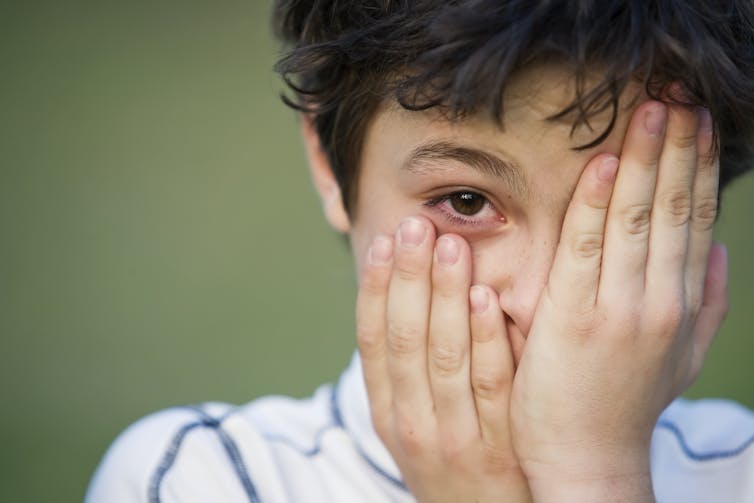 Hay fever symptoms in children are the same as adults.
Creatista/Shutterstock
Hay fever symptoms in children are the same as adults.
Creatista/Shutterstock
While these symptoms may initially look like the common cold, the persistence of symptoms after weeks usually points towards hay fever.
Children with hay fever usually don’t have fevers (which are more common with infections) but they may be more prone to recurrent colds.
Read more: Health Check: how to tell the difference between hay fever and the common cold
If you’re unsure, take your child to your local doctor for a diagnosis. If necessary, they can use skin prick or blood tests to detect the presence of relevant IgE antibodies to the suspected allergens.
Your doctor may then discuss the three main treatment options: avoiding the allergen, oral and topical medications, and allergen immunotherapy.
Avoiding the allergen
Once you suspect or know the allergen, you can help minimise your child’s contact with the cause of their hay fever.
For children who have seasonal allergic rhinitis, allergen minimisation strategies could include:
- staying indoors on windy days with high pollen counts
- avoiding activities with allergen exposure (such as grass mowing)
- having a shower promptly after outdoor activities
- using re-circulated air in the car.
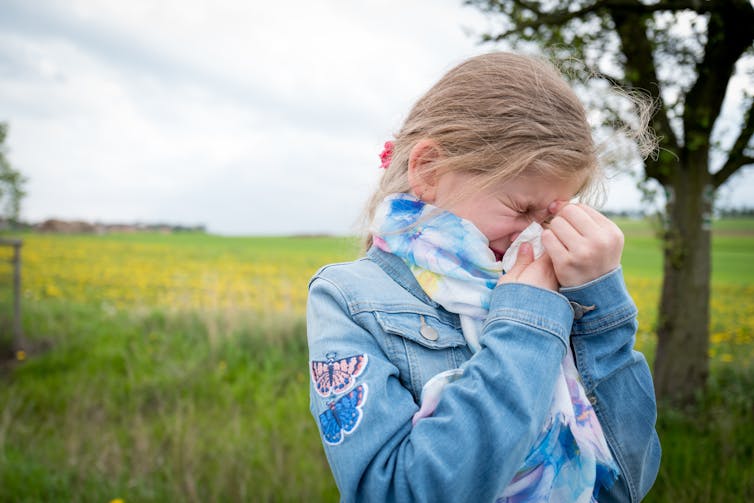 Try to keep kids with hay fever indoors on days with a high pollen count.
Eva Foreman/Shutterstock
Try to keep kids with hay fever indoors on days with a high pollen count.
Eva Foreman/Shutterstock
For cases of perennial allergic rhinitis, where house dust mite is the dominant cause, avoidance strategies could include:
- washing household bedding (sheets and pillow cases) in hot water (above 60°C)
- removing soft toys
- replacing woollen underlays with dust mite covers
- vacuuming carpets with vacuum cleaners fitted with high efficiency particulate air (HEPA) filters.
Medications
Medical therapy is often required in addition to avoiding the allergen.
First line treatments are non-sedating oral antihistamines such as cetirizine, loratadine, fexofenadine and desloratadine. These are available as a syrup or tablets, and can be used for children aged 12 months and over.
They’re available over the counter at pharmacies, or your doctor can advise you on which might work best for your child.
Read more: Health Check: what are the options for treating hay fever?
Nasal steroid sprays (also called intranasal corticosteroids) are also very effective in alleviating symptoms when used correctly.
For children who suffer from seasonal allergic rhinitis, nasal steroid sprays should be started prior to the start of the pollen season, and maintained throughout the season.
Nasal steroid sprays can be used for children aged two years and above, and need to be started under the direction of your doctor.
Side effects can include nose bleeds or nasal dryness. While long-term use is generally safe, it’s best to have ongoing reviews by your doctor.
Other treatment options include:
- intranasal decongestants – sprays to dry the nose – which relieve congestion in the nose by shrinking swollen blood vessels in the nose. These can be used for up to three days
- antihistamine nasal sprays, which may act more quickly than oral antihistamines but only in the nasal passages
- nasal irrigation with saline (salty water) to clear the nasal passages of the allergens.
Desensitisation
 Allergen immunotherapy involves monthly injections, or daily drops or tablets.
Microgen/Shutterstock
Allergen immunotherapy involves monthly injections, or daily drops or tablets.
Microgen/Shutterstock
Allergen immunotherapy, also known as desensitisation, is an option for children who aren’t getting enough relief from medications and avoiding the allergen.
It involves a regular administration of the allergen, either via monthly injections (called the subcutaneous route) or daily drops/tablets under the tongue (known as the sublingual route).
Allergen immunotherapy is available for children aged five years and above via a paediatric allergy specialist, and successfully reduces symptoms in 40-50% of patients.
Treatment is usually given for a period of three to five years, with costs ranging from A$50-A$200 monthly, depending on the number of allergens and products used.
Read more: Health Check: what's the right way to blow your nose?
Authors: Paxton Loke, Paediatric Allergist and Immunologist, Murdoch Children's Research Institute

















