

NZ was first to grant women the vote in 1893, but then took 26 years to let them stand for parliament
- Written by Katie Pickles, Professor of History at the University of Canterbury and current Royal Society of New Zealand Te Apārangi James Cook Research Fellow, University of Canterbury
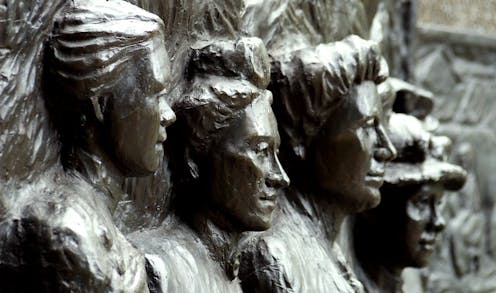
Today marks the passing of the much celebrated 1893 Electoral Act, 126 years ago, which made New Zealand the first country in the world to grant women the right to vote.
But it would take 26 years before the often twinned step of allowing women to stand for parliament happened. On October 29, it will be a century since the passing of the 1919 Women’s Parliamentary Rights Act, which opened the way for women to enter politics.
Women’s suffrage and women’s right to stand for parliament are natural companions, two sides of the same coin. It would be fair to assume both happened at the same time.
Early women’s suffrage bills included women standing for parliament. But, in the hope of success, the right was omitted from the third and successful 1893 bill. Suffragists didn’t want to risk women standing for parliament sinking the bill.
The leader of the suffrage movement, Kate Sheppard, reluctantly accepted the omission and expected that the right would follow soon afterwards. But that didn’t happen.
Read more: Why New Zealand was the first country where women won the right to vote
Post-vote agitation
After women won suffrage, agitation for several egalitarian causes, including women in parliament, continued. The Women’s Christian Temperance Movement (WCTU) and, from 1896, the National Council of Women (NCW) both called for the bar to be removed.
Women including Kate Sheppard, Margaret Sievwright, Stella Henderson and Sarah Saunders Page kept up the battle. But the unity found in rallying around the major women’s suffrage cause was lacking and the heady and energetic climate of 1893 had receded.
From 1894 to 1900, sympathetic male politicians from across the political spectrum presented eight separate bills. Supportive conservatives emphasised the “unique maternal influence” that women would bring to parliament. Conservative MP Alfred Newman argued that New Zealand must retain its world-leading reputation for social legislation, but he downplayed the significance. He predicted that even if women were allowed to stand for parliament, few would be interested and even fewer would be elected.
Left-leaning supportive MPs George Russell and Tommy Taylor saw the matter as one of extending women’s rights and the next logical step towards societal equality. But contemplating women in the House was a step too far and all attempts failed.
Enduring prejudice
The failure in the pre-war years was largely because any support for women in parliament was outweighed by enduring prejudice against their direct participation in politics.
At the beginning of the new century, Prime Minister Richard Seddon was well aware of public opinion being either indifferent to or against women in parliament. A new generation of women with professional careers who might stand for parliament, if allowed, comprised a small minority.
Much to the chagrin of supporters, New Zealand began to lag behind other countries. Australia simultaneously granted women the right to vote and stand for parliament in 1902 at the federal level, with the exception of Aboriginal women in some states.
Women in Finland were able to both vote and stand for election from 1906, as part of reforms following unrest. In 1907, 19 women were elected to the new Finnish parliament.
The game changer: the first world war
Importantly, during the first world war, women’s status improved rapidly and this overrode previous prejudices. Women became essential and valued citizens in the war effort. Most contributed from their homes, volunteering their domestic skills, while increasing numbers entered the public sphere as nurses, factory and public sector workers.
Ellen Melville became an Auckland city councillor in 1913. Ada Wells was elected to the Christchurch City Council in 1917. Women proved their worth in keeping the home fires burning while men were away fighting.
In 1918, British women, with some conditions, were enfranchised and allowed to stand for parliament. Canada’s federal government also gave most of its women both the right to vote and stand for parliament.
Read more: 100 years since women won the right to be MPs – what it was like for the pioneers
Late in 1918, MP James McCombs, the New Zealand Labour Party’s first president and long-time supporter of women’s rights, opportunistically included women standing for parliament in a legislative council amendment bill. It was unsuccessful, mostly due to technicalities, and Prime Minister Bill Massey promised to pursue the matter.
Disappointed feminist advocate Jessie Mackay pointed to women’s service during the war and the recent influenza epidemic and shamed New Zealand for failing to keep up with international developments.
Women’s wartime work, renewed feminist activism and male parliamentary support combined to make the 1919 act a foregone conclusion. Introducing the bill, Massey said he did not doubt it would pass because it was important to keep up with Britain. The opposition leader, Joseph Ward, thought war had changed what was due to women, and Labour Party leader Harry Holland pushed women’s role as moral citizens.
The Legislative Council (upper house) held out and women had to wait until 1941 for the right to be appointed there. It took until 1933 for the first woman, Elizabeth McCombs, to be elected to parliament. The belief that a woman’s place was in the home and not parliament, the bastion of masculine power, endured.
Between 1935 and 1975, only 14 women were elected to parliament, compared to 298 men. It was not until the advent of a second wave of feminism and the introduction of proportional representation in 1996 that numbers of women in the house began to increase.
Authors: Katie Pickles, Professor of History at the University of Canterbury and current Royal Society of New Zealand Te Apārangi James Cook Research Fellow, University of Canterbury

















