

How likely is conflict between the US and Iran?
- Written by Ben Rich, Lecturer in International Relations and Security Studies, Curtin University
This week’s strikes on the Abqaiq and Khurais oil processing facilities in Saudi Arabia represent the latest in a pattern of actions by the Islamic Republic of Iran to escalate tensions in the Persian Gulf.
Unlike previous incidents, the impact of this attack has not just been felt locally. With half of Saudi oil output halted – around 6% of total world production – global fuel oil prices have spiked. The markets are spooked.
Direct culpability for the attack remains unclear. While Yemeni Houthi rebels have claimed responsibility, other sources and evidence have pointed to an Iraqi source, potentially the Hashd al-Shaabi militia.
Some sources inside the US government have also outright accused Iran itself. This seems unlikely, though, given Iran’s penchant for proxy activity and plausible deniability.
Read more: As pressure on Iran mounts, there is little room for quiet diplomacy to free detained Australians
Regardless of who physically pressed the launch button, however, it is almost certain that Tehran was the primary enabler of the strike. The state has a long history of supplying proxy non-state actors with the equipment, intelligence and training necessary to execute such attacks.
Indeed, in the context of the past few months, the attack appears to be the latest in a series of efforts by Iran to escalate tensions and insecurity in the Persian Gulf to push back on the US “maximum pressure” sanctions campaign.
A strategy of tension
Since early this year, Iran has committed itself to a strategy of destabilisation in and around the Arabian Peninsula.
The reasons have been myriad, but primarily revolve around the fallout from the US withdrawal from the 2015 nuclear agreement. This has left Iran diplomatically isolated, economically strained and feeling betrayed by the wider international community.
Seeing few good options, the Iranian leadership has decided to promote chaos and instability to inflict what pain it can on global energy markets. The hope is this will add urgency to the negotiations with world powers and force them to seek a political solution to the economic and security standoff that provides an acceptable exit for Iran.
According to US Secretary of State Mike Pompeo, the Islamic Republic has been involved in nearly 100 incidents over the past few months targeting oil, transport and security infrastructure and equipment.
These have included attacks and seizures of several oil tankers in the gulf, as well as strikes on airports, military bases, diplomatic compounds and now oil facilities in Saudi Arabia.
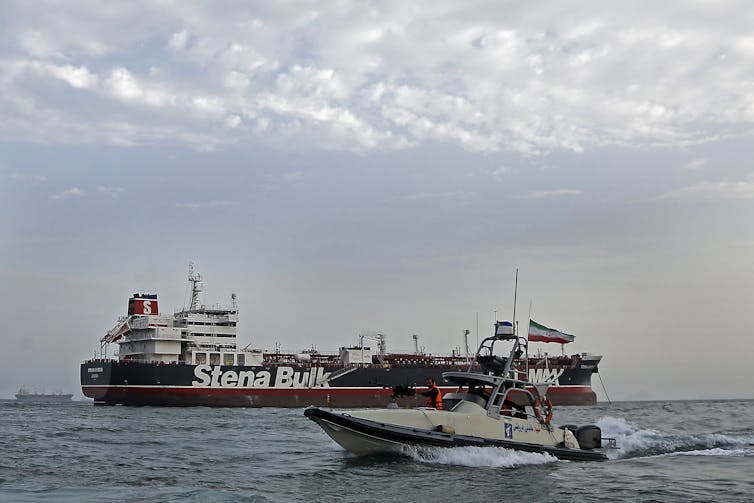 Iran seized the British-flagged oil tanker Stena Impero in July.
Hasan Shirvani/EPA
Iran seized the British-flagged oil tanker Stena Impero in July.
Hasan Shirvani/EPA
While Iran has been directly implicated in a few of these cases, the majority appear to have been undertaken by allied non-state actors in Iraq and Yemen.
If one considers Iran’s historical patronage of such organisations, this should come as no surprise. Since the revolution in 1979, the Islamic Republic has actively cultivated relationships with such groups as a key part of its foreign policy, most famously with Hezbollah in Lebanon.
Such close alliances have permitted Tehran to project its influence into areas it otherwise would have little access to. They also grant a degree of plausible deniability when it comes to radical actions like those witnessed this week.
This can make it diplomatically more difficult for affected countries to assign blame and, more importantly, react to such provocations.
Read more: Infographic: what is the conflict between the US and Iran about and how is Australia now involved?
In the case of the attacks on the Saudi oil facilities, the Iranian leadership has staunchly rejected any responsibility, framing the attack as Houthi revenge against Saudi war crimes.
What was notable in these attacks was their relative bloodlessness and precision. They were primarily designed to threaten and inflict economic harm and uncertainty, rather than kill and maim.
This, combined with a general commitment to employing militant proxies, highlights the Iranian desire to create enough tension to achieve political outcomes, while avoiding crossing a threshold that would lead to dramatic military blowback from the US and its allies.
This is a fine line to walk at the best of times.
Gambling on inaction
Tehran’s brinkmanship rests on an assumption that calibrated provocations will not elicit serious reprisals.
Iran’s security elites have concluded that the Trump administration has little stomach for serious foreign military adventurism. A quick examination of the recent historical record shows that while the current American leadership has demonstrated an unprecedented amount of security policy bark – particularly on Twitter – this has not coincided with a similar level of bite.
Trump’s initial threats of “fire and fury” towards North Korean leader Kim Jong-Un in 2017 were quickly shown to be pure bluster.
Indeed, such bellicose posturing quickly gave way to unprecedented dialogue between the two countries. This culminated in an ongoing series of no-strings-attached summits in which the US president bizarrely prostrated himself before the Hermit Kingdom’s autocrat for little clear gain.
Read more: Iran's leader is losing his grasp on power. Does this mean diplomacy is doomed?
More evidence of American reticence can be found in Syria. Trump loudly and continually warned against Bashar al-Assad’s use of chemical weapons against Syrian civilians.
But, when push came to shove, punitive measures by the US proved little more than anaemic symbolism and posed no serious threat to the regime’s survival.
Just a few months ago, Trump also aborted several military strikes on Iranian military targets after the downing of a US drone. It was another indication Washington has little appetite for open conflict.
Internally, Trump has also clashed heavily with several of the hawks in his administration. In some cases, he has purged them when their views clashed too heavily with his own risk aversion.
The most notable recent example was the humiliating dismissal of his national security adviser, John Bolton, one of the 2003 Iraq war’s chief architects and a staunch advocate of regime change in Iran.
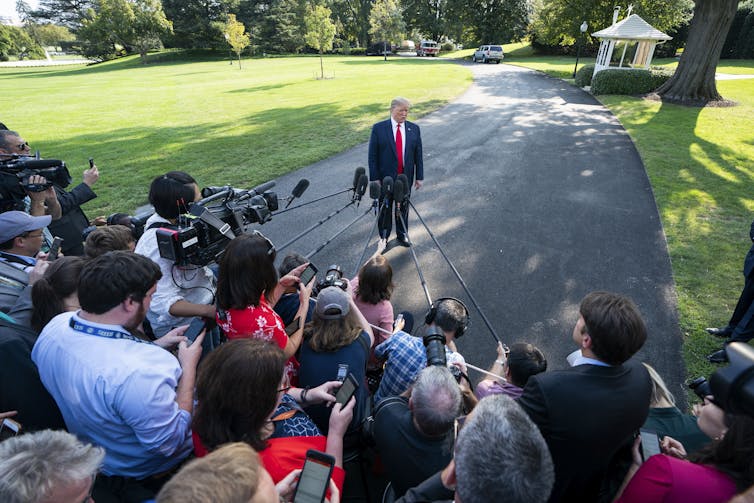 Trump has backed away from confrontation with Iran in recent days, saying he wants to wait for the result of an investigation into the Saudi strike.
Jim Lo Scalzo/EPA
Trump has backed away from confrontation with Iran in recent days, saying he wants to wait for the result of an investigation into the Saudi strike.
Jim Lo Scalzo/EPA
Rolling the dice
The Saudi incident this week represents an undeniable and significant escalation by Iran in its ongoing campaign of tension in the region. The attack has seriously raised the stakes and potential for a conflict between both regional and global players.
But looking at the Trump administration’s recent history, Iranian foreign policymakers are assuming their actions will not spark a dramatic escalation.
In theory, this is a reasonable conclusion, supported by evidence. But security dilemmas like this are characterised by an incredibly complex intersection of competing interests, understandings and short time frames. This often leads to tragic and unpredictable outcomes for those involved.
One has only to look at the ramifications of a previous US intervention against Iranian disruption in the gulf, Operation Praying Mantis in 1988, for evidence of the potential for a rapid escalation to large-scale military exchange.
Authors: Ben Rich, Lecturer in International Relations and Security Studies, Curtin University
Read more http://theconversation.com/how-likely-is-conflict-between-the-us-and-iran-123714

















