

Can’t fill your ADHD script? Here’s why, and what to do while the shortage persists
- Written by Jack Janetzki, Lecturer in Pharmacy and Pharmacology, University of South Australia
Attention-deficit hyperactivity disorder (ADHD) diagnoses are rising across Australia.
But after finally getting a diagnosis, many people are discovering the medicine they’ve been prescribed isn’t available at the pharmacy.
Australia faces a nation-wide shortage of methylphenidate (sold as Concerta and Ritalin).
What does it mean for people with ADHD?
ADHD medication shortages have persisted since 2023, with shortages of lisdexamfetamine (Vyvanse), and are now affecting more people.
Many people with ADHD have to call multiple pharmacies to find their medication. They might be put on waiting lists to access their prescribed medications, or have to contact their doctor or their child’s doctor to get a new script for a different medication.
Some people with ADHD are switching between strengths or changing to different medicines. This can mean starting again with slow dose changes, and can result in poor symptom control and more side effects.
Some people have had to skip doses or go without medicine altogether, making it hard to concentrate, stay organised and manage emotions.
Shortages can also increase inequality. People in rural areas with fewer pharmacies, for example, have more difficulty accessing these medications.
And people with fewer financial resources are less able to access alternative medications that aren’t subsidised.
Increasing access to diagnosis and treatment
Around 8% of children and 2.5% of adults in Australia have ADHD. It makes it hard to focus, sit still, and/or control impulses. For many, medication helps manage these symptoms.
Diagnosis has often involved seeing a specialist such as psychiatrist or paediatrician.
But from September, GPs in New South Wales will be able to continue ADHD prescriptions without needing specialist approval. In 2026, GPs in South Australia and Western Australia will be able to diagnose ADHD and start treatment.
However, ongoing shortages may still stop people from getting the medicine they need.
Why are these medicines running out?
These shortages are largely due to manufacturing issues – including problems sourcing raw ingredients and production quotas in the United States.
When one brand runs out, it puts pressure on other brands. This creates a domino effect across the supply chain.
There is also increasing demand.
In 2022-2023 almost 470,000 Australians were prescribed ADHD medications. That’s four times the number from nine years earlier.
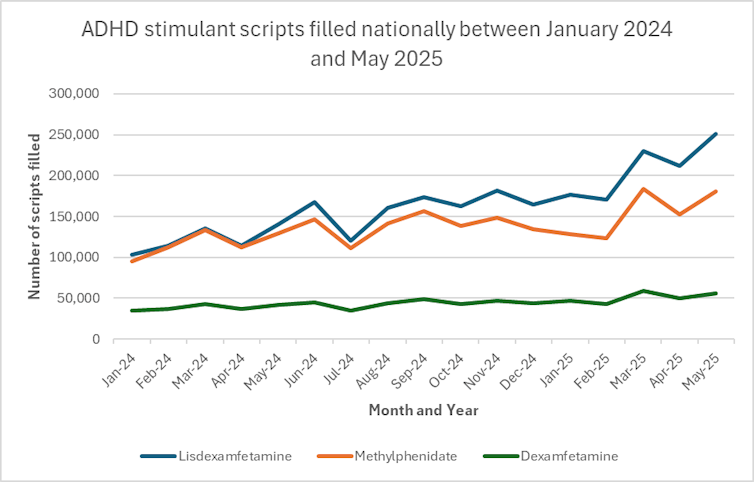
From January 2024 to May 2025, the number of prescriptions filled increased further, by 60% for dexamfetamine, 88% for methylphenidate and 140% for lisdexamfetamine.
Shortages of several strengths and brands of menthylphenidate (Concerta and Ritalin) and are expected to continue into late 2025. Both the long-acting and short-acting types are affected.
Pharmacies can’t always help
Stimulants to treat ADHD are tightly controlled. Pharmacies can only supply one-month of medicine at a time.
In some states such as NSW, paper prescriptions for tightly controlled medicines must be filled at the same pharmacy each time. So patients have not been able to get their medicine elsewhere even if it’s in stock.
In response to the methylphenidate shortages, NSW Health has allowed pharmacies to transfer paper prescriptions to other pharmacists that have stock available. This change is temporary but helpful.
This rule is different in other states such as Victoria and South Australia, where people are able to visit or call other pharmacies to see if they have stock.
However, ideally a patient will be able to build a rapport with one main pharmacy – and the pharmacy will know exactly how many regular patients they need to get stock for.
What are regulators doing about it?
The national medicines regulator, the Therapeutic Goods Administration (TGA) has set up a group called the Medicine Shortage Action Groups to respond to the methylphenidate shortage.
This group includes members from health professional groups and peak bodies. It will give advice to health professionals and are creating resources for patients, families and schools about the shortages and how to reduce disruptions to their or their child’s treatment.
The TGA has also recently approved the temporary use of some methylphenidate brands from overseas.
Some of these are now listed on the Pharmaceutical Benefits Scheme, which means they are available at a subsidised price.
The body representing physicians, the Royal Australasian College of Physicians, has called for early warnings about shortages. That way, doctors can help patients change to alternatives before it’s too late.
What can you do if you can’t get a script filled?
If you’re finding it hard to get your ADHD medicine:
talk to your pharmacist. They may be able to order an overseas-registered alternative or suggest a different brand
speak with your GP, psychiatrist or your child’s paediatrician. They might adjust your or your child’s dose or suggest a different medication for their ADHD. This might mean changing to another stimulant that is available in a short- or long-acting formulation or by changing to a medicine for ADHD that is not a stimulant. Ask your physician to contact the pharmacy to see what they have in stock while you’re at your appointment
check the TGA’s Medicine Shortage Reports Database for updates on when the medicine might become available.
If you’re calling around to find stock:
call mid-morning to see if they’ve got stock. Pharmacies are generally less busy after the morning rush
say exactly what medicine, strength and brand you are looking for. If you don’t mind which brand be sure to tell the pharmacist
keep a list of pharmacies so you don’t double up
if you live in a rural area and find that a pharmacy in a nearby town has stock, ask if they can courier the medication to you.
Authors: Jack Janetzki, Lecturer in Pharmacy and Pharmacology, University of South Australia

















