

Earth’s ‘oldest’ impact crater is much younger than previously thought – new study
- Written by Aaron J. Cavosie, Senior Lecturer, School of Earth and Planetary Sciences, Curtin University
Ever been late because you misread a clock? Sometimes, the “clocks” geologists use to date events can also be misread. Unravelling Earth’s 4.5-billion-year history with rocks is tricky business.
Case in point: the discovery of an ancient meteorite impact crater was recently reported in the remote Pilbara region of Western Australia. The original study, by a different group, made headlines with the claim the crater formed 3.5 billion years ago. If true, it would be Earth’s oldest by far.
As it turns out, we’d also been investigating the same site. Our results are published in Science Advances today. While we agree that this is the site of an ancient meteorite impact, we have reached different conclusions about its age, size and significance.
Let’s consider the claims made about this fascinating crater.
One impact crater, two versions of events
Planetary scientists search for ancient impacts to learn about Earth’s early formation. So far, nobody has found an impact crater older than the 2.23-billion-year-old Yarrabubba structure, also in Australia. (Some of the authors from both 2025 Pilbara studies were coauthors on the 2020 Yarrabubba study.)
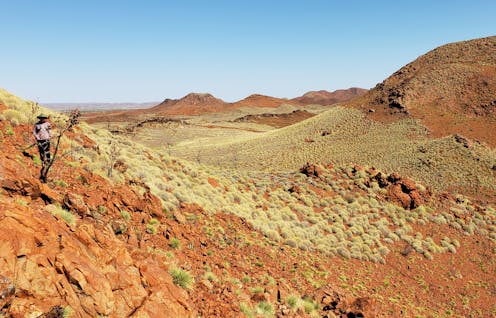
The new contender is located in an area called North Pole Dome. Despite the name, this isn’t where Santa lives. It’s an arid, hot, ochre-stained landscape.

The first report on the new crater claimed it formed 3.5 billion years ago, and was more than 100 kilometres in diameter. It was proposed that such a large impact might have played a role in forming continental crust in the Pilbara. More speculatively, the researchers also suggested it may have influenced early life.
Our study concludes the impact actually happened much later, sometime after 2.7 billion years ago. This is at least 800 million years younger than the earlier estimate (and we think it’s probably even younger; more on that in a moment).
We also determined the crater was much smaller – about 16km in diameter. In our view, this impact was too young and too small to have influenced continent formation or early life.
So how could two studies arrive at such different findings?
Subtle clues of an impact
The originally circular crater is deeply eroded, leaving only subtle clues on the landscape. However, among the rust-coloured basalts are unique telltale signs of meteorite impact: shatter cones.

Shatter cones are distinctive fossilised imprints of shock waves that have passed through rocks. Their unique conical shapes form under brief but immense pressure where a meteorite strikes Earth.
Both studies found shatter cones, and agree the site is an ancient impact.
This new crater also needed a name. We consulted the local Aboriginal people, the Nyamal, who shared the traditional name for this place and its people: Miralga. The “Miralga impact structure” name recognises this heritage.
Determining the timing of the impact
The impact age was estimated by field observations, as neither study found material likely to yield an impact age by radiometric dating – a method that uses measurements of radioactive isotopes.
Both studies applied a geological principle called the law of superposition. This states that rock layers get deposited one on top of another over time, so rocks on top are younger than those below.
 Example of the law of superposition, known as Hutton’s unconformity, at Siccar Point Scotland. The gently dipping layered rocks at the top left were deposited onto – and are therefore younger than – the nearly vertical layered rocks at the bottom right.
Anne Burgess/Wikimedia Commons, CC BY-SA
Example of the law of superposition, known as Hutton’s unconformity, at Siccar Point Scotland. The gently dipping layered rocks at the top left were deposited onto – and are therefore younger than – the nearly vertical layered rocks at the bottom right.
Anne Burgess/Wikimedia Commons, CC BY-SA
The first group found shatter cones within and below a sedimentary layer known to have been deposited 3.47 billion years ago, but no shatter cones in younger rocks above this layer. This meant the impact occurred during deposition of the sedimentary layer.
Their observation seemed to be a “smoking gun” for an impact 3.47 billion years ago.
As it turns out, there was more to the story.
Our investigation found shatter cones in the same 3.47 billion-year-old rocks, but also in younger overlying rocks, including lavas known to have erupted 2.77 billion years ago.
 Outcrop of shatter cones in 2.77-billion-year-old basalt at the Miralga impact structure. These lavas are the youngest rocks in the area we found to have shatter cones. They have distinctive holes (vesicles) representing trapped gas bubbles. The pen is 15cm long.
Aaron Cavosie
Outcrop of shatter cones in 2.77-billion-year-old basalt at the Miralga impact structure. These lavas are the youngest rocks in the area we found to have shatter cones. They have distinctive holes (vesicles) representing trapped gas bubbles. The pen is 15cm long.
Aaron Cavosie
The impact had to occur after the formation of the youngest rocks that contained shatter cones, meaning sometime after the 2.77-billion-year-old lavas.
At the moment, we don’t know precisely how young the crater is. We can only constrain the impact to have occurred between 2.7 billion and 400 million years ago. We’re working on dating the impact by isotopic methods, but these results aren’t yet in.
Smaller than originally thought
We made the first map showing where shatter cones are found. There are many hundreds over an area 6km across. From this map and their orientations, we calculate the original crater was about 16km in diameter.
A 16km crater is a far cry from the original estimate of more than 100km. It’s too small to have influenced the formation of continents or life. By the time of the impact, the Pilbara was already quite old.
 Artist’s depiction looking northwest across the Pilbara, over the 16km-wide Miralga crater. The crater is shown 3km above the modern land surface to account for the deep erosion that has since erased it. The crater size is based on the distribution of shatter cones (inset). The cones point up and back towards the original ‘ground zero’ of the impact. Maps produced using Google Earth Studio.
Alec Brenner
Artist’s depiction looking northwest across the Pilbara, over the 16km-wide Miralga crater. The crater is shown 3km above the modern land surface to account for the deep erosion that has since erased it. The crater size is based on the distribution of shatter cones (inset). The cones point up and back towards the original ‘ground zero’ of the impact. Maps produced using Google Earth Studio.
Alec Brenner
A new connection to Mars
Science is a self-policing sport. Claims of discovery are based on data available at the time, but they often require modification based on new data or observations.
While it’s not the world’s oldest, the Miralga impact is scientifically unique, as craters formed in basalt are rare. Most basalts there formed 3.47 billion years ago, making them the oldest shocked target rocks known.
Prior to impact, these ancient basalts had been chemically altered by seawater. Sedimentary rocks nearby also contain the earliest well-established fossils on Earth. Such rocks likely covered much of early Earth and Mars.
This makes the Miralga impact structure a playground for planetary scientists studying the cratered surface (and maybe early life) of Mars. It’s an easily accessible proving ground for Mars exploration instruments and imagery, right here on Earth.
Authors: Aaron J. Cavosie, Senior Lecturer, School of Earth and Planetary Sciences, Curtin University


















