

We travelled to Antarctica to see if a Māori lunar calendar might help track environmental change
- Written by Holly Winton, Senior Research Fellow in Climatology, Te Herenga Waka — Victoria University of Wellington
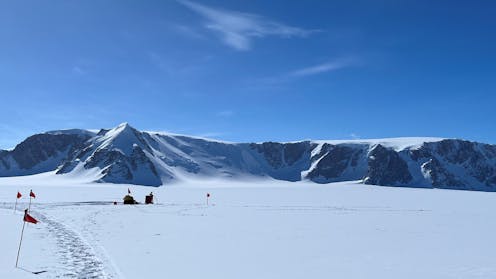
Antarctica’s patterns of stark seasonal changes, with months of darkness followed by a summer of 24-hour daylight, prompted us to explore how a Māori lunar and environmental calendar (Maramataka) might apply to the continent and help us recognise changes as the climate continues to warm.
Maramataka represent an ancient knowledge system using environmental signs (tohu) to impart knowledge about lunar and environmental connections. It traces the mauri (energy flow) between the land (whenua), the ocean (moana) and the sky and atmosphere (rangi), and how people connect to the natural world.
Maramataka are regionally specific. For example, in Manukau, the arrival of godwits from the Arctic indicates seasonal changes that align with the migration of eels moving up the local Puhinui stream.
During matiti muramura, the third summer phase that aligns with the summer solstice, the environment offers tohu that guide seasonal activity. The flowering of pohutukawa is a land sign (tohu o te whenua), the rising of Rehua (Antares, the brightest star in the constellation Scorpius) is an atmospheric sign (tohu o te rangi), and sea urchins (kina) are a sea sign (tohu o te moana).
When these signs align, it signals balance in nature and the right time to gather food. But if they are out of sync (such as early flowering or small kina), it means something in the environment (te taiao) is out of balance.
These tohu remind us how deeply land, sea and sky are connected, and why careful observation matters. When they’re out of sync, they call us to pause, observe and adapt in ways that restore natural balance and uphold the mauri of te taiao.
Tracking a Maramataka in Antarctica
One of the key tohu we observed in Antarctica was the mass arrival of Weddell seals outside New Zealand’s Scott Base at the height of summer.
Guided by Maramataka authorities, we explored other local tohu using Hautuu Waka, an ancient framework of weaving and wayfinding to navigate a changing environment. Originally used for navigating vast oceans, wayfinding in this context becomes a metaphor for navigating the complexities of today’s environmental and social challenges.
During the Antarctic summer, the Sun doesn’t set. But we documented the Moon when visible in the day sky and observed the Sun, clouds, mountains and various forms of snow and ice. This included glacial ice on the land, sea ice in the ocean and snowflakes in the sky.
While the tohu in Antarctica were vastly different from those observed in Aotearoa, the energy phases of the Maramataka Moon cycles aligned with traditional stories (pūrākau) describing snow and ice.
We identified some of the 12 different forms of snow recorded by ethnographers, who described them as the “offspring of wind and rain”.
At Scott Base, we observed feather-like snow (hukapuhi) and floating snow (hukarangaranga). Further inland on the high-elevation polar plateau, we found “unseen” snow (hukakoropuku), which is not always visible to the naked eye but felt on the skin, and dust-like snow (hukapunehunehu), akin to diamond dust. The latter phenomenon occurs when air temperatures are cold enough for water vapour to condense directly out of the atmosphere and form tiny ice crystals, which sparkle like diamonds.
In te ao Māori, snow has a genealogy (whakapapa) that connects it to wider systems of life and knowledge. Snow is part of a continuum that begins in Ranginui (the sky father) and moves through the god (atua) of weather Tāwhirimātea, who shapes the form and movement of clouds, winds, rain and snow. Each type of snow carries its own name, qualities and behaviour, reflecting its journey through the skies and land.
The existence of the specific terms (kupu) for different forms of snow and ice reflect generations of observation, passed down through whakapapa and oral histories (kōrero tuku iho).
Connecting Western science and mātauranga Māori
Our first observations of tohu in Antarctica mark the initial step towards intertwining the ancient knowledge system of mātauranga Māori with modern scientific exploration.
Observing snow through traditional practices provided insights into processes that cannot be fully understood through Western science methods alone. Mātauranga Māori recognises tohu through close sensory attention and relational awareness with the landscape.
Drawing on our field observations and past and present knowledge of environmental calendars found in mātauranga Māori and palaeo-climate data such as ice cores, we can begin to connect different knowledge systems in Antarctica.
For example, just as the Maramataka contains information about the environment over time, so do Antarctic ice cores. Every snowflake carries a chemical signature of the environment that, day by day, builds up a record of the past. By measuring the chemistry of Antarctic ice, we gain proxy information about environmental and seasonal cycles such as temperature, winds, sea ice and marine phytoplankton.
The middle of summer in an ice core record is marked by peak levels in chemical signals from marine phytoplankton that bloom in the Ross Sea when sea ice melts, temperatures are warmer and light and nutrients are available. This biogenic aerosol is a summer tohu identified as a key environmental time marker in the Maramataka of the onset of the breading season and surge in biological activity.
The knowledge of Maramataka has developed over millennia. Conceptualising this for Antarctica opens a way of using Māori methods and frameworks to glean new insights about the continent and ocean. Grounded in te ao Māori understanding that everything is connected, this approach invites us to see the polar environment not as a remote but a living system of interwoven tohu, rhythms and relationships.
Authors: Holly Winton, Senior Research Fellow in Climatology, Te Herenga Waka — Victoria University of Wellington

















