

What’s the difference between sperm and semen? And can pre-ejaculate get you pregnant?
- Written by Theresa Larkin, Associate Professor of Medical Sciences, University of Wollongong
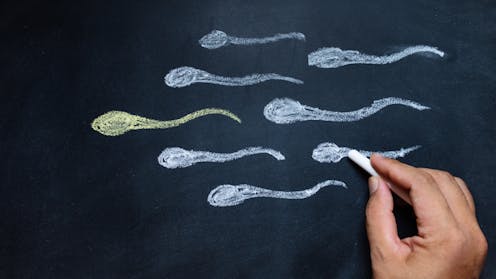
Semen, sperm, spunk, cum, ejaculate, pre-cum, seminal fluid. These are just some of the many words we use to describe what comes out of an erect penis.
Some of these terms can be used interchangeably, but they’re not all the same. Do you know the difference?
What is sperm?
Sperm are male reproductive (sex) cells. The word “sperm” can refer to spermatozoon (singular) or spermatozoa (plural).
Sperm are tiny cells with an oval-shaped body and a long tail. They measure just 1/20th of a millimetre in length and can only be seen with a microscope.
Sperm are produced in the two testes (testicles). The testes are glands located inside the scrotum (the skin sac underneath where the penis is attached to the body).
The testes begin producing sperm at puberty. Sperm production then continues throughout adult life, beginning to decline around age 40. The testes make about 200 million sperm every day.
To develop, sperm need a temperature range of 34–35°C, which is lower than core body temperature (usually between 36 and 37°C). This is why the testes are located in the cooler scrotum and not in the abdomen or pelvis.
Each sperm carries chromosomes, which are made up of DNA and genes. When a sperm cell fertilises a female reproductive cell (an ovum or egg), the genetic information of the sperm and ovum combines to form an embryo.
What is semen?
Ejaculated sperm has to reach the uterine (fallopian) tubes to fertilise an egg. This is a long journey, so sperm are carried in a fluid that nourishes and protects it (seminal fluid).
Semen is the mix of sperm and seminal fluid together. It is Latin for “seed” from serere, “to sow”. Semen only exists outside the body, because sperm and seminal fluid only combine at the point of ejaculation.
Seminal fluid is made in the sex glands. These are the seminal vesicles and prostate, which sit just behind and below the bladder, respectively.
The seminal vesicles produce a thick, gel-like substance. It clumps the sperm together immediately after ejaculation and provides the sperm with energy (fructose) to survive their journey.
This fluid is alkaline – the opposite to acidic – which protects sperm in the more acidic vagina.
The prostate secretes a thinner, milky fluid with acids that liquefy the semen. This helps the sperm to separate from the initial clump so they can travel through the cervix and uterus to the uterine tubes.
The prostate also provides zinc, which is essential for sperm survival.
Ejaculating secretes these fluids and sperm into the urethra, the narrow tube that runs through the penis and also transports urine. At this point, they combine as semen.
Semen is about 10% sperm and 90% fluid from the seminal vesicles and prostate.
What happens after ejaculation
Ejaculating usually produces between 1.5 and 5 millilitres of semen, and each mL contains anywhere between 15 and 200 million sperm.
If semen is ejaculated into a vagina, sperm have to travel around 15 centimetres to reach the uterine tubes, which is the most common site for fertilisation.
The fastest and healthiest sperm travel this distance – about 3,000 times their body length – in only 30 minutes.
For a human of average height, this equates to swimming about 5 kilometres in half an hour. That means sperm can swim twice as fast as the current world record for a 5km open water swim.
Does ‘pre-cum’ have sperm in it?
An aroused and erect penis can secrete up to 4mL of pre-ejaculate (pre-cum), which is completely different to semen.
Pre-ejaculate is produced by different sex glands – the small bulbourethral glands that sit just under the prostate. It is a mucus fluid that lubricates and flushes out the urethra in the penis.
Theoretically, pre-ejaculate doesn’t contain sperm. However, one small study found the pre-ejaculate of about 40% of men they studied contained sperm, though in very low numbers.
The risk of getting pregnant from pre-ejaculate is very low – but not zero.
What can semen say about your overall health?
Semen is usually creamy-white or pale grey. It often has a faint ammonia or bleach smell, because of its alkaline pH.
However its colour, consistency and smell can vary between people and even on different days for the same person.
If semen has a foul odour, it may indicate an infection and should be checked by a doctor.
Contraception and fertility
A vasectomy is a form of male contraceptive. This involves cutting the two vas deferens – the tubes that carry sperm from the testes to the urethra. After a vasectomy, ejaculating will produce slightly less semen and it won’t contain sperm.
Clinical trials have also started for a new potential male contraceptive pill that blocks sperm production in the testes.
Oxidative stress – an imbalance of too many damaging chemicals and not enough antioxidants – has a negative impact on sperm health and strongly contributes to male infertility.
The World Health Organization has published a range of values for semen volume and sperm number, concentration, movement and structure among fertile males. However, low sperm count does not always mean lower fertility.
To keep sperm healthy, it’s recommended to eat a healthy diet rich in antioxidants, exercise regularly, maintain a healthy weight, and not smoke, use recreational drugs or drink a lot of alcohol.
Authors: Theresa Larkin, Associate Professor of Medical Sciences, University of Wollongong

















