

Gonski’s vision of 'personalised learning' will stifle creativity and lead to a generation of automatons
- Written by Alan Reid, Professor Emeritus of Education, University of South Australia
The education debate in Australia becomes tangled when the same key concepts are used by various groups and individuals to mean very different things.
Take the concept of “personalised learning”. It can describe a flexible approach to learning which starts with each student’s individual strengths and capabilities, and encourages a wide range of learning activities. Or it can be used to justify a program of rigid and scripted individual learning progressions.
In the past few years the idea of “learning progressions” has garnered a lot of attention in curriculum debates and reviews. Invariably it is argued learning progressions promote “personalised learning”.
It is important therefore to subject this claim to some scrutiny and try to understand the version of “personalised learning” being promoted in policy circles.
From year levels to learning progressions
In 2017 the then Turnbull government appointed David Gonski to lead a review into how to improve Australian schools. The idea was that if the amount of Commonwealth money going to schools was to be increased – as recommended by the earlier Gonski review in 2011 – then we needed guidance as to what the money should be spent on.
A central proposal in the subsequent 2018 report, dubbed as Gonski 2.0, relates to “personalised learning”. Using the well-rehearsed argument that all students should be able to demonstrate a year’s learning growth every year, the report’s first recommendation is that schools move from a year-based curriculum to a curriculum expressed as learning progressions independent of year or age.
It claims this move will enable schools to better meet the individual learning needs of students than does the organisation of schools by year levels. The latter, the report says, is a remnant of the industrial era and must change if schools are to come into the 21st century.
Read more: Gonski review reveals another grand plan to overhaul education: but do we really need it?
Certainly, the idea of scrapping year levels potentially creates greater flexibility for students and teachers. Rather than aiming curriculum at the average of a cohort of students at a particular age, teachers can “personalise” the curriculum by making an individual student’s readiness for learning the key criterion for curriculum planning.
Of course, a number of schools already do this, and in many other schools where year levels are still used, teachers use adaptive or differentiated teaching to cater for individual interests.
There is always a danger removing year levels will result in a return to streaming if teachers group students according to perceived ability levels rather than age, but this is not an automatic outcome and can be guarded against.
However, the question of removing year-level structures can’t be separated from the issue of what is taught and how. And it is here that it seems the report has taken a progressive idea like personalisation and colonised it with an instrumental purpose.
Gonski’s version of personalised learning
There are different approaches to personalising learning. Some enable teachers and students to negotiate learning programs based on students’ interests and learning needs.
For instance, in the Big Picture schools in Australia and the US, students investigate topics or issues individually or in groups and report on their findings.The key to this kind of learning is skilled teachers helping students make connections across the curriculum, because key concepts are understood through negotiation and collaboration.
This approach prizes student agency and group as well as individual activities. It recognises learning is not a linear and scripted activity.
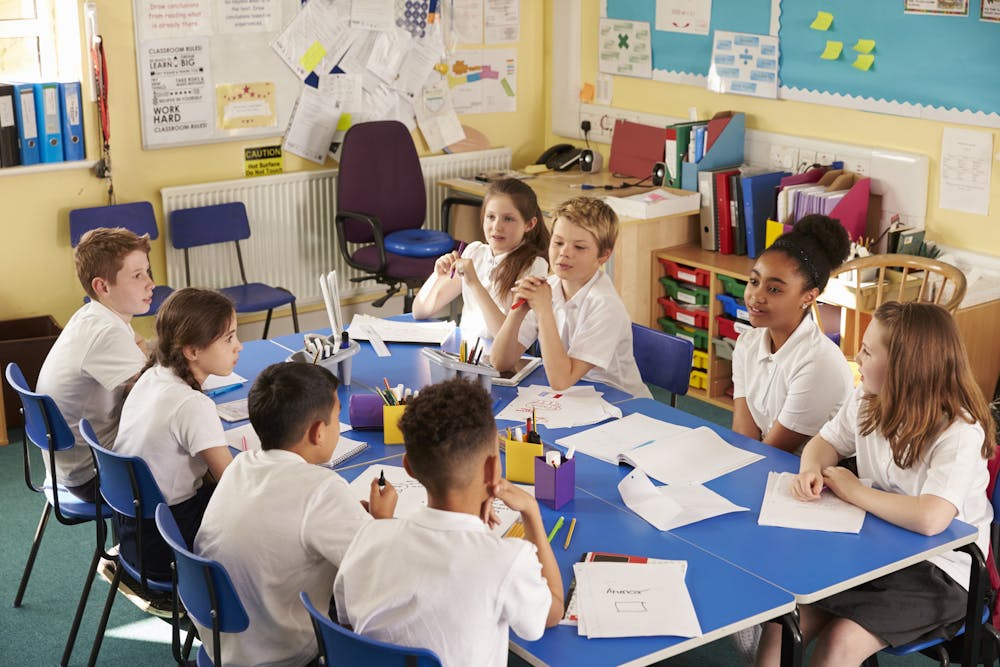 There are many approaches to personalised learning, some of which include indivudal and group activities.
from shutterstock.com
There are many approaches to personalised learning, some of which include indivudal and group activities.
from shutterstock.com
But that is not the version of personalised learning proposed in the 2018 Gonski report. This report recommends an approach where content and skills across every area of the curriculum are atomised into bite-sized chunks of knowledge, and then sequenced into progression levels.
Students work on their own and, at regular points, use online assessment tools to test their readiness for the next chunk of knowledge. Once one level is mastered, they move onto the next.
The report recommends that, over the next five years, the recently developed and implemented Australian Curriculum should be rewritten so every learning area and general capability is written up as a number of progression levels.
It offers an example of “spelling” being broken into a 16-level progression, with students mastering each step before moving lock-step onto the next level.
The Gonski version of personalised learning bears an uncanny resemblance to the model of direct instruction developed in the US in the 1960s. This is a tightly scripted, step-by-step approach that follows a predetermined sequence through packaged resource materials.
Assessment follows each instruction phase with tests aligned to the behavioural goals of the program. The results are fed back to the teacher and student, and the stage is then set for the next phase.
Read more: Explainer: what is explicit instruction and how does it help children learn?
Similarly, Gonski suggests students advance incrementally through progression levels. At regular intervals they should be assessed by an online assessment tool against the learning progressions that measure student attainment and growth in attainment levels over time.
The tool could also suggest, for consideration by the teacher, potential interventions to build further progress.
Although there is an apparent nod in the direction of teacher decision making, it is inevitable the tightly scripted nature of the process will result in a reliance on the use of online resources.
Online assessment tools make students automatons
The National Education Policy Centre in the United States recently reviewed a number of personalised learning programs in the country that have adopted similar characteristics to those Gonski prescribes. The report concludes that they reflect
[…] a hyper-rational approach to curriculum and pedagogy that limits students’ agency, narrows what they can learn in school, and limits schools’ ability to respond effectively to a diverse student body.
The manifestation of this model in the US has been a financial bonanza for private technology companies such as Summit, owned by Facebook founder Mark Zuckerberg. These companies have developed online tests and learning resources capable of tracking the progress of, and devising programs for, individual students.
With such programs, students become individual automatons moving through standardised progression levels. Creativity and critical thinking are stifled as students are steered down an already determined path. And teachers are increasingly excluded from the process, as planning and decision-making is done by algorithms.
Read more: It's back to school for Facebook, and it's personal
The result is a narrow and highly individualised learning experience that is unlikely to prepare students adequately for the challenges of the 21st century.
The point is that “personalised learning” can take many forms. Some approaches will liberate learners, some will tightly constrain them. The model proposed by Gonski is more likely to do the latter. Far from moving schools away from an industrial model, Gonski’s model would entrench it.
Rather than immediately adopting a model such as “progression levels”, surely it would be better to clarify our understanding about personalised learning, including the theories and assumptions on which various versions are based.
Then, if personalised learning is the goal, why not evaluate a number of different models of personalised learning?
The version of personalised learning Australia promotes should be one that nurtures a love and a passion for learning, not one that reduces it to a checklist.
This is an edited extract from Alan Reid’s book, Changing Australian Education: How policy is taking us backwards and what can be done about it, (Allen and Unwin: Sydney), available from October 1, 2019.
Authors: Alan Reid, Professor Emeritus of Education, University of South Australia

















