

Could the latest ‘interstellar comet’ be an alien probe? Why spotting cosmic visitors is harder than you think
- Written by: Sara Webb, Lecturer, Centre for Astrophysics and Supercomputing, Swinburne University of Technology
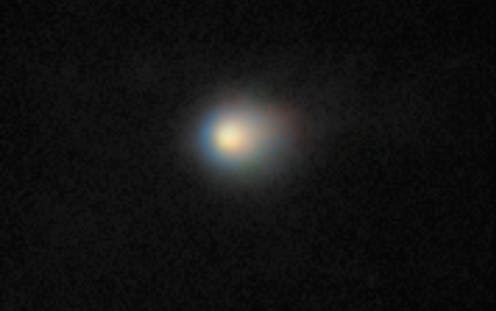
On July 1, astronomers spotted an unusual high-speed object zooming towards the Sun. Dubbed 3I/ATLAS, the surprising space traveller had one very special quality: its orbit showed it had come from outside our Solar System.
For only the third time ever, we had discovered a true interstellar visitor. And it was weird.
3I/ATLAS breaking records
3I/ATLAS appeared to be travelling at 245,000 kilometres per hour, making it the fastest object ever detected in our Solar System.
It was also huge. Early estimates suggest the object could be up to 20km in size. Finally, scientists believe it may even be older than our Sun.
Davide Farnocchia, navigation engineer at NASA’s JPL, explains the discovery of 3I/ATLAS.Could it be alien?
Our first assumption when we see something in space is that it’s a lump of rock or ice. But the strange properties of 3I/ATLAS have suggested to some that it may be something else entirely.
Harvard astrophysics professor Avi Loeb and colleagues last week uploaded a paper titled Is the Interstellar Object 3I/ATLAS Alien Technology? to the arXiv preprint server. (The paper has not yet been peer reviewed.)
Loeb is a controversial figure among astronomers and astrophysicists. He has previously suggested that the first known interstellar object, 1I/ʻOumuamua, discovered in 2017, may also have been an alien craft.
Among other oddities Loeb suggests may be signs of deliberate alien origin, he notes the orbit of 3I/ATLAS takes it improbably close to Venus, Mars and Jupiter.

We’ve sent out our own alien probes
The idea of alien probes wandering the cosmos may sound strange, but humans sent out a few ourselves in the 1970s. Both Voyager 1 and 2 have officially left our Solar System, and Pioneer 10 and 11 are not far behind.
So it’s not a stretch to think that alien civilisations – if they exist – would have launched their own galactic explorers.
However, this brings us to a crucial question: short of little green men popping out to say hello, how would we actually know if 3I/ATLAS, or any other interstellar object, was an alien probe?
Detecting alien probes 101
The first step to determining whether something is a natural object or an alien probe is of course to spot it.
Most things we see in our Solar System don’t emit light of their own. Instead, we only see them by the light they reflect from the Sun.
Larger objects generally reflect more sunlight, so they are easier for us to see. So what we see tends to be larger comets and asteroid, especially farther from Earth.
It can be very difficult to spot smaller objects. At present, we can track objects down to a size of ten or 20 metres out as far from the Sun as Jupiter.
Our own Voyager probes are about ten metres in size (if we include their radio antennas). If an alien probe was similar, we probably wouldn’t spot it until it was somewhere in the asteroid belt between Jupiter and Mars.
If we did spot something suspicious, to figure out if it really were a probe or not we would look for a few telltales.

First off, because a natural origin is most likely, we would look for evidence that no aliens were involved. One clue in this direction might be if the object were emitting a “tail” of gas in the way that comets do.
However, we might also want to look for hints of alien origin. One very strong piece of evidence would be any kind of radio waves coming from the probe as a form of communication. This is assuming the probe was still in working order, and not completely defunct.
We might also look for signs of electrostatic discharge caused by sunlight hitting the probe.
Another dead giveaway would be signs of manoeuvring or propulsion. An active probe might try to correct its course or reposition its antennas to send and receive signals to and from its origin.
And a genuine smoking gun would be an approach to Earth in a stable orbit. Not to brag, but Earth is genuinely the most interesting place in the Solar System – we have water, a healthy atmosphere, a strong magnetic field and life. A probe with any decision-making capacity would likely want to investigate and collect data about our interesting little planet.
We may never know
Without clear signs one way or the other, however, it may be impossible to know if some interstellar objects are natural or alien-made.
Objects like 3I/ATLAS remind us that space is vast, strange, and full of surprises. Most of them have natural explanations. But the strangest objects are worth a second look.
For now, 3I/ATLAS is likely just an unusually fast, old and icy visitor from a distant system. But it also serves as a test case: a chance to refine the way we search, observe and ask questions about the universe.
Authors: Sara Webb, Lecturer, Centre for Astrophysics and Supercomputing, Swinburne University of Technology


















