

With no end in sight and the world losing interest, the Hong Kong protesters need a new script
- Written by Amanda Tattersall, Postdoc in Urban Geography and Research Lead at Sydney Policy Lab. Host of ChangeMakers Podcast., University of Sydney
Today is the 70th anniversary of the founding of the People’s Republic of China, and protesters in Hong Kong intend to upstage Beijing’s celebrations. They will build on the global solidarity protests from the past weekend, staged in 60 cities across the world, including in Australia.
On Sunday in Hong Kong, tens of thousands took to the streets even though no protest permits were granted by the police. Riot control weapons were deployed against the protesters and those near the protests were subject to random searches.
While it might look like these are the same kind of protests that have dominated global headlines for months, Hong Kong is changing. It is moving closer towards crisis. The local government’s previous strategy of “wait them out” is failing, and advised by mainland Chinese officials, the government is exploring legal tools - like the state of emergency provisions - as a response.
Over the past 100 days, the violence between police and students has escalated. Always an asymmetric war, students initially responded in self-defence - using umbrellas, helmets and masks to hold their position on the streets.
As the police’s weapons have become more excessive - tear gas fired in train stations, rubber bullets shot into faces, sponge grenades, water cannons - the students’ responses have become increasingly indignant. They have engaged in targeted actions like street fires, petrol bombs and vandalism to public infrastructure and government sites, like the city’s mass transit system.
Two weeks ago, police representatives argued that live ammunition was justified in response to Molotov cocktails. About the same time, the protesters collectively decided to fight back against police, and not just use self-defence.
It is spiralling. So, where does this end?
Maintaining local support
The Hong Kong police have tried to turn off the tap of mass support to the young protesters, who are called the Braves. Initially they used images of property damage or acts of aggression on television and social media to try to sway public opinion against the younger members of the movement.
More recently, they’ve shut down the right to mass protest. The police have been increasingly denying permits to protest, limiting the space where people can protest, or revoking permission within hours of a march starting.
None of these tactics has worked. Most Hong Kongers continue to support the “five demands” and the protest movement, while disapproving of Chief Executive Carrie Lam’s handling of the situation. (Her approval rating now sits at just 24.9%).
Most older residents feel they have let the young generation down. They not only support the Braves, many are also part of growing support networks providing them with assistance. For example, drivers pick up stranded protesters around the city and volunteers set up makeshift underground hospitals for students afraid to use state-run services.
The perils of self-righteousness
But there is a problem. The rest of the world is turning away from the weekly battles. The thing that made the protests initially so captivating was their novelty and bravery. But what began as original is now predictable. And this brings danger.
The first danger is increasing violence. The need to hold the world’s attention brings the risk of spiralling into greater violence. There is also a dark recognition that if lethal violence was to occur during a protest - if a protester was shot by live ammunition, for instance, or a brick killed a police officer - it would utterly change the dynamics.
Read more: New research shows vast majority of Hong Kong protesters support more radical tactics
The second, less obvious danger lies in self-righteousness. For most protest movements, there is an inherent tension between the ideals and commitment to the ambitious goals that brought people to the streets en masse and the capacity to negotiate with the powerful to achieve them.
This tension is a universal frustration. Protesters are loathe to be considered “sell outs,” but not making a deal risks not winning anything.
The social movement led by Martin Luther King Jr. in the US, for instance, didn’t achieve civil rights in a single boycott. Waves of different movements over decades, using varied protest tactics, and the art of compromise, brought change incrementally. Push, negotiate, make a deal – repeated as a pattern for victory.
Every night, Hong Kong protesters shout their motto, “Five demands, not one less”, referring to the five concessions they are demanding from the government.
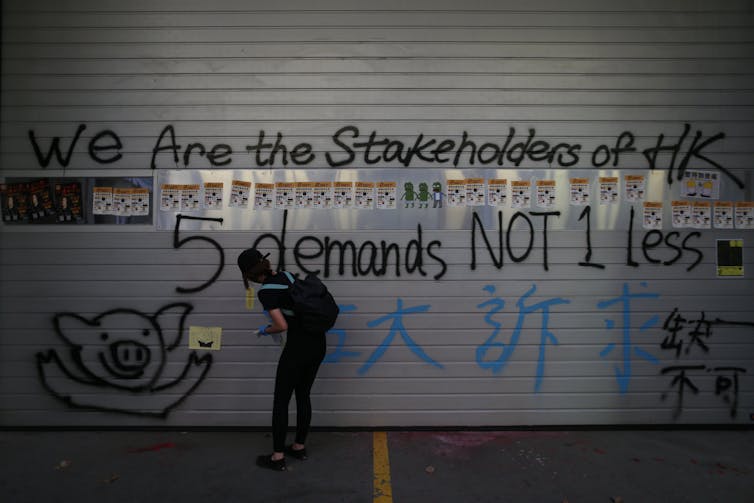 The five demands include universal suffrage and an inquiry into the heavy-handed police response to protesters.
Jerome Favre/EPA
The five demands include universal suffrage and an inquiry into the heavy-handed police response to protesters.
Jerome Favre/EPA
But this righteous ritual conceals a growing fear. Hong Kongers, including leaders I interviewed, worry that all they could win from this movement is the permanent withdrawal of the controversial extradition bill that sparked the unrest, which they’ve already achieved.
With the end of “one country, two systems” model in sight in 2047, the stakes are high. Locals are terrified they might not get closer to universal suffrage and that Beijing will continue to encroach on their political freedoms.
That said, this isn’t a simple battle - and winning a “deal” that doesn’t provide a pathway to democracy won’t be good enough. It’s all well and good for distant observers to casually comment that Hong Kongers need to do a deal, but the “five demands” are not an ambit. This was a “joint consensus.”
Read more: Trust Me, I’m An Expert: Why the Hong Kong protesters feel they have nothing to lose
In contrast to the authoritarianism in China (not to mention elsewhere), Hong Kongers hope they can be a beacon for democracy and enlightenment. Taiwan, for one, is certainly seeing Hong Kong as a source of inspiration in their its battle against Beijing’s push for reunification.
The Braves see it as nothing short of a life or death battle for their identity, and unless they believe they are moving towards a more independent future, they plan to keep fighting.
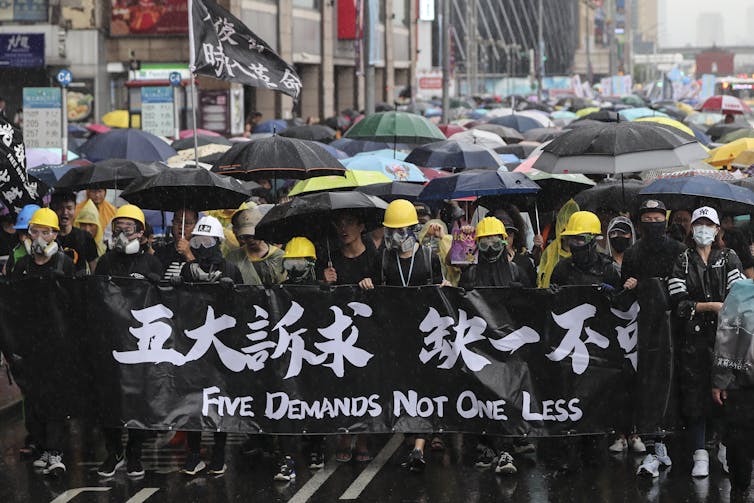 Tens of thousands of people in Taiwan demonstrated in support of Hong Kongers on Sunday.
Ritchie B. Tongo/EPA
Tens of thousands of people in Taiwan demonstrated in support of Hong Kongers on Sunday.
Ritchie B. Tongo/EPA
What Hong Kongers can learn from the French Revolution
So how do you push and negotiate in this context?
Perhaps history can provide some inspiration. In the battle to win democracy in the French Revolution, for example, two important strategies were prosecuted simultaneously.
In Paris, the protesters fought street battles and built barricades, but the leaders also built for themselves the kind of state they envisioned living in. They constructed their own National Assembly, which advanced the idea of universal male suffrage.
This idea of crafting what is known as a “pre-figurative form” might be useful for Hong Kong. Imagine if Hong Kongers, crippled with an undemocratic Legislative Council, created their own Legislative Assembly - a model for their goal of a parliament elected by everyone. The idea has been tried in Hong Kong before; the Occupy Trio who helped lead the Umbrella movement held a people’s referendum calling for universal suffrage in 2014.
The natural inertia of any movement means that a continuation of street battles is likely, which ultimately leads to an escalation of violence. However, if the protesters can channel their energy in a more lasting, organised way, they may be able to achieve even more than the “five demands”.
As well as singing their protest anthem, “Do you hear the people sing?”, the protesters should borrow more ideas from successful democracy movements of the past. This may provide new energy to surprise Beijing and sustain the momentum of frustrated Hong Kongers.
Author Amanda Tattersall hosts the ChangeMakers podcast series which explores the long history of Hong Kong and its protests. The first episode is available here:
Authors: Amanda Tattersall, Postdoc in Urban Geography and Research Lead at Sydney Policy Lab. Host of ChangeMakers Podcast., University of Sydney

















