
Birds use hidden black and white feathers to make themselves more colourful
- Written by: Simon Griffith, Professor of Avian Behavioural Ecology, Macquarie University
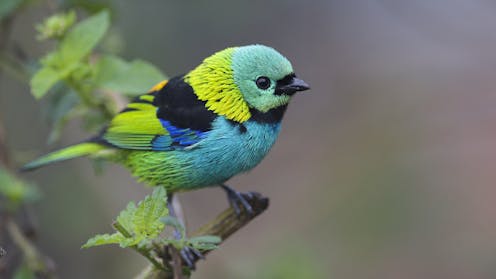
Birds are perhaps the most colourful group of animals, bringing a splash of colour to the natural world around us every day. Indeed, exclusively black and white birds – such as magpies – are in the minority.
However, new research by a team from Princeton University in the United States has revealed a surprising trick in which birds use those boring black and white feathers to make their colours even more vivid.

In the study, published today in Science Advances, Rosalyn Price-Waldman and her colleagues discovered that if coloured feathers are placed over a layer of either white or black underlying feathers, their colours are enhanced.
A particularly striking discovery was that in some species the different colour of males and females wasn’t due to the colour the two sexes put into the feathers, but rather in the amount of white or black in the layer underneath.
Why birds are so bright – and how they do it
Typically, male birds have more vivid colours than females. As Charles Darwin first explained, the most colourful males are more likely to attract mates and produce more offspring than those that aren’t as vivid. This process of “sexual selection” is the evolutionary force that has resulted in most of the colours we see in birds today.
Evolution is a process that rewards clever solutions in the competition among males to stand out in the crowd. Depositing a layer of black underneath patches of bright blue feathers has enabled males to produce that extra vibrancy that helps them in the competition for mates.

The reason the black layer works so well is that it absorbs all the light that passes through the top layer of coloured feathers. The colour we see is blue because those top feathers have a fine structure that scatters light in a particular way, and reflects light in the blue part of the spectrum.
The feathers appear particularly vivid blue because the light in other wavelengths is absorbed by the under-layer. If the under-layer was paler, some of the light in the other parts of the light spectrum would bounce back and the blue would not “pop out” as much.
Different tricks for different colours
Interestingly, in the new study, the researchers found that for yellow feathers the opposite trick works. Yellow feathers contain yellow pigments – carotenoids – and in this case they are enhanced if they have a white under-layer.
The white layer reflects light that passes through the yellow feathers, and this increases the brightness of these yellow patches, making them more striking in contrast to surrounding patches of colour.
 The red feather tips of a scarlet-rumped tanager (Ramphocelus passerinii) are enhanced by the white feathers beneath them.
Rosalyn Price-Waldman
The red feather tips of a scarlet-rumped tanager (Ramphocelus passerinii) are enhanced by the white feathers beneath them.
Rosalyn Price-Waldman
A surprisingly common technique
The authors focused most of their work on species of tanager, typically very colourful fruit-eating birds that are native to Central and South America.
However, once they had discovered what was happening in tanagers, they checked to see if it was occurring in other birds.
 The vivid blue colouring of the Australian splendid fairy wren (Malurus splendens) is enhanced by an underlayer of colourless feathers.
Robbie Goodall / Getty Images
The vivid blue colouring of the Australian splendid fairy wren (Malurus splendens) is enhanced by an underlayer of colourless feathers.
Robbie Goodall / Getty Images
This additional work revealed that the use of black and white underlying feathers to enhance colour is found in many other bird families, including the Australian fairy wrens which have such vivid blue colouration.
This widespread use of black and white across so many different species suggests birds have been enhancing the production of colour in this clever way for tens of millions of years, and that it is widely used across birds.
 The color of the vibrant red crown of this red-capped manakin (Ceratopipra mentalis) is magnified by a hidden layer of white plumage.
Daniel Field
The color of the vibrant red crown of this red-capped manakin (Ceratopipra mentalis) is magnified by a hidden layer of white plumage.
Daniel Field
The study is important because it helps us to understand how complex traits such as colour can evolve in nature. It may also help us to improve the production of vibrant colours in our own architecture, art and fashion.
Authors: Simon Griffith, Professor of Avian Behavioural Ecology, Macquarie University


















