
what DNA revealed about the weird deep-sea world of brittle stars
- Written by: Tim O'Hara, Senior Curator of Marine Invertebrates, Museums Victoria Research Institute
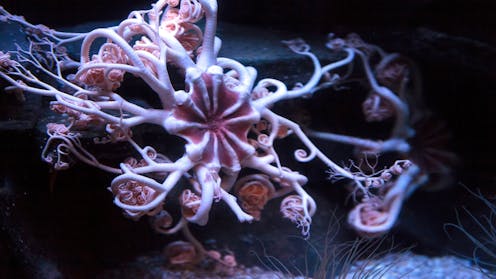
You may have read that the deep sea is a very different environment from the land and shallow water. There is no light, it is very cold, and the pressure of all the water above is immense.
Plants can’t grow there, and the energy powering life mostly comes from organic matter sinking from the sunlit surface. These facts have been known for more than 150 years.
But I want to tell you something you probably don’t know about the deep sea: for animals on the seafloor, it is a very connected environment. There are few environmental barriers to stop animals slowly expanding their distribution to cover thousands of kilometres. Over a million years, deep-sea animals can spread from Iceland to Tasmania.
In a new study published today in Nature, we map the distribution and relatedness of a single group of marine animals across all ocean seafloors, from the coast down to the abyssal plains of the deep sea, from the equator to the pole.
Five arms, no brain, no eyes or heart
We sequenced the DNA of thousands of animal specimens stored in natural history collections of museums across the globe, deposited from hundreds of research voyages. For the first time, we have enough data to explore how marine life has evolved and dispersed across the oceans over the past 100 million years.
We studied a group of animals called brittle stars, strange spiny creatures with a disc-like body and five sinuous or branched arms. They have a central mouth and gut, but no brain, no eyes and no heart.

While these shy animals would not be always familiar to beach combers or snorkelers, they are perfect for our project as they are found in abundance across deep seafloors and frequently surveyed by research expeditions. They have inhabited our planet for more than 480 million years, efficiently consuming and recycling organic matter.
Deep-sea lifestyles
Life in the deep is distributed in a different way to that in shallow seas.
In shallow waters, the temperature differs a lot between the tropics, the temperate regions (mid latitudes) and the poles. This imposes a barrier to the movement of marine life. Animals (and plants) generally adapt to a narrow range of temperatures and only rarely spread to other climates.
So, if you are a tropical shallow-water species, you cannot migrate through frigid waters around South America, or through the Canadian Arctic, to get from the Pacific to Atlantic Ocean. For tens of millions of years, shallow marine species have evolved independently in different oceans and seas.

But we found the deep sea is not like that. Species in different regions are much more closely related.
In fact, the age and geographic distribution of species on a family tree of deep-sea brittle stars resembles that of a group of seabirds or marine mammals. Yet these brittle stars don’t have wings or fins to get around.
 The deep-sea brittle star Ophiotholia can burrow like a corkscrew into muddy seafloors.
Caroline Harding / Museums Victoria, CC BY
The deep-sea brittle star Ophiotholia can burrow like a corkscrew into muddy seafloors.
Caroline Harding / Museums Victoria, CC BY
How eggs and larvae roam the globe
The secret of how slow-moving brittle stars migrate across oceans appears to be their eggs and larvae.
In warm, shallow waters, a yolk-filled food reserve is rapidly used up by the developing larva. But in the cold deep sea, a yolky larva can survive with very slow metabolic activity, drifting on slow-moving currents for more than a year before settling. This greatly expands the range of a brittle star’s offspring.
Moreover, there are numerous seamounts, ridges and plains on the oceanic seafloor that offer transit points for long-distance migration at different depths. This dispersal across oceans has been going on for a long time.
The most prominent of these dispersal highways is across the southern Indian Ocean, transporting deep-sea animals from the Atlantic and Southern Oceans to Australia and New Zealand. In contrast, very few shallow-water animals have traversed such vast distances.
A patchwork of deep-sea life
While brittle star populations show lots of evidence of long-distance connections, deep-sea communities are not uniform around the planet.
Life in the deep is perilous. There is always the threat that a given species may be wiped out in particular regions.
Seawater conditions can change, as can currents and food supplies. New predators or diseases may arrive at any time.
Over time, the combination of high connectivity and high rates of regional extinction has led to a patchwork of deep-sea species distributions across oceans.
To conserve these ecosystems into the future, we will need a much better understanding of the global patterns of deep-sea life.
Authors: Tim O'Hara, Senior Curator of Marine Invertebrates, Museums Victoria Research Institute


















