
Historic ruling finds climate change ‘imperils all forms of life’ and puts laggard nations on notice
- Written by: Jacqueline Peel, Professor of Law and Director, Melbourne Climate Futures, The University of Melbourne
Climate change “imperils all forms of life” and countries must tackle the problem or face consequences under international law, the International Court of Justice (ICJ) has found.
The court delivered its long-awaited advisory opinion overnight. The momentous case opens the door for countries impacted by climate disasters to sue major emitting countries for reparations.
And citizens could seek to hold governments to account for a failure to safeguard their human rights if their own or other countries fail to take adequate action to ensure a safe climate.
Here’s what the court ruled – and the global ramifications likely to flow from it.

Climate change breaches human rights
The ICJ case was instigated by law students at the University of the South Pacific in Vanuatu in 2019. They successfully launched a campaign for the court to examine two key issues: the obligations of countries to protect the climate from greenhouse gases, and the legal consequences for failing to do so.
The court found a clean, healthy and sustainable environment is essential for the enjoyment of many other human rights. As such, it found, the full enjoyment of human rights cannot be ensured without the protection of the climate system and other parts of the environment.
The ruling confirms climate change is much more than a legal problem. Rather, the justices concluded, it is an:
existential problem of planetary proportions that imperils all forms of life and the very health of our planet.
Most nations have signed up to global human rights agreements such as the International Covenant on Civil and Political Rights. The ICJ ruling means parties to those agreements must take measures to protect the climate system and other parts of the environment.
An advisory opinion from the International Court of Justice is not legally binding. But it is an authoritative description of the state of the law and the rights of countries to seek reparations if the law is breached. As such, it carries great legal weight.
Just as climate science assessments of the Intergovernmental Panel on Climate Change have become the gold standard for understanding the causes and impacts of climate change, the court’s ruling provides a clear baseline against which to assess countries’ action, or inaction, on climate change.
Keeping 1.5°C alive?
In recent years, many states’ emissions reduction targets under the Paris Agreement have seemed to “settle” at levels which would hold global temperature increases to 2°C at best.
But the International Court of Justice ruled the much more ambitious 1.5°C goal had become the scientifically based consensus target under the Paris Agreement.
Some countries argued formal emissions targets should be left to the discretion of each government. However, the court found against this. Rather, each nation’s targets had to be in line with – and make an adequate contribution to – the global goal of holding heating to 1.5°C.
The court found each state’s emissions reduction pledges should be judged against a stringent “due diligence” standard. The standard takes into account each country’s historical contributions to emissions, level of development and national circumstances, among other factors.
The ruling means rich countries, such as Australia, will be required under international law to make more ambitious emission-reduction pledges under the Paris Agreement, such as for the 2035 target currently under consideration by the Albanese government.
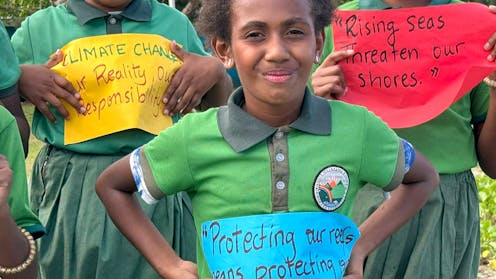
The court decision also provides a measure of climate justice for small island states, which have historically low emissions but face a much higher risk of damage from climate change than other nations.
Holding states accountable for inaction
Because climate change is global, it is difficult – but not impossible – to attribute damage from extreme weather to the actions of any one nation or group of nations.
On this question, the court said while climate change is caused by the cumulative impact of many human activities, it is scientifically possible to determine each nation’s total contribution to global emissions, taking into account both historical and current emissions.
If a nation experiences damage caused by the failure of another nation, or group of nations, to fulfil international climate obligations, the ruling means legal proceedings may be launched against the nations causing the harm. It may result in compensation or other remedies.
For small, climate-vulnerable nations such as those in the Alliance of Small Island States, this opens more legal options in their efforts to encourage high-emitting nations to properly address climate change.
Importantly, the court made clear nations can be legally liable even if damage from climate change comes from many causes, including from the activities of private actors such as companies.
That means nations cannot seek an exemption because others have contributed to the problem. They must also act to regulate companies and other entities under their jurisdiction whose activities contribute to climate change.

Paris Agreement quitters aren’t safe
One line of argument put to the court by Australia and other states was that climate treaties represented the only obligations to tackle climate change under international law.
But the court found this was not the case. Rather, other international laws applied.
The United States pulled out of the Paris Agreement earlier this year. The court’s opinion means the US and other nations are still accountable for climate harms under other international laws by which all countries are bound.
Could this lead to greater climate action?
The International Court of Justice has produced a truly historic ruling.
It will set a new baseline in terms what countries need to do to address climate change and opens up new avenues of recourse against high-emitting states not doing enough on climate change.
Authors: Jacqueline Peel, Professor of Law and Director, Melbourne Climate Futures, The University of Melbourne


















