

From futuristic design icon to environmental villain – the 80-year history of the plastic chair
- Written by: Geoff Isaac, Research Fellow, Design, Architecture and Building, University of Technology Sydney
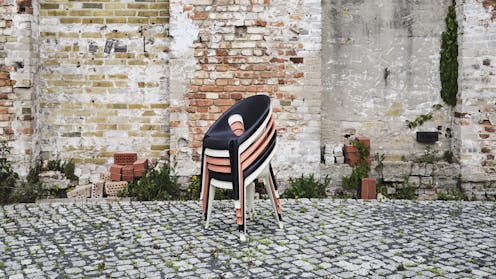
What springs to mind when you’re asked to think of plastic chairs? Do you picture the ubiquitous lightweight, stackable polypropylene chair sold cheaply in hardware stores worldwide?
Or perhaps you picture something more glamorous, such as Shiro Kuramata’s Miss Blanche (1988). This limited-edition artwork, featuring imitation roses suspended in acrylic resin, now sells for more than US$500,000 at auction.
I research industrial design, exploring the symbiotic relationship between technology, commercial design and sustainability. The 80-year history of the plastic chair was the focus of my PhD.
This humble, ubiquitous object offers unique insights into society’s shifting attitudes to plastic, and the changes to come.
An 80-year history
The story of the plastic chair began in the United States in the 1930s, when petrochemical manufacturers DuPont and Röhm & Haas started mass-producing acrylic glass.
The material, available in rods and sheets, enabled industrial designers to produce a wide range of consumer products using traditional manufacturing techniques.
Widespread shortages of traditional materials during World War II drove further development of plastics.
After the war, designers and manufacturers quickly embraced plastics. They were seen as the foundation of a new, plentiful future, allowing the masses to access products previously reserved for the elite. Many household items such as televisions, toys and upholstery became cheaper, thanks to plastics.
Fibreglass manufacturing advanced during WWII to support the US Navy. This involves weaving strands of glass into a loose mat, which is then placed into a mould. Polyester resin is poured in to bind the fibres together before it hardens into a solid shape. Fibreglass is strong, lightweight, corrosion-resistant and can be moulded into complex shapes.
The first fibreglass chair designs were Charles and Ray Eames’ Plastic Armchair and Eero Saarinen’s Tulip Chair. Then the Space Age (1957–69) inspired enthusiastic experiments with technicolor-saturated glossy surfaces and futuristic curved shapes, all made possible by fibreglass.
Designers could handcraft prototypes, perfecting comfort and form. Many designs from this era are still in production and often feature in science fiction films.
Plastic furniture features many in sci-fi movies (Scandinavian Design 101)A shift in public sentiment
Looking back at Earth from space was a turning point for humanity. The famous Earthrise photo captured the precarious nature of our existence and dependence on finite resources, such as fossil fuels. Oil was used to make most plastic at that time.
In the 1970s, the price of oil shot up tenfold when Arab nations banned petroleum exports and cut oil production during the Arab–Iraeli War. The Iraq–Iran war followed. In 1981, oil reached US$31 per barrel. Suddenly, plastics were expensive.
Early plastics also had drawbacks. Colours faded and surfaces scratched, eroding consumer confidence. Disillusioned consumers began to favour traditional materials such as metal and timber. Few noteworthy plastic chair designs appeared during the next two decades.
In response, the plastics industry changed tactics. If consumers favoured wooden furniture, then woodchips and veneer – held together by polymer adhesives and varnished with polyurethane – offered a cost-effective solution. Plastics were simply camouflaged within an ever-increasing range of products.
As the environmental impacts of plastics became evident, the industry recognised it had an image problem and launched a major public relations effort around recycling. It worked. By the end of the century, plastics were fashionable again.
Recycling eases guilt
From the late 1990s, leading designers enthusiastically embraced injection moulding. This was much cheaper and faster than labour-intensive fibreglass.
Philippe Starck’s LaMarie for Kartell launched a new trend for translucent chairs. Karim Rashid launched the affordable Oh Chair and Jasper Morrison introduced air injection moulding to the industry with the Air Chair.
The revival was brief. The limitations of mechanical recycling gradually became more widely understood. Of the 8.3 billion tonnes of plastic produced by 2020, just 9% had been recycled, or more accurately “downcycled” such as by turning PET bottles into polyester for clothing.
Ocean pollution became a focus when it was shown that by 2050, there will be more plastic than fish in our seas. Alarm further intensified over the impact of chemical additives used in plastics and their effects on human health and the ability to reproduce.
In response, designers and manufactures are now exploring plastics made at least partly from recycled plastics or renewable organic resources such as plants, algae or even carbon dioxide (bioplastics).
My study of 60 such chairs identified the Bell Chair as the best of the bunch. Made from just 2.8kg of plastic waste, the design minimises the amount of energy required to make and transport the chair.
These chairs come off the automated production line stacked 12-high for efficient transport. The manufacturer Magis also claims Bell Chairs can be recycled at end-of-life. But the lack of a resin identification code mark, and the inclusion of fibreglass, make it unlikely the product will actually be recycled.
I thought my study would identify chairs made from bioplastics as delivering superior environmental outcomes. However, designers working with these materials were forced to compensate for inferior material strength by bulking up their designs, or mixing bio-based material with traditional plastics.
Bulky designs demand higher energy consumption during manufacture and transport, while hybridised materials are problematic as they cannot be recycled and are not biodegradable.

The chair of the future
Bans on single-use plastics, and measures to reduce plastic packaging and increase recycled content in packaging and products, are beginning to take effect. Manufacturers are also experimenting with renewable plastics in consumer goods.
But to achieve global emissions-reduction targets, the transition from virgin fossil-based plastics to renewable plastics must accelerate. Government intervention will be crucial where voluntary industry agreements are failing, both at home and abroad.
It’s likely the plastic chair of the future will be made entirely from renewable organic resources. Creating a more circular plastics economy is not only possible, it’s imperative.
Read more: Curious Kids: why can some plastics be recycled but others can't?
Authors: Geoff Isaac, Research Fellow, Design, Architecture and Building, University of Technology Sydney


















