

how earthquakes and tsunamis shook ancient Greece and Rome
- Written by: Konstantine Panegyres, Lecturer in Classics and Ancient History, The University of Western Australia
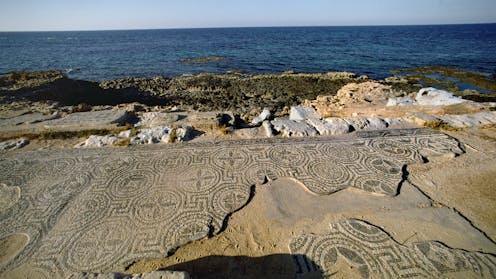
The Greek poet Crinagoras of Mytilene (1st century BC–1st century AD) once addressed a little poem to an earthquake. He asked the quake not to destroy his house:
Earthquake, most dread of all shocks … spare my new-built house, for I do not know of any terror equal to the quivering of the earth.
Like us, ancient people had many things to say about natural disasters. So, what information did they leave behind for us, and what can we learn from them?
The story of Nicomedia
One of the most vivid ancient accounts of an earthquake is found in the writings of the Roman historian Ammianus Marcellinus (c. 330–395 AD).
On August 24 358 AD, there was a huge earthquake at Nicomedia, a city in Asia Minor.
As Ammianus recounts:
A terrific earthquake completely overturned the city and its suburbs … since most of the houses were carried down the slopes of the hill, they fell one upon another, while everything resounded with the vast roar of their destruction.
The human effect was devastating.

Most people were “killed at one blow”, says Ammianus. Others, he tells us, were “imprisoned unhurt within slanting house roofs, to be consumed by the agony of starvation”.
Hidden in the rubble “with fractured skulls or amputated arms or legs”, injured survivors “hovered between life and death”, but most could not be recovered, “despite their pleas and protestations” resounding from beneath the rubble, according to Ammianus.
Famous natural disasters in the ancient world
A number of natural disasters involving earthquakes and tsunamis were especially famous in ancient Greek and Roman times.
In 464 BC, in Sparta, there was a huge earthquake. People at the time said it was greater than any earthquake that had ever occurred beforehand.
According to the Greek writer Plutarch (c. 46–119 AD), the earthquake “tore the land of the Lacedaemonians into many chasms”, collapsed the peaks of the surrounding mountains, and “demolished the entire city with the exception of five houses”.
In 373–372 BC, the Greek coastal cities of Helice and Buris were destroyed by tsunamis. They were permanently submerged beneath the waves.
An anonymous Greek poet evocatively wrote that the walls of these cities, which had once been thriving with many people, were now silent under the waves, “clad with thick sea-moss”.
But arguably the most famous ancient tsunami occurred on July 21 365 AD on the northern coast of Africa, at that time controlled by the Romans.
Again according to Ammianus, early in the morning there was a huge earthquake. Then, not long after, the water retreated from the shore:
the sea with its rolling waves was driven back and withdrew from the land, so that in the abyss of the deep thus revealed people saw many kinds of sea-creatures stuck fast in the slime … and vast mountains and deep valleys, which nature had hidden in the unplumbed depths.
Then, suddenly, the sea returned with a vengeance. As Ammianus tells us, it smashed over the land destroying everything in its path:
The great mass of waters killed many thousands of people by drowning … the lifeless bodies of shipwrecked persons lay floating on their backs or on their faces … great ships, driven by the mad blasts, landed on the tops of buildings, and some were driven almost two miles inland.
Earthquakes were famous for their sound. The Roman scholar Pliny the Elder (23–79 AD) explained that earthquakes have a “terrible sound” – like “the bellowing of cattle or the shouts of human beings or the clash of weapons struck together”.
Ancient ideas about what causes earthquakes and tsunamis
Like today, ancient people wanted to know what caused these phenomena. There were various different theories.
Some people thought Poseidon, god of the sea, earthquakes and horses, was responsible.
As the Greek writer Plutarch (c. 46–119 AD) comments, “men sacrifice to Poseidon when they wish to put a stop to earthquakes”.

However, other people looked beyond divine explanations.
One interesting theory held by the philosopher Anaximenes (6th century BC) was that the earth itself was the cause of earthquakes.
According to Anaximenes, huge parts of the earth beneath the ground can move, collapse, detach or tear away, thus causing shaking.
“Huge waves”, said Anaximenes, are “produced by the weight [of falling earth] crashing down into the [waters] from above”.
Ancient people knew nothing of tectonic plates and continental drift. These were discovered much later, mainly through the pioneering work of Alfred Wegener (1880–1930).
Preparing for natural disasters
Ancient Greeks and Romans had little way of predicting or preparing for earthquakes and tsunamis.
Pherecydes of Samos (6th century BC) was said to have predicted an earthquake “from the appearance of some water drawn from a well”, according to the Roman statesman Cicero (106–43 BC).
For the most part, though, ancient people had to live at the mercy of these occurrences.
As the anonymous author of a treatise titled On the Cosmos once wrote, natural disasters are part of life on earth:
Violent earthquakes before now have torn up many parts of the earth; monstrous storms of rain have burst out and overwhelmed it; incursions and withdrawals of the waves have often made seas of dry land and dry land of seas…
While our understanding of these events (and our ability to prepare for them, and recover afterward) has improved immeasurably since ancient times, earthquakes and tsunamis are things we will always have to deal with.
Authors: Konstantine Panegyres, Lecturer in Classics and Ancient History, The University of Western Australia


















