

Marine climate interventions can have unintended consequences – we need to manage the risks
- Written by: Emily M. Ogier, Associate Professor in Marine Social Science, University of Tasmania
The world’s oceans are being rapidly transformed as climate change intensifies. Corals are bleaching, sea levels are rising, and seawater is becoming more acidic – making life difficult for shellfish and reef-building corals. All this and more is unfolding on our watch, with profound consequences for marine ecosystems and the people who depend on them.
In response, scientists, governments and industries are trying to intervene. People all over the world are experimenting with new ways to capture and store more carbon dioxide, or make up for damage already done.
Ocean-based climate actions include breeding more heat-tolerant corals, restoring mangroves, and farming seaweed. Such interventions offer hope, but they’re also inherently risky. Some may be ineffective, inequitable or even harmful.
The pace of innovation is now outstripping the capacity to responsibly regulate, monitor and evaluate these interventions. This means current and future generations may not be getting value for money, or worse – the chance to avoid irreversible change may be slipping away.
In our new research, published in Science, we reviewed the latest evidence on known and perceived risks of new ocean-based climate interventions. We then gathered emerging ideas on how to reduce those risks.
We found the risks aren’t being widely considered, and the benefits are unclear. But there are emerging assessment tools and planning frameworks we can build on, to plan ocean-based climate actions that meet humanity’s climate goals.
The promise and peril of marine climate interventions
Marine climate interventions vary in scope and ambition. Examples can be found all over the world. These include:
Some interventions are still at proof-of-concept stage, and several have been tested and abandoned. Others are facing challenges owing to complexity of monitoring and verification.
Each has its own set of benefits, costs and risks. For example, making the ocean more alkaline may help to squeeze in more carbon from the atmosphere, but it’s difficult to verify how much carbon has been removed. This makes it hard to justify the costs and the potential damage to ecosystems, such as effects on local fish populations.
Restoring coral can support biodiversity in the short term, but it may not last as warming exceeds their (modified) ability to adapt. This type of intervention is also expensive and labour-intensive, with unintended emissions from energy-intensive processes. So it may be impossible to scale up.
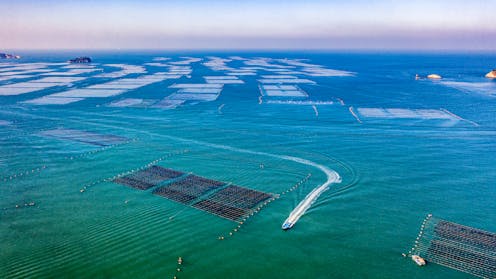
Seaweed farming at scale would occupy thousands if not millions of square kilometres of oceans, displacing fishing, shipping and conservation. Harvesting 1 billion tonnes of seaweed carbon would require farming more than 1 million square km of the Pacific Ocean, and would deliver just 10% of the annual atmospheric carbon dioxide removal required to limit global warming to 1.5°C.
It’s doubtful whether seaweed farming would actually remove carbon from the atmosphere. But seaweed farming can – if well-planned – produce a range of other climate-related benefits.
Moreover, interventions often overlap in space and time, creating cumulative impacts and unintended consequences. In some cases, the projects may displace other users, undermine Indigenous rights, or erode public trust in climate science and policy. Without careful understanding and planning, these efforts could exacerbate the very problems they aim to solve.

Governance gaps and ethical dilemmas
One of the most pressing challenges is the lack of regulation and oversight suited to the scale and complexity of marine climate interventions.
Existing regulations are often outdated, fragmented, or designed for land-based systems. Few countries have biosafety laws for the ocean. This means many interventions proceed without comprehensive risk assessments or community consultation.
Ethical dilemmas abound. Who decides what constitutes a “healthy” ocean? Who bears responsibility if an intervention causes harm? And how do we ensure benefits — such as improved livelihoods or climate resilience — are equitably distributed?
Currently, scientists, funding bodies and non-government organisations do the bulk of the decision-making. There is limited input from governments, local communities and Indigenous Peoples. This imbalance risks perpetuating historical injustices and undermining the legitimacy of many ocean-based climate actions.

Toward responsible marine transformation
We identified opportunities for scientists, policymakers, and funding bodies to work together more effectively on more comprehensive assessments of interventions.
Guidelines and insights are emerging from experimental-scale research into capturing and storing “blue” carbon in ocean and coastal ecosystems. Similarly, a non-profit organisation in the United States has developed a code of conduct for marine carbon dioxide removal. However these guidelines are yet to be integrated into broader governance frameworks.
Awareness of the urgent need to ensure intervention is done responsibly is also growing. Many high-level policy documents now recognise the importance of transitioning to more sustainable, equitable, and adaptive states. For example, the Samoa Climate Change Policy 2020 recognises the need to adapt coastal economies and communities to warming oceans, while also working to reduce carbon emissions.
We can use the ocean in our fight against climate change (United Nations)Proceed with caution
The ocean is central to our climate future. It absorbs heat, stores carbon, and sustains life. But it is also vulnerable — and increasingly, a site of experimentation. If we are to harness the promise of ocean-based climate action, we must do so with care, humility, and foresight.
Responsible governance is not a barrier to innovation — it is its foundation. By embedding ethical, inclusive, and evidence-based principles into our marine climate strategies, we can chart a course toward a more resilient and equitable ocean future.
Authors: Emily M. Ogier, Associate Professor in Marine Social Science, University of Tasmania


















