

Economists want a carbon price comeback – but does Australia have the political courage?
- Written by: Felicity Deane, Professor of Trade Law and Taxation, Queensland University of Technology
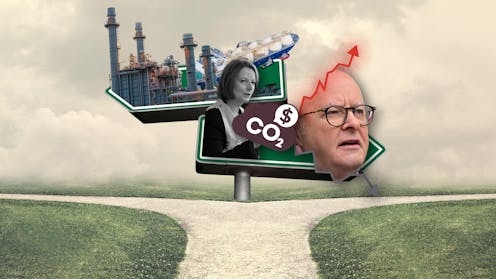
Bold economic ideas are flowing ahead of this month’s roundtable convened by the Albanese government, aimed at boosting Australia’s productivity and economy, and repairing the budget. Among the biggest ideas to emerge is: should Australia resurrect its carbon price?
Many respected economists say the answer is a firm yes. Among them are former Treasury secretary Ken Henry, policy expert Rod Sims, and Ross Garnaut, a leading economist and former Labor climate advisor.
Of course, Australia has had this discussion before. In 2012, after much political debate, the carbon price established by Julia Gillard’s minority Labor government began. Two years later, partisan politics had killed it off.
Carbon pricing is clearly the most economically efficient way to tackle climate change, in Australia and around the world. But getting the policy back on the national agenda will take great political courage.
Why are we talking about this now?
Carbon pricing is not new – the theory underpinning it dates back to the early 20th century.
As the theory goes, pollution caused by the production of goods and services imposes a cost on society. If polluting companies don’t cover that cost, society bears it instead.
A carbon price forces industry to emit less by, for example, investing in cleaner technologies or energy efficiency. If a business continues to emit greenhouse gases, it pays a financial penalty.
The policy can take several forms, such as an emissions trading scheme or direct carbon tax.
Under Labor, Australia’s central climate policy is the “safeguard mechanism”, which limits emissions from about 220 of Australia’s most polluting facilities.
One major problem with the policy, however, is that companies can buy carbon credits to reduce their overall emissions – on paper, at least. Carbon credits represent emissions reductions made elsewhere. But carbon credit schemes are plagued by claims they do not lead to real emissions reduction.
And the safeguard mechanism targets only large industrial facilities, when many other parts of the economy contribute substantial greenhouse gas emissions. But a carbon price, depending on its design, can encourage emissions cuts across the economy.
A submission to the government roundtable by the Superpower Institute – the brainchild of Garnaut and Sims – argues a carbon price would neatly address the main economic conundrums Australia is grappling with.
As Garnaut noted in a speech last week, Australia is on a trajectory to miss its renewable energy targets, largely due to insufficient investment. He pointed to the Capacity Investment Scheme, expansion of which the federal government announced last week. The scheme uses taxpayer dollars to underwrite new renewables projects.
Garnaut says the scheme was valuable, but poses a risk to the federal budget. He called on the government to redesign its emissions-reduction strategy around a carbon price, describing it as “the most economically efficient tax reform available to Australia at a time when we need budget repair”.
The comments follow those of former Treasury secretary Ken Henry, who has a coveted seat at the roundtable. Henry last month described the Gillard-era carbon price as “the world’s best carbon policy”, and asked “Why the hell did we ever drop it?”
Among Australia’s best economic minds, momentum for the policy has been building. Indeed, a 2023 survey by the Economic Society of Australia asked 50 leading economists about the best way to reach net-zero emissions. The most popular answer? A carbon price.
The evidence is in
The argument for carbon pricing is backed by academic research.
A study published last year examined 21 carbon pricing schemes and found at least 17 yielded immediate and substantial emission reductions, despite a low carbon price in most instances.
And a large study in 2020 analysed 142 countries over more than two decades. In countries with carbon prices, the average annual growth rate in emissions was about two percentage points lower than countries without one.
The extent of emissions reductions depends on the mechanism and price applied to emissions. Had the Gillard government’s carbon price remained in place, for example, analysis suggests Australia would have saved 72 million tonnes of emissions between 2012 and 2020.
But would a carbon price fix the budget deficit? It’s not a silver bullet. However, it could be part of a reform package that also includes a higher goods and services tax (GST) or a tax on superannuation.
Together, the changes would mean Australia was less dependent on income tax revenue – a tax system that can place a disproportionate burden on young people and future generations.
Carbon pricing can, if not well designed, unfairly impact lower income-earners, by increasing electricity and other costs. But with the right fiscal measures, people in need can be supported through the transition – as occurred under Gillard’s policy.
It’s time to act
Australia is a leading coal exporter – and one of the world’s highest per capita emitters. It will also feel some of the worst effects of climate change.
So we have very good reasons to adopt the best possible emissions reduction policy.
Of course, carbon pricing was a poisoned chalice for the Gillard government, and famously fell victim to partisan politics, as experts predicted.
Ultimately, Labor was defeated in 2013 by the Abbott-led Coalition, which had campaigned to repeal what it branded a “carbon tax”.
But now, Treasurer Jim Chalmers says nothing is ruled in or out of discussion at next month’s roundtable. With many of the nation’s most celebrated economists in the room, the idea of a carbon price is unlikely to be quickly dismissed.
Authors: Felicity Deane, Professor of Trade Law and Taxation, Queensland University of Technology


















