

Foot-and-mouth disease would devastate Australia’s graziers if it got in. Here’s how a new vaccine might help
- Written by: Timothy J. Mahony, Professor of Animal Health and Director, Centre for Animal Science, The University of Queensland
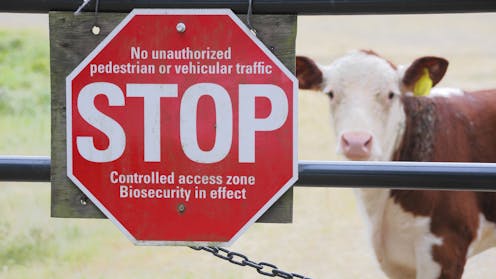
It sounds innocuous. But foot-and mouth disease is one of the world’s most economically devastating diseases affecting livestock.
When this highly contagious virus infects cattle, many develop painful blisters. Some die, but the real damage is longer term. Milk yields drop sharply for dairy cows and overall health takes a hit. While the disease can infect other cloven-hoofed animals such as sheep, cows are the worst hit.
The last outbreak in Australia was in 1872. But three years ago, foot and mouth arrived in Indonesia, triggering widespread alarm and new biosecurity measures. If the virus made it to Australia, it would put livestock exports at real risk. Graziers are also on edge about the government’s decision to open the door to beef imports from the United States.
When an outbreak is detected, authorities usually have to cull huge numbers of animals to prevent it spreading. But now another option is emerging – a new locally-produced mRNA vaccine able to be tailored to specific viral strains.
If the vaccine proves safe and effective, it could let authorities respond rapidly to any outbreak by vaccinating animals in a ring around any outbreak.

What’s so bad about foot-and-mouth?
The virus which causes foot-and-mouth disease is extremely contagious. Many other infectious animal diseases only spread between animals in close proximity. But this virus can spread through the air and survive on surfaces for a long time.
The widespread and persistent damage it does to animal health, milk output and fertility is enough to make it a real concern for big farming nations such as Australia.
Livestock exporters rely on Australia’s status as a nation free of major animal diseases. This status means animals and animal products can be freely exported to many nations.
If foot-and-mouth entered Australia, it would devastate the export trade. Many countries would stop buying Australian animals and animal products to stop the virus getting into their own disease-free herds.
In 2001, an outbreak of the virus in the United Kingdom was detected after it had already spread widely. To control it, authorities culled over six million animals. It cost the industry an estimated A$16 billion in damages.
These mass culls are done because the virus is so contagious. Authorities have to race against its spread.

How would this vaccine fit in?
It’s unlikely Australia’s 30 million cattle would be preemptively vaccinated against the virus.
This is for several reasons. While vaccines help animals fight the virus, preemptive vaccination could actually affect Australia’s disease free status, as vaccination can make it harder to detect an outbreak. Immunity tends to last less than a year. The virus has many different strains, which makes it harder to get full protection. Any vaccine has to match the dominant strains in a region.
If foot-and-mouth got into Australia, the main goal would be to eradicate it as quickly as possible. Otherwise, the virus could jump into feral herds of pigs, goats and deer, after which it would become very difficult to control.
If the virus was detected early and confined to a small area, authorities would most likely lock down animal movement in the area and slaughter the affected herds.
But if the virus was detected late and a wider outbreak was under way, authorities would have to launch a different response. This would involve creating blockages to the virus as quickly as possible. Vaccinating animals in the wider area would act to create a barrier to the virus spreading, alongside other measures such as restricting animal movement and culling.
Vaccines for foot-and-mouth aren’t new. Stockpiles already exist overseas, and Australia would be able to access these in the event of an outbreak.
There are two reasons this new mRNA vaccine is a significant development.
First, it’s being locally produced, making it easier for authorities to ramp up a response at the speed required.
Second, mRNA technology offers the ability to rapidly tweak vaccines to match new strains. This would likely boost how effective it is. mRNA vaccine production can be scaled up very quickly too.
While the technology seems promising, it’s not guaranteed. Livestock vaccines have to pass rigorous regulatory checks to ensure they’re safe for the animals and for human consumers.
 Authorities have to respond quickly to foot-and-mouth outbreaks. Pictured: an Indonesian animal health officer inspecting a cow’s mouth for blisters on the outskirts of Jakarta after the virus emerged in 2022.
Wulandari Wulandari/Shutterstock
Authorities have to respond quickly to foot-and-mouth outbreaks. Pictured: an Indonesian animal health officer inspecting a cow’s mouth for blisters on the outskirts of Jakarta after the virus emerged in 2022.
Wulandari Wulandari/Shutterstock
What’s next?
The news of this new vaccine for foot-and-mouth is welcome. But it’s not a silver bullet.
Australia has long relied on stringent biosecurity measures to protect its large agricultural export industries. To boost their effectiveness, authorities have also rolled out new technologies such as one of the world’s best livestock tracking systems. Each cow in Australia has a unique ID tag. The tag records where the animal has been over the course of its life.
If there’s an outbreak of an infectious disease such as foot-and-mouth, this tracking data will be invaluable. Authorities will be able to see where infected animals have been and which others may have been exposed.
Vaccines, culling and tracking might sound like overkill. But this simple virus cannot be underestimated.
Authors: Timothy J. Mahony, Professor of Animal Health and Director, Centre for Animal Science, The University of Queensland


















