

Soaring food prices prove the Gaza famine is real – and will affect generations to come
- Written by: Ilan Noy, Chair in the Economics of Disasters and Climate Change, Te Herenga Waka — Victoria University of Wellington
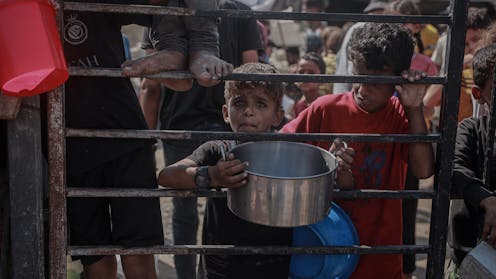
The words and pictures documenting the famine in the Gaza strip are horrifying.
The coverage has led to acrimonious and often misguided debates about whether there is famine, and who is to blame for it – most recently exemplified by the controversy surrounding a picture published by the New York Times of an emaciated child who is also suffering from a preexisting health condition.
While pictures and words may mislead, numbers usually don’t.
The Nobel prize-winning Indian economist Amartya Sen observed some decades ago that famines are always political and economic events, and that the most direct way to analyse them is to look at food quantities and prices.
This has led to decades of research on past famines. One observation is that dramatic increases in food prices always mean there is a famine, even though not every famine is accompanied by rising food costs.
The price increases we have seen in Gaza are unprecedented.
The economic historian Yannai Spitzer observed in the Israeli newspaper Haaretz that staple food prices during the Irish Potato Famine showed a three- to five-fold increase, while there was a ten-fold rise during the Great Bengal Famine of 1943. In the North Korean famine of the 1990s, the price of rice rose by a factor of 12. At least a million people died of hunger in each of these events.
Now, the New York Times has reported the price of flour in Gaza has increased by a factor of 30 and potatoes cost 50 times more.
Israel’s food blockade
As was the case for the UK government in Ireland in the 1840s and Bengal in the 1940s, Israel is responsible for this famine because it controls almost all the Gaza strip and its borders. But Israel has also created the conditions for the famine.
Following a deliberate policy in March of stopping food from coming in, it resumed deliveries of food in May through a very limited set of “stations” it established through a new US-backed organisation (the Gaza Humanitarian Foundation), in a system that seemed designed to fail.
Before Israel’s decision in March to stop food from coming in, the price of flour in Gaza was roughly back to its prewar levels (having previously peaked in 2024 in another round of border closures). Since March, food prices have gone up by an annualised inflation rate of more than 5,000%.
The excuse the Israeli government gives for its starvation policy is that Hamas controls the population by restricting food supplies. It blames Hamas for any shortage of food.
However, if you want to disarm an enemy of its ability to wield food supplies as a weapon by rationing them, the obvious way to do so is the opposite: you would increase the food supply dramatically and hence lower its price.
Restricting supplies and increasing their value is primarily immoral and criminal, but it is also counterproductive for Israel’s stated aims. Indeed, flooding Gaza with food would have achieved much more in weakening Hamas than the starvation policy the Israeli government has chosen.
The UN’s top humanitarian aid official has described Israel’s decision to halt humanitarian assistance to put pressure on Hamas as “cruel collective punishment” – something forbidden under international humanitarian law.
The long-term aftermath of famines
Cormac Ó Gráda, the Irish economic historian of famines, quotes a Kashmiri proverb which says “famine goes, but the stains remain”.
The current famine in Gaza will leave long-lasting pain for Gazans and an enduring moral stain on Israel – for many generations. Ó Gráda points out two main ways in which the consequences of famines endure. Most obvious is the persistent memory of it; second are the direct effects on the long-term wellbeing of exposed populations and their descendants.
The Irish and the Indians have not forgotten the famines that affected them. They still resent the British government for its actions. The memory of these famines still influences relations between Ireland, India and the UK, just as Ukraine’s famine of the early 1930s is still a background to the Ukraine-Russia war.
The generational impact is also significant. Several studies in China find children conceived during China’s Great Leap Forward famine of 1959–1960 (which also killed millions) are less healthy, face more mental health challenges and have lower cognitive abilities than those conceived either before or after the famine.
Other researchers found similar evidence from famines in Ireland and the Netherlands, supporting what is known as the “foetal origins” hypothesis, which proposes that the period of gestation has significant impacts on health in adulthood. Even more worryingly, recent research shows these harmful effects can be transmitted to later generations through epigenetic channels.
Each day without available and accessible food supplies means more serious ongoing effects for the people of Gaza and the Israeli civilian hostages still held by Hamas – as well as later generations. Failure to prevent the famine will persist in collective memory as a moral stain on the international community, but primarily on Israel. Only immediate flooding of the strip with food aid can help now.
Authors: Ilan Noy, Chair in the Economics of Disasters and Climate Change, Te Herenga Waka — Victoria University of Wellington


















