

These students cut air pollution near their schools – by taking aim at their parents’ idling cars
- Written by: Aria Yangfan Huang, PhD Candidate, School of Psychology, Deakin University
At the start and end of every school day, many Australian children head to the carpark or street to get picked up. While they’re waiting, they will be breathing in a mix of toxic gases and particle pollution.
Why? Because many parents leave their car engines idling while parked. The practice leads to noticeable spikes in pollutants which can trigger asthma attacks and harm student health.
Idling is a surprisingly high cause of carbon emissions, too. Previous research suggests Australian drivers leave their cars idling up to 20% of their total travel time, producing as much as 8% of a trip’s emissions.
Our new research shows how primary school students from two Melbourne schools made a real difference using a simple, child-led solution: talking about the problem with their parents. Student-led conversations successfully helped cut idling by up to 40% during afternoon pick-up and 18% in the mornings.
At a time when many young people feel hopeless about climate change, programs like ours can help build a sense of agency and purpose.

A solution led by students
Around schools, idling cars create pollution hotspots exposing children to harmful pollutants such as nitrogen dioxide and fine particulate matter.
Children are particularly vulnerable. They breathe in and out more often, have a greater lung surface area relative to their body size and are shorter than adults, placing them closer to vehicle exhaust emissions. Even brief exposure can increase the risk of asthma, respiratory infections and inflammation. Idling cars poses a significant and preventable health risk to children.
To tackle the problem, we created the Idle Off program. We ran three hands-on sessions for 40 students in Melbourne’s inner western suburbs, where we presented information about air pollution from vehicle exhausts and what these fumes could do to human health and the climate.
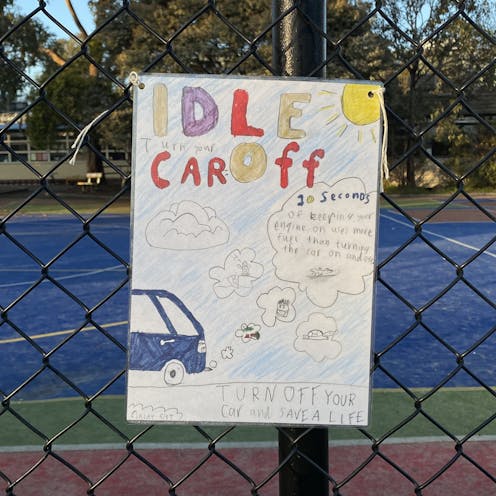
While raising awareness of issues is important, we wanted to give students the tools to make a visible change. To that end, our sessions focused on how to advocate for change. Students designed posters and wrote speeches on the topic. Some stuck posters up around car parks. Others used their prepared notes to talk to their parents about why idling was a problem worth tackling and still others spoke at the school assembly.
It worked. A week after the program, we observed a drop in idling of 18% during morning drop-off and 40% during afternoon pick-up. The differing figures make sense, because parents are often in a rush to get to work in the mornings and are less likely to turn off their cars for a quick goodbye.

Why involve children?
Transport is one of the hardest sectors to decarbonise.
But car idling is one of the easiest behaviours to change. Internationally, anti-idling campaigns have led to improved air quality. In Australia, the problem of idling has largely been overlooked.
Many young Australians experience growing climate anxiety. They know the crisis is real but often feel powerless to do anything about it.
Our research found when children are given knowledge and practical tools, their anxiety can shift into confidence and a sense of control. After the program, the number of students believing children are able to advocate for change rose from 68% to 97%. Students felt proud to be part of something that made a real difference. As one student told us:
the part that made me feel like I had made a difference was when we did [a] speech [at] assembly […] I feel like that kind of taught people what we had learned […] and then lots more people understood and told their friends and family.
The parents of our student participants also noted a growing sense of responsibility – not only in their children, but in themselves. As one parent told us:
they remind me of what I can do as an individual […] If everyone does a little bit, things can improve massively.
These reflections suggest hearing messages directly from children may make environmental messages more relatable and perhaps harder to ignore. Previous research supports this idea.
The program shows children are not only capable of understanding complex issues, but able to influence adults, shape conversations and drive actual behaviour change.
 Anti-idling campaigns have gained traction in nations such as the United Kingdom. But Australia hasn’t yet followed suit.
Mike Kemp/Getty
Anti-idling campaigns have gained traction in nations such as the United Kingdom. But Australia hasn’t yet followed suit.
Mike Kemp/Getty
Small programs, big impact
Simple, concrete programs for schoolchildren could be used to tackle other environmental issues – especially those visible locally, such as plastic waste, recycling and energy saving.
Students, teachers and parents rated Idle Off as “highly acceptable and feasible”. Programs focused on solving problems such as this one are affordable, easy to adapt and require only basic materials and brief training for educators.
We monitored idling behaviour for two weeks. While this follow-up was short, there’s strong potential for lasting change if Idle Off or similar programs are taken up widely by schools.
Tackling car idling is one of the simplest actions we can take to cut emissions and reduce how many pollutants schoolchildren inhale.
Meaningful climate action doesn’t always require big budgets or long timelines. It can start with a hand-drawn poster on the school fence and a child who feels able to use their voice to ask adults to turn their cars off.
Authors: Aria Yangfan Huang, PhD Candidate, School of Psychology, Deakin University


















