

Google AI


Modern Australian

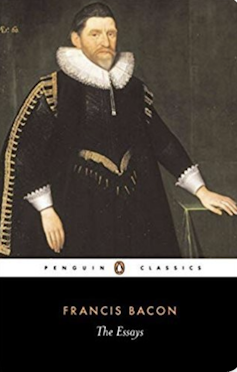
Francis Bacon’s Essays explore the darker side of human nature. 400 years on, they still instruct and unnerve

  • Written by: Matthew Sharpe, Associate Professor in Philosophy, Australian Catholic University
Francis Bacon’s Essays explore the darker side of human nature. 400 years on, they still instruct and unnerve

In our guides to the classics, experts explain key literary works.

It’s 400 years since the publication of the complete edition of British philosopher Francis Bacon’s Essays. Not without pride, Bacon (1561-1626) muses in the preface that his little book’s Latin version might “last, as long as books last.” The Essays have, in fact, never been out of print since 1625.

His compatriate, poet laureate Ben Johnson, claimed Bacon’s writing represented “the mark and acme of our language.” Bacon’s Essays are indeed written with an ornamental grace. They brim with images and analogies more often associated with poetry than prose.

Almost every line reads like a quotable proverb. “Virtue is like a rich stone, best plain set”. “Suspicions amongst thoughts are like bats amongst birds, that ever fly by twilight”. “There is no excellent beauty that has not some strangeness in the proportion”.

A renaissance man, Bacon was the son of Queen Elizabeth’s Lord Chancellor. From early on, he was drawn into a political life at the court. He eventually rose to the Lord Chancellorship himself under King James, before falling from grace in disputed circumstances in 1621.

Yet Bacon was always ambivalent about his public calling. His letters attest that he felt himself better suited for the “contemplative” life of the mind.

He is best known today for his vital role in making the case for a new “advancement of learning” in early modern Europe. His 1620 work, Novum Organum, modelled a “new method” for studying nature, with rules for making structured observations, then tabulating and interpreting findings, which would inspire the later experimental sciences.

The Essays, in contrast, address social, moral and political subjects. They first appeared in 1597, (as a collection of just ten), expanding to an edition of 38 essays in 1612. Then, in 1625, the final edition of 58 essays was published. Bacon died the following year. Ever interested in the natural world, he caught a fatal chill while conducting experiments on the refrigeration of chickens in the snow.

What are the essays about?

Bacon’s Essays share their title with Michel de Montaigne’s earlier, much-loved book. Yet, they differ greatly from those of his French predecessor. Montaigne is warm, free-ranging and often playful. Readers feel like he is their friend. Bacon remains aloof, even grave, with only occasional flashes of wit.

Read more: Guide to the classics: Michel de Montaigne's Essays

What makes Bacon’s Essays so continually incisive is that, alongside Machiavelli (whom he admired), Bacon is among the first and most discerning authors to unsentimentally explore the darker sides of human nature.

His first essay, Of Truth, opens with a famous shot at the biblical Pontius Pilate, the Roman governor who gave the order for Jesus’s execution: “‘What is truth?’, said jesting Pilate, and would not stay for an answer …” Some authors, Bacon complains, “delight in giddiness, and count it a bondage to fix a belief”. They look more to fascinate and entertain, than to educate and inform. Bacon is no such “discoursing wit”. His Essays mean to get straight to the point.

Indeed, he seems at times to want to pack more into single paragraphs (consider Of Adversity or Of Studies) than many writers contain in entire books. In Bacon’s own terms, almost every line is intended to “come home to men’s business and bosoms” – that is, the serious concerns of readers’ professional and private lives. The density of the Essays make his deepest intentions difficult to pin down. There is also the variety of the subjects he examines. We go from “the greatness of kingdoms and estates,” via analyses of passions like anger and envy, to domestic concerns like marriage and raising children, with no clear continuity between the individual pieces. Yet, as his essay Of Counsel makes clear, the book aims to guide people on how to live, in their professional or public (“civil”) and wider (“moral”) lives. When it comes to the “civil knowledge” Bacon proffers in essays like Of Negotiating (a renaissance take on the art of the deal), his concerns are primarily those of the courts, aristocrats and monarchs of his day. Several of these essays, on the pageantry and manners of the elites, are now (understandably) dated. But others can be read as discerning studies in what we call “leadership theory”. They address the psychological and ethical challenges people in leadership face, if they are not to misuse their power – or be misused by others. These essays contain canny observations about the difficult personalities we encounter in most organisations: their strengths and weaknesses, roles they are best (and least) suited for and the ways in which they can undermine group performance. As for Bacon’s morals, despite recurrent accusations that he was a heartless careerist, he writes as acerbically against “wisdom for a man’s self” or what we’d call “egoism” or even “sociopathy” today: Wisdom for a man’s self is, in many branches thereof, a depraved thing. It is the wisdom of rats, that will be sure to leave a house, somewhat before it fall. It is the wisdom of the fox, that thrusts out the badger, who digged and made room for him. It is the wisdom of crocodiles, that shed tears when they would devour. Bacon’s ethical thinking is heavily indebted to classical authors, notably Aristotle and the Stoics. At the same time, he claims the highest virtue is Christian charity or philanthropy, in ways the ancient philosophers did not fathom. Confronting the darker sides The problem is that good intentions may not get far in public life, Bacon counsels, if a person is not awake to the ways in which such intentions can be misled and abused. For Bacon, we have to understand the wiles of the “tyrannical and unjust”, if we are not to fall prey to them, over and over: For it is not possible to join serpentine wisdom with the columbine innocency, except men know exactly all the conditions of the serpent; his baseness and going upon his belly, his volubility and lubricity, his envy and sting, and the rest; that is, all forms and natures of evil. This is why Bacon’s Essays include examinations of different kinds of deceit and concealment, itemising in fine detail the ruses “movers and shakers” use to promote themselves, often at the expense of the wider good. “Cunning men”, Bacon says nicely, “are like haberdashers of small wares”. If people with more generous intentions do not know how to recognise these “wares”, such men can cause great harm to businesses, workplaces, even entire nations. Bacon warns us, “nothing doth more hurt in a state, than that cunning men pass for wise.” To be forewarned, by contrast, is to be nobody’s fool. A book to be tasted, chewed and digested “Some books are to be tasted, others to be swallowed, and some few to be chewed and digested,” Bacon writes famously in Of Studies. He seems to have intended his Essays, by the time of their final 1625 edition, to be all three. There are essays of great lyrical beauty like Of Adversity or, indeed Of Beauty. These can almost be savored for their poetry alone. However, there are other essays which Bacon clearly wants us to read closely, chewing over and applying the observations and advice they give us for our professional or public careers. Alongside Of Cunning, Baconian essays almost worthy of a criminologist or forensic psychologist include Of Boldness, Of Ambition, Of Envy, Of Revenge, and Of Vainglory. Bacon also includes insightful political essays like On Seditions and Troubles. This longer piece identifies the signs and steps whereby states collapse, when they fail to defend their basic norms and institutions against seditious adventurers and factions. Signs of trouble include: Libels and licentious discourses against the state, when they are frequent and open; and in like sort, false news often running up and down … With false news rampant today in ways Bacon could scarcely have imagined, the reader of 2025 can be struck by the insight and foresight of his “civil and moral counsels”. Four hundred years later, the philosophical Lord Chancellor’s Essays still instruct and unnerve.

Authors: Matthew Sharpe, Associate Professor in Philosophy, Australian Catholic University

Read more https://theconversation.com/francis-bacons-essays-explore-the-darker-side-of-human-nature-400-years-on-they-still-instruct-and-unnerve-259051

What to Do When an Older Car Is No Longer Worth Keeping in Melbourne

Ever looked at another repair quote and wondered whether your old car is still worth the trouble? It is a common turning point for Melbourne motoris...

Your Baby's First Year: A Local Guide to Feeding, Sleep, and When to Get Extra Support

Ask ten parents in a Brisbane mothers' group how their baby is feeding or sleeping, and expect ten different answers.  Someone's baby sleeps throug...

Kitchen and Laundry Makeover Ideas That Don't Require a Full Renovation

Full kitchen renos are expensive — and most people don't actually need one.  They need the kitchen to stop looking like it's stuck in 2009, or they...

How Technology Is Reshaping the Modern Australian Commercial Kitchen

The commercial kitchen has always been shaped by technology. Refrigeration changed how ingredients could be stored, modern ventilation transformed k...

The Number on a Roller Blind Fabric That Nobody Explains

Somewhere in the fabric book, next to the colour name, there is a percentage. Three per cent. Five per cent. Ten per cent. Nobody explains it, most c...

What’s Trending in Men’s Jewellery This Father’s Day!

Finding a Father’s Day gift that feels personal, stylish and genuinely wearable is not always easy. While socks and novelty mugs have traditionally ...

Road Signs: Understanding Their Role in Clear and Effective Signage

Effective signage and display hardware can help businesses communicate information, promote products and organise customer or visitor movement. Road...

Bottle Label Printing: Key Factors to Consider Before Your Next Packaging Run

Effective packaging begins with understanding the product, bottle material, artwork and production requirements when planning bottle label printing. H...

Planning a Long-Distance Move With Interstate Movers Melbourne

Moving between states involves more planning than a typical local relocation. Along with packing and transporting household belongings, you need to...

Understanding the Role of an I/O Controller in Industrial Automation

Modern industrial systems depend on accurate communication between sensors, machines and control systems. An I/O controller can help manage this commu...

How the Right Mining Hose Supports Demanding Operations

Mining environments place considerable demands on equipment used for material transfer, water management and processing. Hoses operating in these co...

Simple Ideas for Making Social Gatherings More Memorable

We have all been to those parties where everyone just stands around the kitchen island, staring at their phones, waiting for someone else to make a mo...

Outdoor Wall Lights: Improving Exterior Lighting Around Your Home

Lighting can influence how a room looks, feels and functions, so the right fitting should be selected according to both appearance and practical req...

Commercial Office Cleaning: Combining Routine Office Cleaning With Melbourne Service

Keeping a workplace clean requires a service that can accommodate everyday tasks as well as the particular needs of the business. Professional comme...

Caravan Sales in Queensland: How to Find the Right Caravan for Sale QLD

Caravan ownership is about more than having somewhere to sleep while travelling. For many Queenslanders, it is one of the best ways to explore regio...

What Sir Walter Buffalo Turf Actually Costs in 2026 (And Why Quotes Vary So Much)

Two quotes landed on a Hills District homeowner's kitchen table last spring for the exact same 80-square-metre backyard. One said $12 a metre. The o...

Nearly 1,300 NSW Hospital Beds Are Occupied By People Who Are Ready To Go Home

1,276 people in NSW hospitals have been medically cleared for discharge but remain in hospital because they're still waiting for NDIS or aged care sup...

National Survey Launched to Measure Operational Impacts of Federal NDIS Policy Reforms

The effects of recent NDIS reforms are beginning to move beyond policy papers and into day to day service delivery. A new national survey is asking ...
















