

Tiny homes could help ease the housing crisis, but councils are dragging their feet
- Written by: Heather Shearer, Lecturer in GIS and Planning, Griffith University
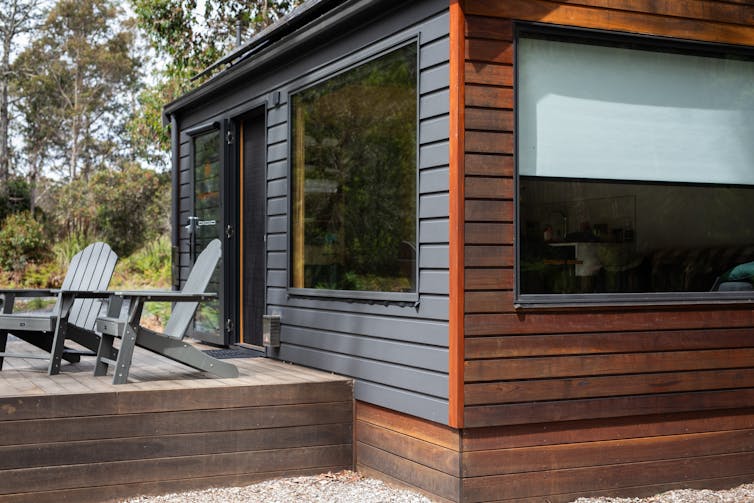
Australia’s housing affordability crisis shows no sign of easing. An average home price now exceeds A$1 million and a recent report found only a handful of rental properties nationwide are affordable for someone on government benefits. Vulnerable people are hit hardest – for example, there has been a 14% increase in women and girls seeking homelessness services.
Yet some councils want to evict people from their own homes. A couple in the Bega Valley, NSW, faces fines of $10,000 per day unless they remove or demolish their tiny house.
On the Sunshine Coast in Queensland, four tiny house owners are fighting council eviction. In Victoria’s Yarra Valley, a couple was told to demolish or rebuild to comply with the Building Code of Australia (BCA).
We’ve researched the planning and social aspects of the tiny house movement in Australia for over a decade. We’ve looked at changing attitudes to tiny houses and living more modestly, and the barriers people face when they choose this path.
Regulations are the biggest obstacle
While interest in tiny houses has soared, actual numbers of tiny house dwellers has stayed low. Are people put off by living in a space half the size of a city unit? Or is it too difficult to secure finance for a depreciating asset?
We found the biggest barrier remains council regulations. Most councils do not explicitly prohibit tiny house living, but don’t know how to classify them. Rules vary markedly between local governments.
Preliminary results of our study investigating attitudes of council planners around Australia found views on tiny and alternative housing differed.
We surveyed all councils with an urban centre of at least 10,000 people, and received 147 valid responses (approximately 50% response rate). Most councils would approve a small, alternative dwelling such as a kit house, converted shipping container or shed house. But what about a tiny house on wheels?
Existing planning schemes don’t cover tiny homes on wheels. Instead, they are managed under local laws, and treated as caravans or even camping. Many councils ban permanent living in a caravan outside a residential caravan park. You can park one on your land, but cannot live in it full-time.
Many planners felt their policies were outdated – written before today’s housing crisis. Nonetheless, they tried to work within existing policies. They weren’t opposed to tiny houses per se, provided they were located away from flood or bushfire risk areas, managed waste properly and didn’t harm the amenities of their neighbours.
Nearly all would consider approving tiny homes if they could be certified under the National Construction Code. This requires a building to meet internal safety, durability and environmental standards. But a tiny home is not considered a permanent dwelling and instead, must comply with vehicle safety and appliance standards.
Pilot programs
Since 2023, some councils have adopted more flexible approaches. In Victoria, the Surf Coast Shire is running a tiny house pilot. Mount Alexander shire in Castlemaine allows people to live permanently in a tiny house provided there is an existing house on the land.
On the Fraser Coast in Queensland, people can live on a caravan for up to six months a year, if waste is managed and the council is notified.
Western Australia’s Shire of Esperance was the first council to include tiny homes in planning policy. But the state government later reversed this, reclassifying them as caravans.
The Tasmanian government released a tiny homes fact sheet, with some councils allowing them as permanent dwellings. But confusion remains; one tiny house advocate applying for council approval was told they “cannot use the bathroom in the tiny house”.
Ironically, classifying tiny homes as caravans has led to some tiny house builders marketing their products for short-term rentals. Planning schemes have policies on this, so these are simpler to regulate, but not helpful in a housing crisis.
Despite the perception that councils are to blame, they are not the root cause. The deeper problem is not council regulations but a lack of clear policy from state and federal government.
A more diverse housing mix
Tiny homes are not for everyone and are not a silver bullet for the housing crisis. Some suggest they are more suited to residential parks, but we feel they can be part of a more diverse housing mix.
Tiny houses can normalise smaller, more sustainable living, and help older people age in place while letting underutilised houses to a larger household. Tiny houses could also give young adults an affordable start.
Navigating the current regulatory landscape is difficult. Groups such as the Australian Tiny House Association offer guidance but real change needs support across all levels of government.
The debate about tiny homes is tied to broader questions: are we over-regulated, does regulation stifle innovation and productivity, and can we relax some rules without compromising safety?
These are not easy questions. But one thing is clear, current policies and laws are blocking tiny houses from contributing to our housing mix. That’s a missed opportunity.
Authors: Heather Shearer, Lecturer in GIS and Planning, Griffith University


















