

‘Bookshelf wealth’ is a TikTok trend, Dua Lipa’s reading Helen Garner. But books have signified taste for centuries
- Written by: David Carter, Professor Emeritus, Australian Literature, The University of Queensland
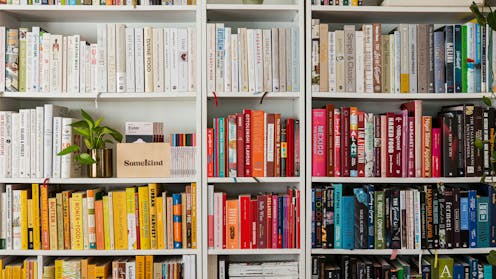
Books and bookshelves as interior decoration are a new trend, according to recent reports. An expert at Etsy, where some sell books by the metre in order to fill shelves, reports a 19,616% increase in searches for “book-lover decor” over the past three months, compared with the same time last year. Another “more bespoke service” offers a metre of assorted vintage books, all with orange covers, for £98.
“Bookshelf wealth” is an interior design trend on TikTok, too. According to the Guardian, “A bookshelf that looks like an heirloom family collection, complete with art and ornaments, suggests you care about literature and art – and have time and money to spend on these things.” Even if you don’t read much, you can gesture through your bookshelves to aspirations to culture and good taste.
Like all bright and not-so-bright new ideas, of course, the use of books and bookshelves as interior decoration has a much older history than its recent online incarnation suggests. Bookshelves as interior decoration – along with book-of-the-month clubs and discussion of books in popular media – were 19th and 20th-century trends too, though with important differences.
Unlike books bought by the metre, those trends could cultivate a genuine interest in reading – as do some 2025 trends, like the celebrity book club. Helen Garner’s This House of Grief was recently chosen by musician Dua Lipa for hers.

Democratising reading
The imposing library in the gentleman’s stately house in the 19th century is a familiar image. It was a key element in marking one’s arrival in the privileged professional or landed classes.
At the end of the 19th century, though, book publishing (and book talk) filtered down to middle-class and working-class readers who began to self-educate or to broaden their reading through accessing new books. These changes were brought about by wider education and employment, but also an increase in publishing activity, especially for new novels. (The later invention of the mass-market paperback, in the 1930s, would be another landmark.) Readers hunted down the classics, followed reading lists set up by reformist associations, or joined newly opened libraries, which also expanded across this period.
A new fashion emerged, from the 1920s, for knowing the best, most absorbing or enjoyable of the many new books appearing: modern novels above all. This fashion for the new often existed alongside a desire to know the classics and their authors – and to display them all in the home.
Book clubs formed, book programs on the new medium of radio were introduced, and new essays and advertisements about owning and displaying books appeared. Features in newspapers and magazines highlighting the “Book of the Week” or “Book of the Month” became common by the late 1920s. So did essays and advertisements addressed primarily to women readers. Most images, though, showed a man sitting in an armchair surrounded by his homely books.
A new language emerged too, describing the emerging book worlds as “middlebrow”, in contrast to the “lowbrow” (those merely following popular or mass tastes) and the highbrow (those whose tastes were only high, refined and, perhaps, pretentious). All three terms could be terms of abuse: usually in feminised forms.
Harvard Classics
The volume of new books could provoke anxieties for both established critics and the new readers about “drowning in a sea of new novels”, alongside new enthusiasms for trying to keep up with the latest. Guidance in reading – what to read and how to read – became a new industry. So did guidance on buying and collecting books, and owning them. And, no less important, to displaying them by building a library in your own home.
In the United States, in 1909–10, Charles W. Eliot, president of Harvard University, edited the Harvard Classics, or Dr Eliot’s Five-Foot Shelf: 50 volumes containing selections of classic works, newly packaged for ordinary and aspiring readers.

Authors ranged from Plato to Saint Augustine, Dante to Milton, and included Charles Dickens, Robert Louis Stevenson and Edgar Allan Poe. Subjects ranged from Christian texts, to texts from Buddhism, Hinduism and Islam. The total choices were extraordinary (and no doubt daunting for many). Special editions were produced, but cheaper versions appeared over the 1920s and 1930s.
Harvard Classics were designed for the home. They could be purchased with a five-foot bookshelf to hold them, as well as a booklet giving plans for reading through the collection in just 15 minutes a day. The mix of high culture and easy access to it was one dimension of what would be labelled the middlebrow. The Harvard Classics were available to Australian readers by the 1940s.
Early book clubs
The American Book-Of-The-Month Club, launched in 1926, was another outstanding success in attracting a new generation of readers. Henry Handel Richardson’s Ultima Thule and Eleanor Dark’s The Timeless Land, in their US editions, were among the club’s successful monthly choices.
 All About Books, Contents, December 1928.
Fryer Library
All About Books, Contents, December 1928.
Fryer Library
In Australia, All About Books, launched in 1928, was produced not by a literary critic, but by a key figure in the book trade, bookseller and editor D.W. Thorpe. Its aim was to “sift the grains of wheat out of so much chaff” – sort out the good books from the so many new books. Its readers were “ordinary readers”, not part of the literary community but eager readers, whether in business or the home, keen to know the best of the latest books.
It presented recommendations of the best new books (and the rest), plus guides to what was being read in England and the US. All About Books printed short notices, plus slightly longer reviews by noted critics George Cowling and Nettie Palmer on new fiction. Palmer’s column was “A Reader’s Notebook”, while Cowling’s became “All Sorts of Reading for Everybody”.
New habits of reading were also linked to new habits of book buying and book owning. The building of a personal library might begin by purchasing the ten-book Masterpiece Library of Short Stories (each book contained two volumes) from the 1920s, or by discerning consumption – a most important quality to achieve – of the new books appearing.
With such abundance, guidance in how to build a personal or “domestic” library was always needed. All About Books obliged.
 The building of a personal library might begin by purchasing the ten-volume Masterpiece Library of Short Stories, from the 1920s.
eBay
The building of a personal library might begin by purchasing the ten-volume Masterpiece Library of Short Stories, from the 1920s.
eBay
Australian home libraries
The home became the crucial site for this new book culture, and the frequent recommendation that books and bookshelves made attractive living-room furniture was not simply trivial. These should be good books in good bookshelves, well presented in the domestic space.
 ‘Personal Letters from Living Authors’, The Listener In, June 1935.
National Library of Australia
‘Personal Letters from Living Authors’, The Listener In, June 1935.
National Library of Australia
The new book culture was very reader-oriented and often feminised. A weekly book page appeared in the commercial radio paper, The Listener-In, edited and written by Miss J.G. Swain, who also presented a weekly radio program: Living Authors. A Book of the Week selection appeared on the Women’s Page, and readers were invited into close relations with “living authors”.
As leading historian of Australian reading, Patrick Buckridge, has shown, the very successful Australian Women’s Weekly also ran extended pages on good books and good reading from the 1930s to the 1960s. Women readers were specifically addressed, and they were the key participants.
A worried stenographer wrote to the Weekly, with perfect middlebrow judgement:
I like biographies, best-sellers, history and travel books and most of the classics, but the girls I have come in contact with cannot be bothered with any of these, and, if they read at all, just read light fiction. (20 July 1940)
In Buckridge’s words:
Good books and good reading [were] defined mainly by negation […] they are what “light fiction” is not. […] Good books could also be defined […] as the books that should be owned and kept in the home.
 The Australian Women’s Weekly, February 1937.
National Library of Australia
The Australian Women’s Weekly, February 1937.
National Library of Australia
This mid-century period in Australia has often been characterised as a period of cultural lack, before the post-war developments in modern literature and art. But looking back now through the vision of reading and publishing history – and the broad range of cultural institutions – we see something else.
We see a period of cultural expansion and diversity: of new books, new readers, new cultural and commercial opportunities.
Much of this culture around books and reading continued in the post-war decades, in newspaper review pages for example, but criticism was increasingly in the hands of university and other professional critics. The broad public culture around books was divided and much was lost – until its reinvention with the expansion of book festivals, reading groups, and new forms of reading fandom in recent decades
‘At home with books’
Books for the home, for the domestic reader, for owning and displaying in home bookshelves, were no doubt involved in forms of social distinction and class affirmation. To be “at home with books” was a demonstrable level of cultural capital.
But the spread of books and reading also involved forms of democratisation and new kinds of engagement with modern culture. That many of the ideas and the books themselves came from overseas was not a matter of “domination”, but of wanting to keep up with modern culture as it appeared — much as we do today.
In interesting ways, the last two decades have seen something like a resurgence in middlebrow (and “high pop”) cultural enthusiasms. The word “middlebrow” itself has had something of a revival.
Bookshelves as interior decoration are likely to be with us – in ever more complicated and design friendly forms – for quite a long while yet. Bookshelves still have many new and many old stories to tell.
Most importantly today, the popularity and public presence of a wide range of reading activity – right across the scale of genres, from literary to popular – has significant potential to further democratise reading.
Authors: David Carter, Professor Emeritus, Australian Literature, The University of Queensland



















