

How the neoliberalism of ‘Hayek’s Bastards’ changed the world – and fuelled the rise of the populist right
- Written by: Christopher Pollard, Associate Teaching Fellow, Sociology, Deakin University
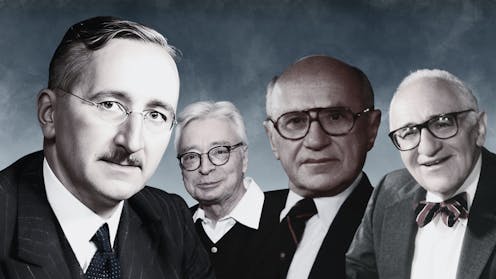
Neoliberalism has had an enormous influence on the world, driving policy and governance at the national and international level, particularly since the 1980s, when it was championed by the Reagan administration in the United States and the Thatcher government in the United Kingdom.
It has been associated with programs of economic deregulation, privatisation of state-owned enterprises, massive tax cuts for businesses and high-income earners, reduction of social services and welfare programs, anti-unionisation, and the independence of monetary policy.
The movement’s intellectual heart was the Mont Pelerin Society, founded in 1947 by the Austrian economist Friedrich Hayek, who used the term “neoliberalism” into the 1950s. With the support of wealthy backers, neoliberalism became a global movement, its free-market principles promoted by a welter of influential institutes and think tanks.
Review: Hayek’s Bastards: The Neoliberal Roots of the Populist Right – Quinn Slobodian (Allen Lane)
In his new book Hayek’s Bastards, historian Quinn Slobodian explores the “neoliberal roots of the populist right”.
Neoliberalism is often described as a form of market fundamentalism: the view that, as Slobodian puts it, “everything on the planet has a price tag, borders are obsolete, the world economy should replace nation-states, and human life is reducible to a cycle of earn, spend, borrow, die”.


Many neoliberals believed that, as Mont Pelerin Society member Charles Murray wrote in the 1990s, “the last thirty years represent an aberration which goes against human nature”. They thought that, as Slobodian puts it, “decades of ‘collectivism’ and state dependency – even in the capitalist world – had eroded the virtues of self-reliance”.
The “mechanisms which existed prior to the welfare state and in some measure served to fulfill its functions are gone”, said Michael S. Joyce, the worried president of conservative funding body the Bradley Foundation.
This presented a serious problem. Joyce thought it unlikely that “the private sector and the free market [would] fill the gap instantly – like Athena sprung fully born from Zeus – thus replacing the welfare state and making the new order acceptable to our citizens”.
A painful transition out of the world of the social state was the only path to recovery.
A return to first principles
Against this background, neoliberals and libertarians in the 1990s argued that, as Slobodian writes, “it was necessary to return to first principles, to open a wide-ranging discussion on the human condition and the prerequisites for market order”.
This involved a shift in focus, away from purely economic issues. As neoliberals sought to ground their arguments in “something beyond the social”, they looked for scientific support for their core view that egalitarian politics and the social state went against “human nature”.
 Quinn Slobodian.
Toter Alter Mann, via Wikimedia Commons, CC BY-SA
Quinn Slobodian.
Toter Alter Mann, via Wikimedia Commons, CC BY-SA
This “appeal to nature” was a central part of the neoliberal solution to the problem of expanding public spending.
Behind it, notes Slobodian, there was a political problem. The social movements of the 1960s and 1970s, the neoliberals believed, had “injected the poison of civil rights, feminism, affirmative action, and ecological consciousness into the veins of the body politic”.
They were, as Slobodian puts it, “confounded by persistent demands for the redress of inequality”. They experienced this as an oppressive atmosphere of “political correctness”. They felt it created “a culture of government dependency” and “special pleading”.
In their view, such demands came at the expense of productivity, innovation, efficiency, stability, and order. To combat them, intellectually and politically, they “turned to nature in matters of race, intelligence, territory, and money”.
Rethinking the conditions of capitalism
Slobodian suggests that changing demographics in the United States – “an aging white population matched by an expanding nonwhite population” – spurred some neoliberals and libertarians to “rethink the conditions necessary for capitalism”.
Extra-economic issues were traditionally addressed in neoliberal debates via a discussion of topics like law, religion and morality. The New Right, which would merge with the alt-right, developed in the direction of advocating an “ethno-economy”.
Proponents argued that certain cultures – and, for some, certain “races” – were “predisposed to market success”. Slobodian summarises their argument like this: “Some societies had developed the cultural traits of personal responsibility, ingenuity, rational action, and low time preference over long periods; others had not.”
The advantageous traits, these neoliberals believed, were not easily transplanted to “less culturally evolved societies”. Alongside this, many began to argue that “cultural homogeneity is a precondition for social stability, and thus the peaceful conduct of market exchange and enjoyment of private property”.
From this line of thinking sprang groups like the “closed borders” libertarians, who advocated free movement for capital and goods, but “drew a hard line against certain kinds of people”. Their demand for an ethno-state, writes Slobodian, was grounded in the demand for an “ethno-economy”.
Race and IQ
“Faced with the neoliberal problem of how to explain unequal capacity in a universal marketplace,” argues Slobodian, influential figures on the right “diverged from Hayekian arguments about social learning and cultural imitation”.
 Friedrich Hayek.
Vladimír Krupa 81, via Wikimedia Commons, CC BY
Friedrich Hayek.
Vladimír Krupa 81, via Wikimedia Commons, CC BY
They seized on what they believed was the “objectivity of race science”. Relying on fringe work on IQ science, many adherents divided humanity into “cognitive classes”. Intelligence – measured by IQ – “became a central category for the new fusionists”.
In 1994, Murray and co-author Richard Herrnstein published The Bell Curve, which argued there was a link between “race” and “intelligence”.
The paleolibertarian Murray Rothbard, another Mont Pelerin Society member and a leading “new fusionist”, also saw differences as “rooted in biology and race as a rigid hierarchy of group traits and abilities”. There was, he thought, a “genetic basis for inequality of intelligence which undercut any attempts to create an equality of outcomes through education or redistribution”.
In the early 1990s, Rothbard outlined a strategy of what he called “paleo-populism”. Its aim was to use electoral democracy as a means of transitioning to a stateless society. Rothbard’s protégé Hans-Hermann Hoppe further radicalised his program. He vilified democracy as “the god that failed” and proposed “racial explanations for patterns of economic behaviour”.
Slobodian credits Hoppe with creating “forums for exchange between theorists of eugenics, ethnic secessionism, and Austrian economics”. Hoppe acted as a bridge from the US to “dissident [Mont Pelerin Society] members in Germany and Austria who sought to create their own alliances to the Right of the mainstream parties”.
‘Junk science yarns’
In their appeal to the “junk science yarns” about IQ and the “biological reality of race”, Slobodian’s neoliberals believed they had identified “a genetic basis for unequal capacity, unequal achievement, and in Hoppe’s work, an explanation for the supposedly natural aversion of races to cohabitation”.
The 2008 global financial crisis and its aftermath, argues Slobodian, “created the conditions for new mutations of neoliberal thought – as well as new schisms”.
In 2015, more than one million refugees arrived in Europe. With them came “a new winning political hybrid that combined xenophobia with free-market values”. In Germany, the racist right’s position was crystallized in Thilo Sarrazin’s book Germany Abolishes Itself, which sold more than 1.5 million copies.
 Murray Rothbard.
Ludwig von Mises Institute, via Wikimedia Commons, CC BY
Murray Rothbard.
Ludwig von Mises Institute, via Wikimedia Commons, CC BY
Drawing on the same research as Murray, Rothbard and Hoppe, Sarrazin made the case for “race differences in cognitive capacity”. His “synthesis of free trade, independent monetary policy, and biological racism is the intellectual core of the insurgent Alternative for Germany (AfD) and Austrian Freedom Party”.
It is important to recognise, Slobodian emphasises, that these figures “did not propose the wholesale rejection of globalism but a variety of it, one that accepts an international division of labour with robust cross-border flows of goods and even multilateral trade agreements”, while “tightening controls on certain kinds of migration”.
The common view of neoliberals and the New Right is scorn for “egalitarianism, global economic equality, and solidarity beyond the nation. Both see capitalism as inevitable and judge citizens by the standards of productivity and efficiency.”
And yet, as Slobodian points out,
The parties dubbed as right-wing populist, from the United States to Britain and Austria […] offer few plans to rein in finance, restore a Golden Age of job security, or end world trade. By and large, the so-called populists’ calls to privatize, deregulate, and slash taxes come straight from the playbook shared by the world’s leaders for the past thirty years.
In other words, a lot of what we have been witnessing is a “family feud”.
Authors: Christopher Pollard, Associate Teaching Fellow, Sociology, Deakin University




















.jpg)

