

off-the-charts marine heat has severely damaged Ningaloo and other pristine coral reefs
- Written by: James Paton Gilmour, Research Scientist: Coral Ecology, Australian Institute of Marine Science
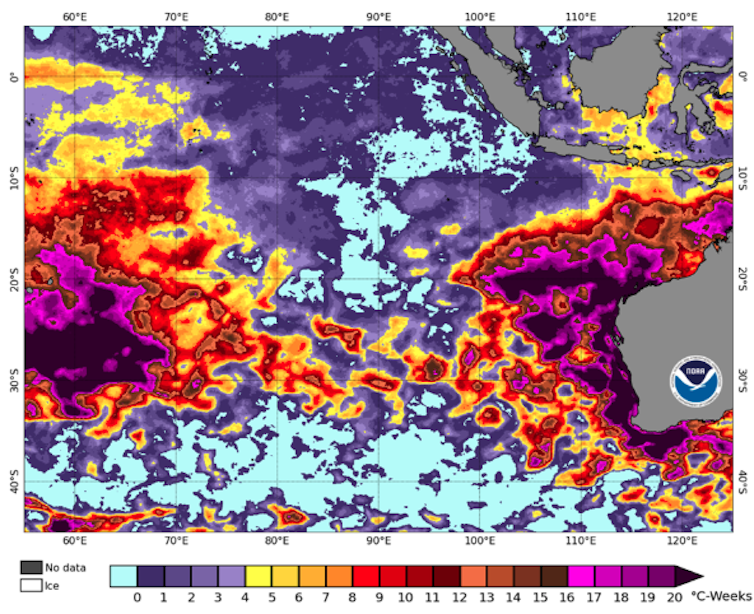
Until now, many of Western Australia’s most pristine coral reefs have avoided the worst bleaching brought by marine heatwaves. But their luck has now run out. The state’s longest lasting, largest and most intense underwater heatwave has hammered them.
The unusual heat began late last year off the northwest coast, before spreading south, eventually affecting seas along more than 1,500km of coastline. Surface temperatures hit up to 4°C above average in places.
For coral, sustained heat stress is measured using degree heating weeks (DHW). At 4 DHW, coral bleaching is likely. At 8 DHW, many corals are at risk of bleaching and dying.
The data so far suggests heat stress on most reefs was more than double that. Central Ningaloo hit 20 DHW. Off some parts of the Pilbara coast, heat stress hit an almost unthinkable 30 DHW.
My colleagues and I have recorded the result: intense bleaching at iconic Ningaloo reef, as well as across the spots we hoped would be more resilient, such as the Rowley Shoals well offshore, and the vast but little-known reefs of the northern Kimberley.
It’s undoubtedly the most widespread coral bleaching event yet recorded in WA. For the worst-hit reefs, it’s hard to see how recovery to their previous glory is possible, given temperatures will continue to rise in the coming years.

Sustained heat over a huge area
The heat started building towards the end of 2024. In the absence of monsoonal storms and cyclones, the unprecedented heat stress continued to rise throughout December 2024 and January 2025. Soon, reefs and other ecosystems off the Kimberley coast began to suffer. Ningaloo was feeling the heat by February.
A late monsoon gave a slight reprieve, but the heat was back on in March and April. By then, the underwater heatwave had swept across the northwest coast between Ningaloo and remote offshore reefs such as Ashmore and the Rowley Shoals. It took until May for the heat to begin to dissipate.

Because unusually warm water sat in place for months in some regions, corals had no reprieve. Worse, the heat spread far down into the ocean. Our surveys of coral 20–30 metres below the surface found similar levels of heat stress and bleaching as those in shallower water, while higher temperatures were documented hundreds of metres deep in some places. While cyclones and other storms often offer temporary cooling by churning up the sea and mixing warm water with cooler, there was very little reprieve this time. The seas were simply too hot.
It will take months for scientists to understand the full extent of what’s happened underwater. Many of these reefs are remote. What we do know is coral reefs over a 1,500km span of ocean are bleaching at levels ranging from medium (11–30% of all corals) up to extreme (more than 90%).
 Intense underwater heatwaves hit many of Western Australia’s coral reefs this year, from Ashmore Reef to the Rowley Shoals to Ningaloo.
AIMS, CC BY-NC-ND
Intense underwater heatwaves hit many of Western Australia’s coral reefs this year, from Ashmore Reef to the Rowley Shoals to Ningaloo.
AIMS, CC BY-NC-ND
At the Rowley Shoals’ Mermaid and Clerke Reefs, field surveys in April found very high (61–90%) death rates across most coral types. Bleaching had hit every type of habitat, from sheltered lagoons to the 30m-deep outer reef slope.
At Ningaloo, coral bleaching and death was at high levels (31–60% of corals) in the northern and central regions in May, with southern Ningaloo less affected, while reefs across the vast Kimberley ranged from high (31–60%) to very high levels.
One way to measure marine heatwaves is by using satellites to monitor sea surface temperatures. But when our researchers arrived at the remote Ashmore Reef, they found the temperatures in shallow lagoons were even hotter in real life than they were in satellite data.
It’s often said coral reefs are the tropical jungles of the sea due to their wealth of species. When the coral bleaches or dies, it threatens many other species. Our scientists saw this clearly. The most obvious change was a drop in the numbers of colourful coral-eating butterflyfish.
There are some small silver linings to the event. WA coral reefs still remain among the world’s healthiest. Bleaching damage can be patchy. Some coral species are less susceptible, and some parts of the reef can escape the worst of the heat. Bleaching hasn’t been spotted this year at Shark Bay, the Houtman Abrolhos Islands, or WA’s southernmost reefs at Rottnest Island.
 Our field surveys showed bleaching and coral death was widespread, from the Rowley Shoals (pictured) to Ningaloo and up into the northern reefs.
James Gilmour/AIMS, Author provided (no reuse)
Our field surveys showed bleaching and coral death was widespread, from the Rowley Shoals (pictured) to Ningaloo and up into the northern reefs.
James Gilmour/AIMS, Author provided (no reuse)
Will coral have a future?
Witnessing this silent devastation has taken a toll on our scientists and everyone in the reef community in WA. It is very hard to see these natural marvels suffering.
What makes it worse is that we know this isn’t a single event. On the contrary: climate change gets steadily worse, year after year. As ocean temperatures rise and rise, the destruction underwater can only increase.
The bleaching in WA is only a small part of the spate of underwater heatwaves that has swept through coral reefs globally since 2023 – the fourth event of its kind to affect all the world’s coral reefs. More than 80% of the world’s reefs have suffered bleaching, including the Great Barrier Reef.
It’s not the end of WA’s coral reefs. Reefs can recover, given enough time. Not all reefs, sites on a reef or types of coral are affected equally. While some will be devastated, others will escape the worst damage and others still may prove resistant to future conditions or adapt faster. Only time will tell what their path to recovery might look like.
But giving these these hard-hit coral reefs a chance will require rapid, meaningful action to cut greenhouse gas emissions.
Good management of local issues and trialling ways of helping coral reefs cope with the heat will also be essential.
Authors: James Paton Gilmour, Research Scientist: Coral Ecology, Australian Institute of Marine Science


















