

Japanese film noir High and Low is a remarkable example of nail-biting tension – and now it’s inspired Spike Lee
- Written by: Kristian Ramsden, PhD Candidate in English, Creative Writing and Film, University of Adelaide
“Wake up y’all. The king is here!”
So proclaims Denzel Washington in Spike Lee’s new film, Highest 2 Lowest, where Washington portrays a hip hop mogul, David King, who finds himself the centre of a high-profile kidnapping case.
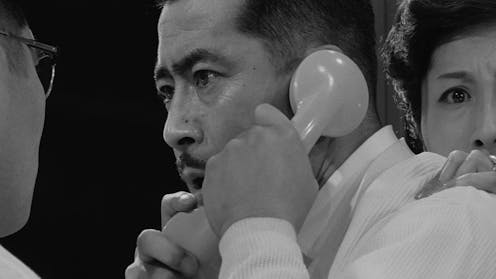
Highest 2 Lowest is a remake of Akira Kurosawa’s 1963 classic crime drama High and Low. In that film, Toshiro Mifune plays high powered executive Kingo Gondo, who, on the eve of the most important night of his career, receives a surprising phone call informing him that his son has been kidnapped.
Kurosawa’s film begins as a corporate thriller before transforming into a police procedural as detectives traverse the streets of Yokohama in the hope of solving the crime. At the same time, the film sees the director examining social tensions under the surface of reconstruction-era Japan.
More than just a historical document, the film stands up as a remarkable example in nail-biting tension, 60 years after release.
From America …
Kurosawa’s original film is already derived from an American source, adapted from King’s Ransom (1959), an instalment in a series of police procedural paperbacks collectively titled 87th precinct, from author Ed McBain.
The novel’s prose is streamlined and action oriented. Simple sentences like “The room was full of cigarette smoke” or “The 87th Precinct building was on Grover Avenue” read like blueprints for a screenplay.
McBain was a pseudonym for the screenwriter Evan Hunter, who would adapt many of his own novels, including King’s Ransom, for a short lived TV series of the same name which aired from 1961–62.
The series was a late entry in a trend of procedural TV shows popular in Eisenhower’s America, epitomised by The Naked City (1958–63) and Dragnet (1951–59).
… to Japan
The Japanese studio Toho bought the rights for King’s Ransom for US$5,000 in 1961. Kurosawa must have sensed the opportunity for second chance, having been disappointed in his earlier attempt to make a detective film with 1949’s Stray Dog.
However, believing McBain’s novel “wasn’t particularly well written”, he started to make radical adjustments.
The biggest change Kurosawa makes to the novel is to split it into two distinct sections.
In the first half, Kurosawa takes the majority of McBain’s novel and restricts it to the sleek living room of Gondo’s nouveau riche mansion. Gondo’s luxurious air conditioned home overlooks the sweltering overcrowded shanty towns of Yokohama – yet the curtains are often drawn.
This section resembles a chamber-play. Kurosawa’s masterful blocking of the actors forces the audience’s eyes to shift around the widescreen frame; examining each character’s reaction in real time to every gradual reveal of information.
In the second half, Kurosawa abandons the claustrophobia of Gondo’s living room and sends the investigation into the streets below. Abandoning the plot of the novel, this is when the film’s observations of contemporary Japanese society come to the forefront.
An era of Americanisation
The film comments on the “Americanisation” of Japan that took place in the postwar era. Following the end of American Occupation, Japan entered into an unprecedented period of production, prosperity and profit known as the Economic Miracle.
A huge demand for “Western” cultural and commercial goods reshaped much of private and public life. The “three sacred treasures” of domestic goods during the 1960s would be the colour television, the automobile and the air conditioner. The continued presence of United States Army bases allowed the proliferation of American comic books and magazines, jazz and rock ‘n’ roll records.
But for the Japanese, America was both a figure of aspirational culture, and of ongoing military control. During protests in 1960 hundreds of thousands protested against American military expansion. Violent clashes with the police ensued, and one young student was killed. US President Dwight D. Eisenhower cancelled a scheduled visit and Japanese Prime Minister Nobusuke Kishi was forced to resign.

This split vision of America is almost directly reflected in the dual structure of High and Low. Gondo’s home represents desire; the streets of Yokohama represent violence, and Kurosawa employs the aesthetic of film noir in intensifying the anxiety of the urban environment.
The film was released one year prior to the 1964 Tokyo Olympics, which sought to reintroduce Japan onto the world stage, showcasing the country’s remarkable transformation.
Kurosawa presents audiences with the repercussions of such progression, asking us to consider the lives and choices of those who have been left behind.
And back to America again
Kurosawa’s films have proved fertile material for American remakes. Seven Samurai (1954) became The Magnificent Seven (1960 and 2016); Yojimbo (1961) became A Fistful of Dollars (1964) and Last Man Standing (1996); and The Hidden Fortress (1958) was an inspiration behind Star Wars (1977).
High and Low has long been earmarked for an American remake. In 1993, Martin Scorsese tried to get a version off the ground, and in 2008 Scorsese tried to pass directing duties to Mike Nichols. Now finally, Lee’s version has premiered at Cannes and to positive reviews.

Kurosawa’s original film continues to impress over half a decade later.
It is ranked 77 on IMDb’s top 250 films of all time and is number six on a similar list from Letterboxd.
In late 2024, the film received a 4K restoration and, along with numerous other Kurosawa classics, was part of a Kurosawa retrospective across cinemas worldwide.
The film has had a remarkable shelf life. It has transcended not only its low brow source material but also language, culture and history.
If Lee’s remake manages to capture even a small portion of the original, then it’s sure to be a great film.
Authors: Kristian Ramsden, PhD Candidate in English, Creative Writing and Film, University of Adelaide


















