

Our land abounds in nature strips – surely we can do more than mow a third of urban green space
- Written by Adrian Marshall, Lecturer, Landscape Architecture and Urban Ecology, University of Melbourne
You may mock the national anthem by singing “Our land abounds in nature strips” but what you might not know is how true that is. In Melbourne, for example, more than a third of all public green space is nature strips. (That figure includes roundabouts, medians and other green bits of the street.)
That’s a remarkable amount. The nature strip is everywhere. A million small patches combine into a giant park spanning the city, making it a significant player in our urban ecosystems.
Read more: Reinventing density: overcoming the suburban setback
A second remarkable thing is that the nature strip is public land that private citizens are required by law to maintain. Councils manage the trees, but we residents mow the lawn.
What are the rules on nature strips?
 Succulents, Agapanthus and Gazanias are the most common plantings on nature strips.
Adrian Marshall CC BY 4.0, Author provided
Succulents, Agapanthus and Gazanias are the most common plantings on nature strips.
Adrian Marshall CC BY 4.0, Author provided
Many residents go further and plant a street tree or some garden plants – succulents, Agapanthus and Gazanias are the most common. But the chances are that, whatever the garden on the nature strip, it’s against the rules.
The rules on nature strips vary from council to council. Some councils don’t allow any plantings. Others restrict plantings by height or allow only plants indigenous to the local area. In some areas, nature strips can only be planted to prevent erosion on steep slopes.
Some councils disallow food plants, for fear of historic lead contamination from leaded petrol. Others insist on no plants within a metre of the kerb and two metres of the footpath.
Read more: Farming the suburbs – why can’t we grow food wherever we want?
These bylaws are inconsistent and illogical. For instance, councils that insist on indigenous species nevertheless plant exotic street trees. Councils that say plants must be less than 30cm high to ensure they don’t block drivers’ sight lines still allow vehicles to park on the street, blocking sight lines.
Bylaws deny us many benefits
To have council bylaws restrict or disallow gardening in the nature strip flies in the face of common sense. Street greenery, whether its trees, shrubs or lawn, provides many benefits. The science is in on this.
Urban wildlife uses street greenery for habitat and food and as green corridors for movement.
Even for those who mow, the lawns of nature strips are not just turf grass. They are home to over 150 species of plants, based on my yet-to-be-published survey data for nearly 50 neighbourhoods, confirming earlier studies. Many of these, like the clovers, provide important resources for pollinators.
One US study showed that changing from a weekly mow to every three weeks increased the number of flowers in a lawn by 250%. Less mowing is good news for bees and butterflies.
An unpublished recent survey by the author and colleagues found gardening in the nature strip adds native plants to the streetscape, increases biodiversity and add structural complexity (more layers of plants, more types of stuff), which is important for many species.
 The greater the diversity of plantings, the greater the benefits a nature strip can provide.
TEDxMelbourne/Flickr, CC BY-NC-ND
The greater the diversity of plantings, the greater the benefits a nature strip can provide.
TEDxMelbourne/Flickr, CC BY-NC-ND
Street greenery helps water soak into the ground, filtering out pollutants, recharging aquifers and making rivers healthier. It cools streets and helps counter the urban heat island effect. It also promotes a sense of community, encourages walking and lowers the incidence of heart disease, diabetes, asthma and depression.
Read more: Increasing tree cover may be like a 'superfood' for community mental health
But councils tend to be risk-averse. They worry they will be sued if someone trips on groundcover or stubs their toe on an out-of-place garden gnome.
Fortunately, this risk aversion isn’t universal. For instance, the City of Vincent in Western Australia is so keen for residents to convert lawn to waterwise plantings that it will remove turf and provide native plants.
But, as climate change looms, stubbed toes are not the main risk we should be worrying about. Rather, we must urgently remake our cities and our culture for sustainability and resilience.
Read more: If planners understand it's cool to green cities, what's stopping them?
Gardening becomes a neighbourly act
One of the great things about gardening in the nature strip is that people are more likely to do it if their neighbours do it. It’s contagious, a positive-feedback loop creating a greener street.
Our recent survey found residents who garden in the nature strip have a greater sense of community than those who don’t.
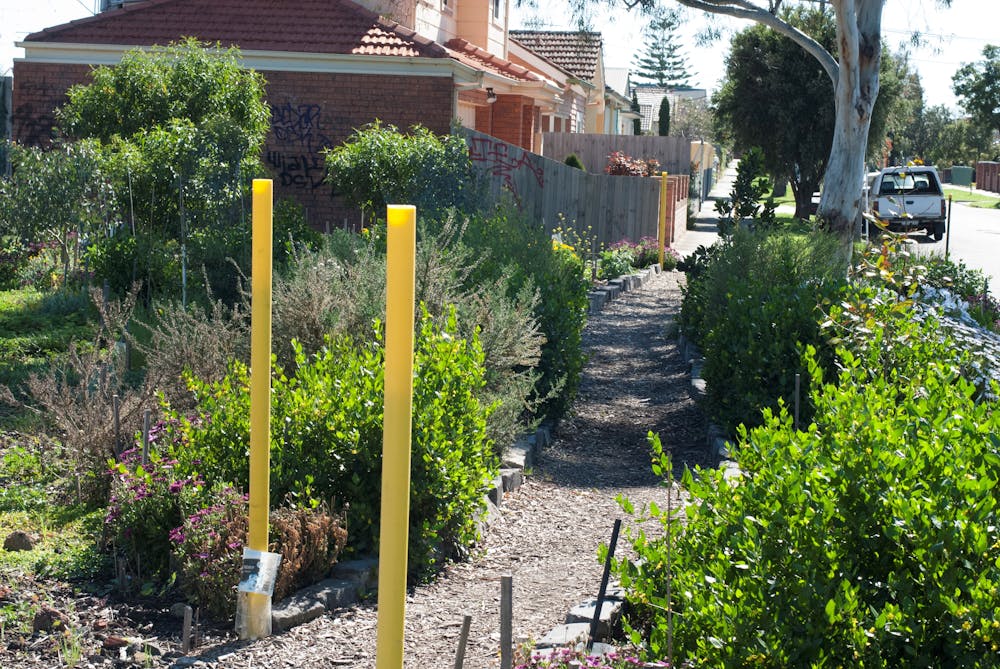
 A well-designed street garden, fully covering the nature strip, allowing pedestrian access to cars and using indigenous plants.
Adrian Marshall CC BY 4.0, Author provided
A well-designed street garden, fully covering the nature strip, allowing pedestrian access to cars and using indigenous plants.
Adrian Marshall CC BY 4.0, Author provided
Interestingly, the benefits nature strips provide are not equally distributed across the city. For instance, newer neighbourhoods have more nature strip than older neighbourhoods (though their trees are younger). People garden the nature strip more on minor roads than major roads, and in more socially advantaged neighbourhoods.
Almost a quarter of residential properties in Melbourne have some sort of nature strip gardening. If councils were to encourage this activity we might achieve more street greening with little cost to our cash-strapped councils. Such encouragement would also free many residents of their sense of frustration at being required to maintain the nature strip but forbidden to do anything more than mow.
Given that more than a third of our public green space is nature strip, the many small actions of residents can add up to substantial positive change.
Authors: Adrian Marshall, Lecturer, Landscape Architecture and Urban Ecology, University of Melbourne

















