

Road-user charges can pay for more than just road maintenance – NZ could lead the way
- Written by: Simon Kingham, Professor of Human Geography, University of Canterbury
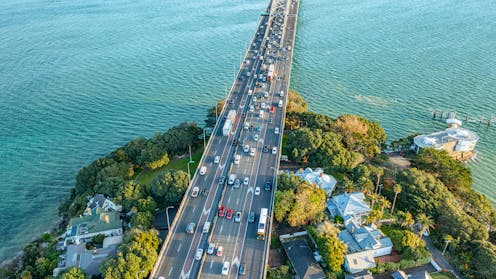
The government heralded its plan to move New Zealand’s entire vehicle fleet to road-user charges as a fairer method of funding road maintenance.
For owners of electric and diesel vehicles, this is nothing new. They already pay road-user charges based on the distance travelled.
But for petrol vehicles, it is a shift away from fuel excise duty, or petrol tax, which is currently about 77 cents per litre of fuel. As it is linked to the price of petrol, more fuel-efficient petrol vehicles pay relatively less than gas guzzlers for every kilometre travelled.
Much of the policy detail is yet to be worked out, but if all of the country’s vehicles paid road-user charges, this would provide opportunities to do more than raise revenue for road building and maintenance.
New Zealand would become the first country to charge all vehicles a distance-based fee and, used in creative ways, this could save money and deliver better societal outcomes, such as safer roads and lower pollution.
How fuel revenue is collected
Fuel excise duty is currently collected at source, when refined fuel either leaves the refinery or is imported. Some other costs are included, such as a fee for New Zealand’s Emissions Trading Scheme, currently around 13 cents per litre. These are simple to collect, have low compliance costs and are essentially unavoidable.
Road-user charges are a distance-based payment. Licenses are pre-purchased in increments of 1,000 kilometres and various rates apply depending on vehicle weight and axle configuration. Heavier electric vehicles (more than 3.5 tonnes) are currently exempt until June 2027.
This system has higher compliance and administration costs than fuel excise duty. It also has a greater risk of evasion, because to some extent, it relies on vehicle owners’ honesty.
With all vehicles moving to road-user charges, everyone will pay for every kilometre they travel on the roads, with increased rates for heavier vehicles (currently anything above 3.5 tonnes). The plan is that this will be administered electronically through some device in or on the vehicle. This already happens with many freight vehicles.
In most freight vehicles, the technology includes GPS and allows freight companies to monitor the performance of their vehicles and drivers. But rolling out electronic road-user charges across the whole vehicle fleet creates interesting opportunities beyond just raising revenue.
Opportunities and challenges
The move to a distance-based scheme could discourage some people from selecting more fuel-efficient vehicles because a road-use system does not encourage that. This could lead to increased greenhouse gas and other emissions.
However, rather than using a uniform road-user charge based solely on vehicle weight and distance travelled, rates could vary based on a range of criteria, including emissions, and pay for other traffic-related costs to society and the environment.
For instance, around 300 people die each year in road crashes, and thousands more are injured. This costs NZ$9-10 billion annually. To help pay, New Zealand could collect higher road-user charge rates for vehicles more likely to cause crashes, based on safety ratings.
Traffic-related air pollution causes more than 2,000 deaths per year, costing New Zealand around $10 billion. Road-user charges could be used to pay for this by charging a higher rate for vehicles that emit more pollution.
The same could be done for noise pollution. And if the electronic road-user charge device is GPS-enabled, vehicles travelling near the most vulnerable citizens – such as near schools during pick-up and drop-off – could be charged more.
This may deter some people from dropping children off right outside the school gate, which in turn could have the added benefit of making walking and cycling feel safer due to less traffic, attracting more people to use active transport and helping create neighbourhood greenways.
But why stop there? New Zealand could use electronic road-user charges to encourage all sorts of other behaviours. For example, lower rates might encourage vehicles to use highways and main roads instead of cutting through quiet residential streets.
Road-user charges could be used to set a congestion price, manage on- and off-street parking and monitor speed limits without the need for any additional technology, saving on setting up separate congestion and parking pricing schemes and speed cameras.
Some will argue this is an invasion of privacy. But as Minister of Transport Chris Bishop indicated, the privacy commissioner will oversee it.
If New Zealand becomes the first country to charge all vehicles for the use of roads, this an opportunity to lead in innovation.
Authors: Simon Kingham, Professor of Human Geography, University of Canterbury


















