

AI has produced 2 new antibiotics to kill ‘superbugs’. It’s promising – but we shouldn’t get too excited yet
- Written by: Thomas Jeffries, Senior Lecturer in Microbiology, Western Sydney University
Researchers from the Massachusetts Institute of Technology (MIT) have used artificial intelligence (AI) to design two new antibiotics effective against antibiotic-resistant bacteria, or “superbugs”.
This is a potentially exciting development, but it’s important to note there are several hurdles to overcome before we might see these antibiotics used in the real world. And if this eventuates, it’s likely to be some years away.
So how did the researchers harness AI to develop these antibiotics? Which superbugs will they target? And what happens next?
Antibiotic resistance is a global health threat
Frequent overuse of antibiotics in medicine and agriculture has led to the evolution of new strains of bacteria resistant to an increasing range of antibiotics. This global public health crisis makes the development of new antibiotics a significant challenge.
Antibiotic-resistant superbugs contribute to around 5 million deaths worldwide annually, and directly cause more than 1.2 million deaths.
It’s estimated superbug infections could lead to more than A$2.5 trillion in lost economic output globally by 2050.
Antibiotic resistance is also increasingly a problem of inequity, with many poorer countries unable to access newer antibiotics to overcome resistant bacteria.
Targeting 2 key superbugs
The researchers used AI to design antibiotics against two prominent superbugs: Neisseria gonorrhoeae and methicillin-resistant Staphylococcus aureus (MRSA).
N. gonorrhoeae causes the sexually transmitted disease gonorrhoea, which has developed high levels of resistance to antibiotics in recent years. The inability to treat it effectively has contributed to a rapid spread of the disease. There were more than 82 million new cases in 2020, mostly in developing nations.
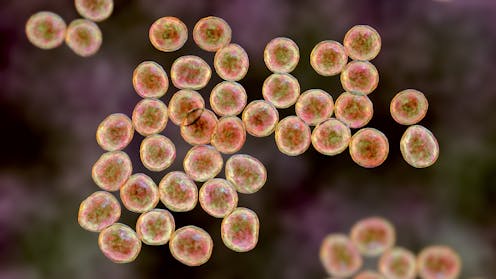
MRSA is a resistant strain of the bacteria Staphylococcus aureus (often referred to as “golden staph”). S. aureus can cause skin infections or serious blood and organ infections. Patients who get sick with the resistant MRSA strain are estimated to be 64% more likely to die as a result of an infection.
To address these challenges, the MIT team harnessed generative AI in two ways.
What did the researchers do?
The research team trained an AI algorithm, called a machine learning neural network, using chemical structures. We can think of this as similar to the way an AI language model would be trained using words.
The first approach, used for gonorrhoea, involved the algorithm screening a large database of existing compounds that had demonstrated antibiotic activity against N. gonorrhoeae. The AI algorithm then used the chemical structures of these compounds as “seeds” and built on them, generating new compounds by adding chemical structures one by one.
This approach led to 80 new candidate compounds, two of which could be chemically synthesised (meaning the scientists could make them in the lab). In the end, one of these demonstrated strong effectiveness against N. gonorrhoeae. It was able to kill the bacteria on a petri dish and in a mouse model.
The second approach, used for MRSA, started from scratch, prompting the AI algorithm with only simple chemical structures such as water and ammonia. The algorithm then predicted chemical structures that would interact effectively with vulnerabilities in the bacteria’s cell defences, and came up with entirely new antibiotic compounds.
Out of around 90 candidates, 22 were synthesised and tested in the lab. Six showed strong antibacterial activity against MRSA in a petri dish. The most promising compound successfully cleared an MRSA skin infection in a mouse model.
Advantages and challenges
An important element of this research is that the two new antibiotics are not just novel in their structure, but also in their mechanisms of action (in other words, how they work against the bacteria).
Traditionally, antibiotic development has relied on tweaking existing antibiotics. It’s hoped the fact these AI-generated molecules have entirely new mechanisms of action will make them more difficult for gonorrhoea and MRSA to evade.
Prior to this research, when it comes to antibiotic development, AI has mainly been used to narrow down libraries of already existing compounds or to modify chemical structures of currently used drugs.
While this work is very promising, several hurdles remain. Both antibiotics must undergo vigorous testing for safety and efficacy in humans through clinical trials, which will take several years and require significant funding.
Another challenge could be financial. As these antibiotics would be intended as “last resort” drugs to preserve their effectiveness, their market use will be limited. This limits the financial incentive for pharmaceutical companies to invest in their development and production.
Nevertheless, this work marks a significant milestone in drug discovery and is an example of how AI might reshape the fight against infectious diseases in the future.
Authors: Thomas Jeffries, Senior Lecturer in Microbiology, Western Sydney University


















