

We’ve been sending animals into space for 7 decades – yet there are still no rules to protect them from harm
- Written by: Anna Marie Brennan, Senior Lecturer in Law, University of Waikato
This week, Russia is expected to launch its Bion-M No.2 biosatellite from the Baikonur Cosmodrome in Kazakhstan, carrying 75 mice and 1,500 fruit flies.
While the mission underscores Russia’s ongoing investment in space medicine, it reignites ethical concerns over the treatment of animals in space research.
Animals have played a pivotal role in space exploration since the 1950s. The former Soviet Union’s launch of the stray dog Laika aboard Sputnik 2 in 1957 marked the first living creature in orbit.
Laika’s cramped, stressful conditions and eventual death from oxygen deprivation highlighted the harsh realities of early space missions.
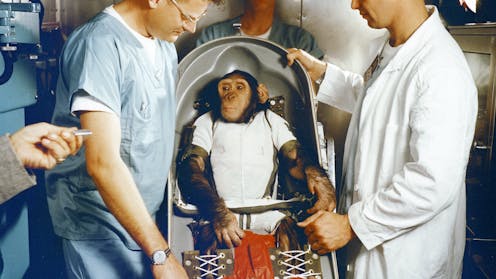
The US followed suit in 1961 with Ham, a chimpanzee sent on a suborbital flight to test task performance in space. Ham endured invasive monitoring, electric shocks for incorrect responses and severe dehydration. Although he recovered physically, he showed signs of psychological trauma following the mission.
As space exploration expands, the absence of legal protections for animals becomes increasingly problematic. International regulations are long overdue to formally recognise the sentience of animals in outer-space law and to safeguard their welfare before, during and after missions.
Forgotten animal casualties of space exploration
Despite technological advances, animal casualties persist. In 2019, Israel’s Beresheet spacecraft crash-landed on the Moon with thousands of tardigrades aboard. The fate of these eight-legged microscopic animals, also known as water bears or moss piglets, remains unknown.
Often, animals used in missions are deemed surplus afterwards, with little legal obligation for their continued care. For example, France’s Félicette, a cat sent into orbit in 1963, was euthanised post-mission for brain study, despite surviving re-entry.
Unlike military working animals, which undergo transition programmes for civilian life, space animals lack formal exit protocols.
Records of their fates are scarce, and their legal status remains ambiguous. This gap stems partly from the absence of animal considerations in outer-space law.
International responses and ethical shifts
Activist pressure, particularly from People for the Ethical Treatment of Animals (PETA), has led to some reforms.
In 1996, NASA withdrew from the BION programme and introduced the Principles for the Ethical Care and Use of Animals. These guidelines were prompted by the Belmont Report which was commissioned in 1974 by the US Congress following controversy about unethical practices in research.
The guidelines emphasise bioethical responsibility, acknowledging that animals “warrant moral concern”.
NASA committed to stewardship of research animals, encompassing acquisition, care and what happens to them after the space mission. The principles outline three core ethical tenets:
Respect for life: use only appropriate species in minimal numbers necessary for valid results.
Societal benefit: weigh the ethical value of animal use against potential societal gains.
Non-maleficence: minimise pain and distress, recognising that animals may suffer similarly to humans.
While these principles don’t ban animal use, they promote ethical reflection and accountability.
Some agencies have followed suit. In 2010, the European Space Agency rejected primate research, opting for simulation technologies to study astronaut health risks.
NASA briefly considered resuming primate experiments in 2010, but PETA’s lobbying led to the cancellation of proposed research at Brookhaven National Laboratory.
Nonetheless, NASA continues to use mice in space studies. In 2024, a group of mice was sent to the International Space Station to examine the effects of space on bodily systems.
Private companies have also faced scrutiny. In 2022, KEKA Aerospace in the Democratic Republic of Congo pledged to stop using animals after a rat named Kavira died aboard its Troposphere 5 rocket.
Legal gaps in outer-space law
Despite growing awareness, the legal and ethical frameworks surrounding animals in space remain underdeveloped. The lack of formal protections and transparency continues to raise questions about the ethical and moral cost of scientific progress.
There are five core outer space treaties, covering issues such as the peaceful use of outer space, the rescue of astronauts, the registration of space objects and liability for damage. But despite the long history of animals participating in space missions, none offers formal protections, focusing solely on human and state interests.
A common argument is that prioritising animal welfare could hinder scientific progress. While violence against humans is prohibited, harm to animals for food, research, medicine and other purposes remains widely accepted on Earth. Some question whether it would be inconsistent to restrict harm to animals in space, where human casualties are more likely.
However, two key observations challenge this view.
First, many countries, including New Zealand, now legally recognise animals as sentient beings, deserving moral and legal consideration. Just as human rights evolved after the second world war, the animal welfare movement has gradually secured protections against cruelty and neglect. Yet, space law remains largely silent on the physical and psychological harm animals endure during missions.
Second, concerns that animal welfare might overshadow human safety are unfounded. Outer-space law is already flexible enough to ensure human protection takes precedence. The real question is whether space law can evolve to safeguard both human and animal interests without conflict.
Importantly, the types of harm animals face in space – stress, injury and death – are not fundamentally different from those permitted on Earth in service of human needs. In both contexts, animals are used to advance human survival or ambition. Thus, the perceived inconsistency in protecting animals in space may be less significant than it appears.
We need a more balanced framework – one that acknowledges animals as sentient participants and ensures their welfare is considered alongside human interests.
Authors: Anna Marie Brennan, Senior Lecturer in Law, University of Waikato



















1.jpg)