

Google AI


Modern Australian

The most powerful tool in an astronomer’s arsenal is a lens – but not the kind you might think

  • Written by: Tania Barone, Research Associate in Galaxy Evolution, Swinburne University of Technology
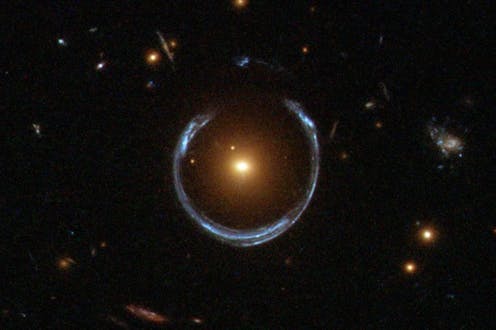
The most powerful tool in an astronomer’s arsenal is a lens – but not the kind you might think

Astronomers are living in a golden age of bigger and better telescopes. But even our most advanced technology pales in comparison to the power of nature’s own “cosmic magnifying glasses” – strong gravitational lenses.

In less than 50 years we have gone from the first-ever discovery of a strong gravitational lens to now finding thousands. As new telescopes come online, we’re expecting to discover thousands more.

With these lenses, we can look deep into the universe, and catch glimpses into the most puzzling of contemporary cosmic mysteries: dark matter and dark energy.

So, what are gravitational lenses and how do they work?

A spectacular demonstration of gravity

Gravitational lenses are the most visually spectacular demonstration of Albert Einstein’s theories of gravity.

According to Einstein, mass bends and warps the very fabric of space, in much the same way that a heavy bowling bowl placed on a mattress will bend the mattress beneath it.

Everything with mass (you, me, a leaf, an atom) bends space-time in this way.

But it’s only when an object is really massive – such as entire galaxies and clusters of galaxies – that this effect becomes so apparent. As light travels from distant objects and passes these massive galaxies, the warped space-time around them bends and focuses this light, magnifying it for us to see.

Diagram showing gravitational lensing of a background galaxy by a foreground cluster of galaxies.
In this diagram, a cluster of many galaxies distorts the light-rays from another galaxy behind it. When viewed from Earth, we see the background galaxy as a warped and highly magnified arc around the foreground cluster. NASA, ESA & L. Calçada, CC BY

We’re not always in the right place to see this effect. Just like how you need to align a magnifying glass in front of your eye, we only observe the gravitational lensing effect when there is a chance alignment of the background object, the foreground lens, and us.

On the rare occasions when this happens, through our telescopes we see multiple, distorted but magnified versions of an object that we wouldn’t otherwise be able to see because it’s too faint.

A foreground cluster of galaxies is warping a galaxy in the background, causing it to appear elongated and distorted. Due to the magnification we can see the galaxy in impressive detail.
The Hubble Space Telescope captures a striking gravitational lens called GAL-CLUS-022058s. Here, a cluster of galaxies is warping a background galaxy, giving us a close-up view of how this galaxy looked 9 billion years ago. ESA/Hubble & NASA, S. Jha Acknowledgement: L. Shatz, CC BY

Revealing the invisible

Even Einstein couldn’t have predicted how important gravitational lenses would become to modern astronomy. In fact, he believed them impossible to observe at all.

This was because Einstein was thinking about gravitational lensing around individual stars, not galaxies. It wasn’t until decades later that astronomers came to realise just how massive galaxies are, and just how full of them our universe is.

Impressively, gravitational lenses can also reveal details about things we can’t see at all.

Theories predict about 85% of the matter that makes up the universe is invisible stuff called dark matter. The way a gravitational lens bends and warps light allows us to measure how much matter is in galaxies – not just the regular matter we can see, but dark matter as well.

Gravitational lenses can also help us map galaxy clusters across the universe, helping us to understand its shape. Is our universe perfectly flat like a sheet of paper? Or does it have curvature to it like a sphere, or flare outwards like a horse saddle?

That depends on how dense the universe is, and mapping galaxy clusters helps us measure the density of a hypothetical force known as dark energy.

Looking at the distant universe

Gravitational lenses typically make the background objects ten to 100 times brighter than they would be otherwise. This effect provides a high-definition view of the distant universe.

The James Webb Space Telescope has been taking advantage of this magnification boost to get a glimpse into what the universe was like in its infancy more than 13 billion years ago, shortly (300 million years) after the Big Bang.

Looking far into the past helps us piece together how our own celestial home, the Milky Way galaxy, formed and how it might change in the future.

How a typical young galaxy looks today (left). Our Milky Way looks similar with spiral arms. In the future our Milky Way may evolve into a massive, elliptical galaxy such as the one on the right. Left: ESA/Hubble & NASA, ESO, J. Lee and the PHANGS-HST Team. Right: NASA, ESA, and The Hubble Heritage Team (STScI/AURA); J. Blakeslee (Washington State University)

We’re about to be spoilt for choice

The catch to all this is gravitational lenses are rare – akin to a needle in a cosmic-scale haystack. To find them, we need high quality images of large swaths of the night sky.

This year, two new skywatching projects are expected to revolutionise the field: the European Space Agency’s Euclid space telescope and the Vera Rubin Observatory in Chile.

Euclid, which launched in 2023 and released its first batch of data earlier this year, will image a monumental one-third of the entire sky, with a clarity that only comes from being in space.

Conversely, the Vera Rubin Observatory will be working from the ground, but will image the entire southern hemisphere sky. It will create the most detailed time-lapsed view of the cosmos ever seen.

Over their lifetimes Euclid and the Vera Rubin Observatory are predicted to unveil 100,000 new gravitational lenses, 100 times more than we currently know.

One of the first images released by the James Webb Space Telescope, this cluster (called SMACS J0723.3−7327) is lensing many distant galaxies behind it. NASA, ESA, CSA, and STScI

How do we find these 100,000 gravitational lenses among the billions of galaxies observed by these telescopes? It is not feasible for scientists to wade through that many images alone.

Instead, Euclid is relying on citizen scientists to help train AI models to know what to look for. By having people each look through a few images and classifying whether they are gravitational lenses or not, AI models can learn from these examples and can then search the entire dataset (if you want to get involved, check out their website).

From individual lenses providing unique new insights into distant galaxies, to studying the effect over large statistical samples to understand the very nature of the universe, gravitational lenses do it all. They are the Swiss Army knife in an astronomer’s toolkit, and we’re about to be spoilt for choice.

Authors: Tania Barone, Research Associate in Galaxy Evolution, Swinburne University of Technology


Read more https://theconversation.com/the-most-powerful-tool-in-an-astronomers-arsenal-is-a-lens-but-not-the-kind-you-might-think-262630

What to Do When an Older Car Is No Longer Worth Keeping in Melbourne

Ever looked at another repair quote and wondered whether your old car is still worth the trouble? It is a common turning point for Melbourne motoris...

Your Baby's First Year: A Local Guide to Feeding, Sleep, and When to Get Extra Support

Ask ten parents in a Brisbane mothers' group how their baby is feeding or sleeping, and expect ten different answers.  Someone's baby sleeps throug...

Kitchen and Laundry Makeover Ideas That Don't Require a Full Renovation

Full kitchen renos are expensive — and most people don't actually need one.  They need the kitchen to stop looking like it's stuck in 2009, or they...

How Technology Is Reshaping the Modern Australian Commercial Kitchen

The commercial kitchen has always been shaped by technology. Refrigeration changed how ingredients could be stored, modern ventilation transformed k...

The Number on a Roller Blind Fabric That Nobody Explains

Somewhere in the fabric book, next to the colour name, there is a percentage. Three per cent. Five per cent. Ten per cent. Nobody explains it, most c...

What’s Trending in Men’s Jewellery This Father’s Day!

Finding a Father’s Day gift that feels personal, stylish and genuinely wearable is not always easy. While socks and novelty mugs have traditionally ...

Road Signs: Understanding Their Role in Clear and Effective Signage

Effective signage and display hardware can help businesses communicate information, promote products and organise customer or visitor movement. Road...

Bottle Label Printing: Key Factors to Consider Before Your Next Packaging Run

Effective packaging begins with understanding the product, bottle material, artwork and production requirements when planning bottle label printing. H...

Planning a Long-Distance Move With Interstate Movers Melbourne

Moving between states involves more planning than a typical local relocation. Along with packing and transporting household belongings, you need to...

Understanding the Role of an I/O Controller in Industrial Automation

Modern industrial systems depend on accurate communication between sensors, machines and control systems. An I/O controller can help manage this commu...

How the Right Mining Hose Supports Demanding Operations

Mining environments place considerable demands on equipment used for material transfer, water management and processing. Hoses operating in these co...

Simple Ideas for Making Social Gatherings More Memorable

We have all been to those parties where everyone just stands around the kitchen island, staring at their phones, waiting for someone else to make a mo...

Outdoor Wall Lights: Improving Exterior Lighting Around Your Home

Lighting can influence how a room looks, feels and functions, so the right fitting should be selected according to both appearance and practical req...

Commercial Office Cleaning: Combining Routine Office Cleaning With Melbourne Service

Keeping a workplace clean requires a service that can accommodate everyday tasks as well as the particular needs of the business. Professional comme...

Caravan Sales in Queensland: How to Find the Right Caravan for Sale QLD

Caravan ownership is about more than having somewhere to sleep while travelling. For many Queenslanders, it is one of the best ways to explore regio...

What Sir Walter Buffalo Turf Actually Costs in 2026 (And Why Quotes Vary So Much)

Two quotes landed on a Hills District homeowner's kitchen table last spring for the exact same 80-square-metre backyard. One said $12 a metre. The o...

Nearly 1,300 NSW Hospital Beds Are Occupied By People Who Are Ready To Go Home

1,276 people in NSW hospitals have been medically cleared for discharge but remain in hospital because they're still waiting for NDIS or aged care sup...

National Survey Launched to Measure Operational Impacts of Federal NDIS Policy Reforms

The effects of recent NDIS reforms are beginning to move beyond policy papers and into day to day service delivery. A new national survey is asking ...















