

Google AI


Modern Australian

What’s a ‘black moon’? Here’s why it’s worth looking up at the sky this week

  • Written by: Laura Nicole Driessen, Postdoctoral Researcher in Radio Astronomy, University of Sydney
What’s a ‘black moon’? Here’s why it’s worth looking up at the sky this week

There’s been a lot of buzz online about the August “black moon”, happening later this week.

While you’ve probably heard of a “blue moon” before, this might be the first time you’ve encountered its ominous-sounding counterpart.

You’re not alone. In fact, neither “blue moon” nor “black moon” are astronomical terms. They describe the moments when the lunar calendar and our calendar year fall out of alignment.

So what is a black moon? The current definition has nothing to do with the actual colour of the Moon.

Full moon, half moon, new moon

Let’s start by defining some key lunar terms. The Moon is “full” when its whole face or disc is illuminated by the Sun. We typically get treated to a nice, bright, full moon at night when the Sun and Moon are opposite each other with Earth in-between.

A “new” moon is when none of the Moon’s face is illuminated and the far side is illuminated instead. This happens when the Moon is up during the day, because the “far side” of the Moon is illuminated when the Moon is in-between Earth and the Sun.

A graphic showing the Sun at the top and the Earth repeated in an arc at the bottom. The Moon is at a different position next to each repeated Earth. The illumination of the Earth relative to the Sun is shown, and the corresponding Moon phase is shown at
Diagram showing how the phases of the Moon are caused by the position of the Moon relative to Earth and the Sun. NASA/JPL-Caltech, CC BY-SA

A lunar cycle – the time it takes for the Moon to go from new, to full, to new again – is approximately 29.5 days long. Most years there are twelve full moons and twelve new moons.

But the 29.5 day cycle doesn’t fit perfectly into a calendar year, so every now and then there are thirteen full or new moons in a calendar year. Seven years out of every nineteen years will have thirteen full or new moons instead of twelve.

Blue moon, black moon

A blue moon is when we get a thirteenth full moon in one calendar year. Conversely, a black moon is when we get a thirteenth new moon in one calendar year.

Because these terms are entirely colloquial, there are a couple of definitions used for these extra moons. One is based on seasons and the other on simple calendar months.
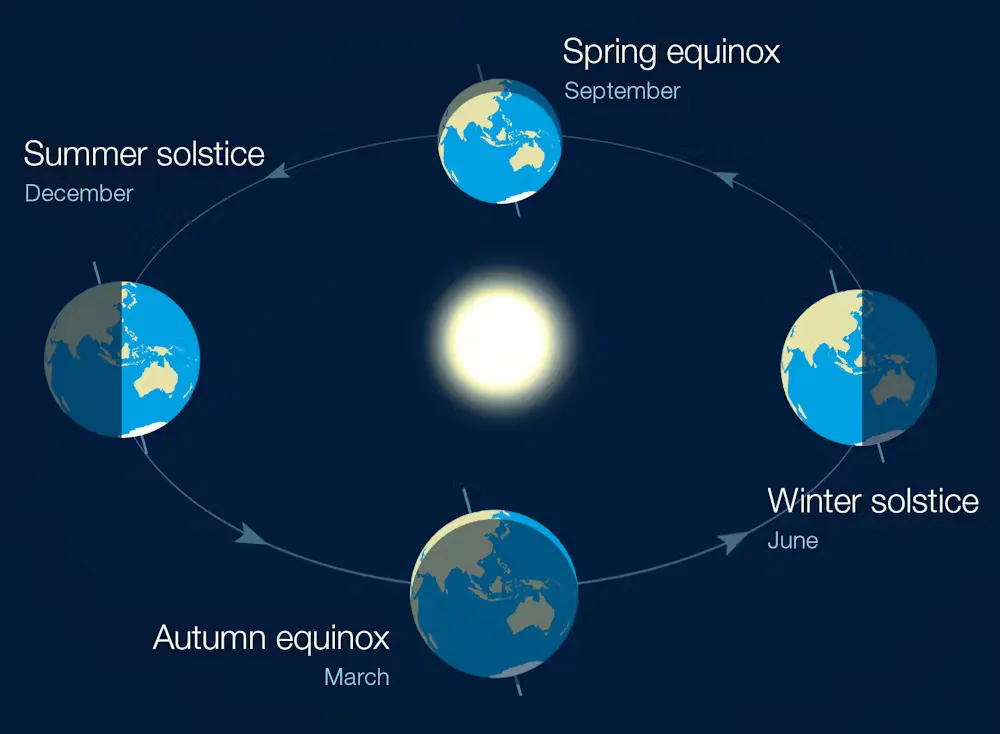
A diagram showing the Earth going around the Sun with the equinoxes and solstices marked.
The four seasons of the calendar year are buffered by solstices and equinoxes. Bureau of Meteorology

Seasonal moons

A calendar year has four seasons, divided by equinoxes and solstices (see above).

Each season is roughly three months long and typically has three full moons. Some cultures give each of those seasonal full moons a special name – you’ve likely heard of “wolf moon”, “strawberry moon”, “harvest moon” and others from American folklore, for example.

Every two or three years, however, we get an extra full moon in a season. When that happens, the first, second and fourth full moons keep their usual names while the third one becomes a “blue moon”.

You’d think the idiom “once in a blue moon” comes from this name, but the folklore name is actually relatively recent. In the 16th century, saying the “moon is blue” was more likely a way to refer to something being false or absurd.

Meanwhile, the third new moon in a season with four new moons is a “black moon” – a term than can only be traced to around 2016.

Calendar moons

The other definition for blue and black moons is related to calendar months.

A blue moon is the second of two full moons in one calendar month, while a black moon is the second new moon in a calendar month.

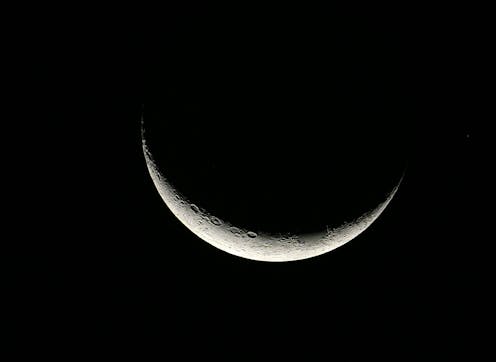
The Moon showing its craters and texture, but very dark, and a slight sliver of light runs along the lower right side of the Moon.
A typical new moon is in shadow because the far side of the Moon is illuminated by the Sun. Goddard Space Flight Centre, CC BY-SA

The black moon this month is a seasonal black moon and it’s happening on August 23. The next calendar-month black moon will happen on August 31 2027.

The next seasonal blue moon will be on May 20 2027 and the next calendar-month blue moon will be on May 31 2026.

You can’t see a black moon, but look at the sky anyway

We can’t actually see the black moon. The Moon will be up during the day and the far side of it will be illuminated.

But new moons in general bode well for keen stargazers. The full moon outshines a lot of the night sky, because it’s about 33,000 times brighter than the brightest star in the sky, Sirius. When there’s a new moon, the night sky is nice and dark, giving you more opportunities to see stars and constellations.

During the black moon on August 23 this weekend, the celestial emu or Gugurmin will be beautifully positioned overhead soon after dusk in the southern hemisphere.

If you’re in the southern hemisphere somewhere very dark and free from light pollution, you’ll be able to spot the Magellanic Clouds, two small galaxies that are interacting with our Milky Way galaxy. Saturn will be visible all night, and Venus and Jupiter will be low on the northeastern horizon just before dawn.

Even though the black moon isn’t a significant astronomical event, it gives us the chance to take in the night sky on a dark, Moon-free night.

Image of the night sky with the milky way and a trace of an emu in blue colour.
Gugurmin stretches across the vast southern sky, visible within the dark parts of the Milky Way. Barnaby Norris and Ray Norris/Wikimedia Commons, CC BY-SA

Read more: Supermoons are boring – here are 5 things in the sky worth your time

Authors: Laura Nicole Driessen, Postdoctoral Researcher in Radio Astronomy, University of Sydney

Read more https://theconversation.com/whats-a-black-moon-heres-why-its-worth-looking-up-at-the-sky-this-week-263205

What to Do When an Older Car Is No Longer Worth Keeping in Melbourne

Ever looked at another repair quote and wondered whether your old car is still worth the trouble? It is a common turning point for Melbourne motoris...

Your Baby's First Year: A Local Guide to Feeding, Sleep, and When to Get Extra Support

Ask ten parents in a Brisbane mothers' group how their baby is feeding or sleeping, and expect ten different answers.  Someone's baby sleeps throug...

Kitchen and Laundry Makeover Ideas That Don't Require a Full Renovation

Full kitchen renos are expensive — and most people don't actually need one.  They need the kitchen to stop looking like it's stuck in 2009, or they...

How Technology Is Reshaping the Modern Australian Commercial Kitchen

The commercial kitchen has always been shaped by technology. Refrigeration changed how ingredients could be stored, modern ventilation transformed k...

The Number on a Roller Blind Fabric That Nobody Explains

Somewhere in the fabric book, next to the colour name, there is a percentage. Three per cent. Five per cent. Ten per cent. Nobody explains it, most c...

What’s Trending in Men’s Jewellery This Father’s Day!

Finding a Father’s Day gift that feels personal, stylish and genuinely wearable is not always easy. While socks and novelty mugs have traditionally ...

Road Signs: Understanding Their Role in Clear and Effective Signage

Effective signage and display hardware can help businesses communicate information, promote products and organise customer or visitor movement. Road...

Bottle Label Printing: Key Factors to Consider Before Your Next Packaging Run

Effective packaging begins with understanding the product, bottle material, artwork and production requirements when planning bottle label printing. H...

Planning a Long-Distance Move With Interstate Movers Melbourne

Moving between states involves more planning than a typical local relocation. Along with packing and transporting household belongings, you need to...

Understanding the Role of an I/O Controller in Industrial Automation

Modern industrial systems depend on accurate communication between sensors, machines and control systems. An I/O controller can help manage this commu...

How the Right Mining Hose Supports Demanding Operations

Mining environments place considerable demands on equipment used for material transfer, water management and processing. Hoses operating in these co...

Simple Ideas for Making Social Gatherings More Memorable

We have all been to those parties where everyone just stands around the kitchen island, staring at their phones, waiting for someone else to make a mo...

Outdoor Wall Lights: Improving Exterior Lighting Around Your Home

Lighting can influence how a room looks, feels and functions, so the right fitting should be selected according to both appearance and practical req...

Commercial Office Cleaning: Combining Routine Office Cleaning With Melbourne Service

Keeping a workplace clean requires a service that can accommodate everyday tasks as well as the particular needs of the business. Professional comme...

Caravan Sales in Queensland: How to Find the Right Caravan for Sale QLD

Caravan ownership is about more than having somewhere to sleep while travelling. For many Queenslanders, it is one of the best ways to explore regio...

What Sir Walter Buffalo Turf Actually Costs in 2026 (And Why Quotes Vary So Much)

Two quotes landed on a Hills District homeowner's kitchen table last spring for the exact same 80-square-metre backyard. One said $12 a metre. The o...

Nearly 1,300 NSW Hospital Beds Are Occupied By People Who Are Ready To Go Home

1,276 people in NSW hospitals have been medically cleared for discharge but remain in hospital because they're still waiting for NDIS or aged care sup...

National Survey Launched to Measure Operational Impacts of Federal NDIS Policy Reforms

The effects of recent NDIS reforms are beginning to move beyond policy papers and into day to day service delivery. A new national survey is asking ...
















