

Why grow plants in space? They can improve how we produce food and medicine on Earth
- Written by: Troy Miller, Post-Doctoral Research Associate, Australian Research Council Centre of Excellence in Plants for Space, The University of Western Australia
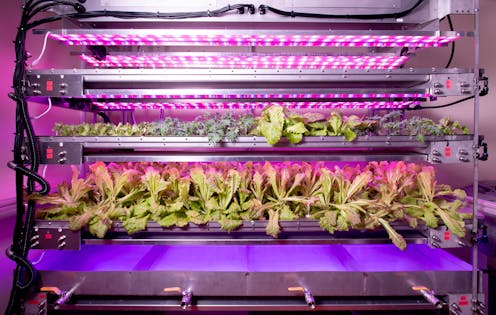
Sometime in the 2040s, humans may well reach a new frontier – Mars. To get there, we’ll need sustainable sources of food, medicines and materials.
As researchers who work on engineering plants to produce such resources in space, we sometimes get asked: “why?”. With issues such as climate change, inequality, global pandemics and environmental degradation, shouldn’t we be focused on Earth, not Mars?
But science can do both. And space research has a long history of not only satisfying the human instinct of exploration, but delivering transformational new inventions as we make discoveries along the way.
Plants not just for space
When the results of scientific research flow into the real world in practical ways, this is known as “research translation”.
These translations are often unexpected and unpredictable. For example, NASA’s need for compact, lightweight imaging technology in space led to the invention of the compact camera sensors we now have in smartphones, webcams, medical devices and more.
That shiny, reflective material used to deflect heat from buildings, appliances or even your car windshield? It’s an insulation technology perfected by NASA to protect spacecraft and astronauts from temperature fluctuations in space.
Within the next decade, we could see “space plants” directly and indirectly improving life on Earth. So what might space-ready plants look like and how could they benefit those of us who never leave Earth?
Flavour and nutrition
Plants nourish us and support our mental wellbeing, but this alone won’t sustain long-term space travel.
The modern space food menu largely consists of processed, long-life foods shipped along for the ride or delivered as cargo to the International Space Station. Anything fresh needs to be produced on the spot and farming animals isn’t an option.
To create a balanced space diet without the need to take dietary supplements, researchers have been developing nutritionally complete plant-based foods that have large quantities of high-quality protein. These will be pick-and-eat plants that can be grown and processed in space, and will provide an optimal balance of essential amino acids. They also include non-essential amino acids normally found in animals, such as taurine and creatine.
Improving plants in this way could help reshape agriculture on Earth, as plant-based diets are more sustainable for a planet facing a climate crisis and reduce global nutrient inequity.
Scientists are also researching plant-based food flavours and textures to address the common complaint from astronauts about “menu fatigue”. For decades, astronauts have reported their sense of taste is dulled in space, making spicy foods a station favourite.

Environmental resistance
Space plants must also thrive in an unfamiliar environment. On Earth, plants rely on gravity to know which way to grow their roots and which way to grow their shoots. This is a process called gravitropism.
In space, gravitropism is confused, causing roots to grow in random directions because of the effects of microgravity on hormone signalling. Research efforts are ongoing to determine the effects of microgravity on plant growth.

For example, water is “sticky” – it clumps together because molecules in water are attracted to each other, rather than pulled downwards into a puddle. In the absence of gravity, this results in sticky blobs of water that cling to surfaces such as plant roots and don’t flow anywhere because they’re held together by surface tension.
Furthermore, a lack of gravity also disrupts convection – it prevents gases from naturally mixing in water. This would limit oxygen availability to the roots of plants and result in low oxygen, also known as hypoxia stress.
Plant hypoxia also happens due to flooding during high rainfall and soil waterlogging. Engineering plants to tolerate microgravity-induced hypoxia will generate data for improving flood resistance in crops on Earth, reducing agricultural losses.
 Water on the ISS clumps into blobs: in microgravity, the surface tension of water becomes the dominant force, causing the spherical structure.
NASA
Water on the ISS clumps into blobs: in microgravity, the surface tension of water becomes the dominant force, causing the spherical structure.
NASA
More than food
On a Moon or Mars base, colonists wouldn’t be able to wait for months or years to resupply essential resources such as medicines or construction materials. So, space plants are being designed to provide more than just food.
Plants have been engineered to produce proteins that elicit immune responses and act as edible vaccines.
On Earth, many pharmaceuticals are produced and extracted from microbes. Plants can be engineered to produce medicinal compounds or building material precursors in similar ways, but these compounds are likely to negatively impact plant growth.
The ability to engineer plants to produce different chemicals in response to environmental cues would allow astronauts to switch plants from making food to making medicine – perhaps with the literal flick of a switch.
Genetic “circuits” responding to light and chemical signals are being developed, too. These have the potential to make crops more readily able to adapt to the stresses of a changing climate.
When innovations need to overcome extreme limitations – such as the environment of space – they can speed up and lead to solutions we wouldn’t otherwise come up with.
The race to land on the Moon led to the development of many everyday items. Now, we’re on the verge of a new biotechnological revolution, getting ready to boldly grow where no plant has grown before.
Authors: Troy Miller, Post-Doctoral Research Associate, Australian Research Council Centre of Excellence in Plants for Space, The University of Western Australia


















