

how Australians can switch to fast, fee-free payments right now
- Written by: Vibhu Arya, PhD Student, UTS Business School, University of Technology Sydney
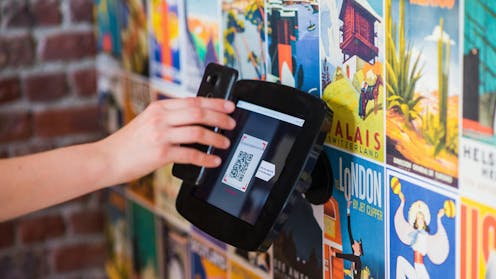
Every day, when Australians tap their card at a cafe checkout or hit pay on an online order, there’s often an unpredictable, frustrating extra cost: the card surcharge.
Australians pay more than $1.2 billion every year in card surcharges, with 88% of our payments still made using cards.
That high cost is why the Reserve Bank is working on how to reduce card surcharges. A final decision is due later this year.
Yet if you visit many parts of Asia, Africa or South America, you’ll discover there are cheaper alternatives to paying by card – saving money for shoppers and businesses.
Global growth in real-time payments
Real-time payments, sometimes also known as instant or fast payments, move money between bank accounts instantly. It’s often as simple as scanning a QR code, or using a mobile number or email.
For example, you place a coffee order – but instead of tapping a bank card, you use your phone to scan a QR code at the counter to pay.
Crucially for the cafe, the money lands instantly into their account. In contrast, tap to pay cards funds usually land in a business’s account a day or two later.
In countries as diverse as India, Brazil, China, Malaysia, Thailand, Indonesia, Nigeria, Bangladesh and advanced economies such as Hong Kong and Singapore, real-time payments for everyday purchases are already common.
For consumers, it’s fee-free. And particularly for small businesses, it’s much cheaper than cards.
The reason it’s cheaper is simple: there are no intermediaries taking a share of fees, with the money moving directly between two bank accounts.
How it’s done worldwide
In India, the most popular way to pay is UPI, with more than 600 million real-time transactions a day.
In China, the most popular ways to pay are Alipay and Wechat wallets, which run on QR codes linked to the user’s bank accounts. But the underlying infrastructure is via real-time payments. China has more than 1 billion real-time transactions a day.
In Brazil, the most popular way to pay is PIX, with more than 75 million transactions a day. It’s free for consumers – and up to ten times cheaper for businesses than cards.
In Singapore, PayNow remains a popular way to pay, free for both consumers and businesses.
Yet in other countries, including Australia, New Zealand, the United States and United Kingdom, card payments still dominate.
Can Australians make real-time payments now?
Yes – but we’re doing it far less than we could.
You can make instant transfers through PayID and pre-approved debits via PayTo.
PayID works by letting you use your mobile number, email address, Australian Business Number (ABN) or organisation identifier to receive fast payments to your bank account. You can have multiple PayIDs, each linked to a different account.
PayTo is different. It works via one-time authorisation, where the consumer allows a business to draw from their account, up to a certain amount and time period. Think of it as real-time payments for recurring payments, such as Spotify, Netflix or gym memberships.
Australia has more than 27 million registered PayIDs, with more than 5 million daily transactions.
How to save Australians millions a year
With PayID and PayTo, money lands in a business’s account instantly. The cost is tiny, projected to fall to four cents a transaction by this year.
Every day, Australians make roughly 45 million card transactions. If even some of those transactions shifted to PayID or PayTo, small businesses could save millions in fees – and customers would be spared a big share of that $1.2 billion in card surcharges.
However, a 2025 Nielsen/Westpac survey found that while 99% of Australian business leaders recognised the need to move to real-time payments, only 25% had started that transition.
Why are real-time payments part of daily life in some countries, but not here? Preliminary research points to one factor above all: the central bank’s role. In Australia’s case, that would mean the Reserve Bank stepping in to do more.
Instead of spending so much time and resources on card surcharges, the Reserve Bank should do more to boost the use of real-time payments.
Are real-time payments riskier?
Real-time payment QR codes overseas are secure, and businesses do not see or retain the customer’s phone number or email.
Unlike card payments, there is no risk of losing your card or card numbers. A payment can only be made via scanning a QR code and authorising it.
Of course, risks remain. Whether using a card or a real-time payment, being aware of the risks of fraud or scammers remains important.
The Australian Banking Association has recommended more Australians use PayID to protect themselves from scams or mistaken payments.
Cutting costs for shoppers and business
Australian small businesses currently get a raw deal. The Reserve Bank says they’re often charged between 1-2% on every transaction, around three times what the big chains pay.
No wonder many end up adding surcharges to cover their costs.
We already have the tools to make real-time payments an option for everyday shopping. Unlike overseas, that option is still rarely offered at the checkout.
A faster, cheaper way to pay than with cards is possible. It’s time to use it.
Authors: Vibhu Arya, PhD Student, UTS Business School, University of Technology Sydney


















